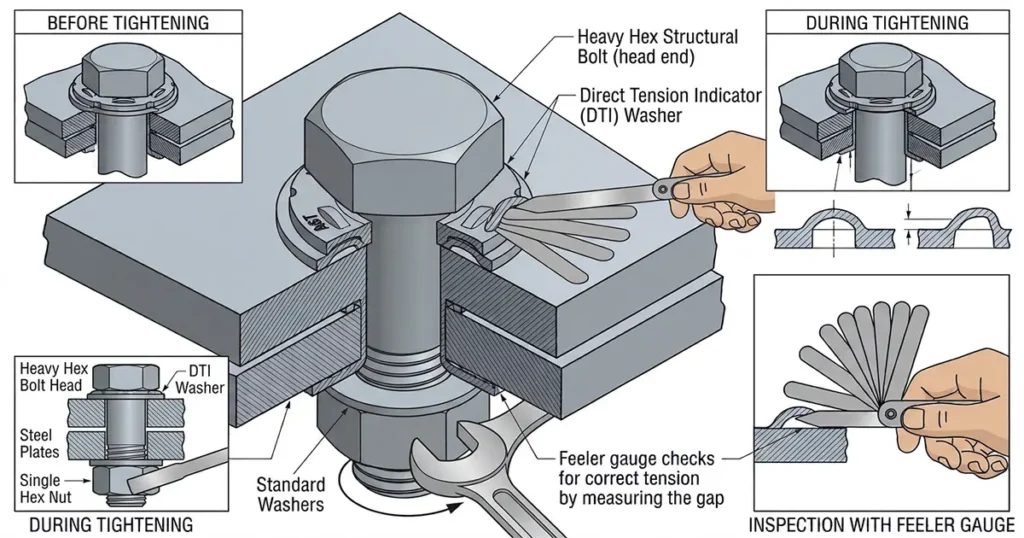
A structural bolt is turned with a wrench either way. The real difference between a direct tension indicator (DTI) and torque-controlled tightening is not the tool — it is the acceptance criterion: what the crew is told to stop on, and what the inspection record can prove afterwards. Torque-controlled tightening stops when the wrench reaches a value. A DTI stops when the indicator will no longer take the feeler gauge.
That difference became sharper in 2025. The RCSC Specification for Structural Joints Using High-Strength Bolts, the document that ASTM F3125/F3125M points to for structural connections, withdrew recognition of the calibrated wrench method — the torque-based pretensioning method — because torque and tension vary too much between bolts that look identical. The direct tension indicator method remains one of its four pretensioning methods.
So the practical question is narrower than “torquing or tensioning”. Both methods use torque. Only one is asked to demonstrate that a minimum tension was reached, and which of them a given connection may use is settled by the specification it is built to rather than by supplier preference.
Both methods apply torque, but only one is asked to prove tension
A DTI washer does not replace the wrench. The nut is still turned by an impact wrench or a torque wrench, and the torque still has to be large enough to compress the indicator. What changes is what the tightening is controlled against. In calibrated wrench tightening, the wrench setting is the criterion: the operator stops at a number, and the joint is accepted because the number was reached. With a DTI, torque is only the means; the criterion is the state of the gap under the gauge.
That is why “bolt tensioning vs bolt torquing” is a slightly misleading way to frame the choice. Torque is present in both. The real question is whether torque is being used as the measurement.
Why a torque value is a weak proxy for bolt tension
The relationship between torque and tension is usually written as T = K × F × d, where the nut factor K folds thread friction and bearing friction into one number. K is not a property of the bolt grade. It moves with lubricant, coating, thread tolerance, washer condition and dirt, so the same torque can produce a materially different tension in two bolts from the same lot. RCSC lists six variables in its commentary on torque-based arbitration: thread finish and tolerance, the uniformity and condition of lubrication, site dust and corrosion, friction between the turned element and the steel or washer, wrench repeatability, and time in service.
The 2025 edition states the consequence in its summary of changes: recognition of the calibrated wrench method “has been withdrawn because of the large variability of torque-to-tension relationship for seemingly similar bolts and conditions.”
The same specification is equally direct about using torque for inspection. Its inspection commentary says torque measurements generally do not provide consistent results “as they are greatly dependent on the friction between the turned element (bolt head or nut) and the steel or washer, as applicable, and the friction between the bolt threads and nut threads, both influenced by the lubrication conditions of the bolting components.” It adds that routine observation of the installation method is always preferred.
Torque has not vanished from RCSC work. It survives as a controlled input: the initial step of the combined method, calibrated so that it produces at least the required initial tension; and the arbitration torque in Section 10, established by pretensioning five sample assemblies in a bolt tension measurement device and recording the torque needed to rotate the nut five degrees. It also survives in snug-tightening, which is not a pretensioned condition. A torque figure that has not been calibrated that way says nothing about the tension in a pretensioned joint.
What a DTI washer is actually asked to establish
ASTM F959/F959M-26, the current edition of the DTI specification, defines the device narrowly: compressible-washer-type direct tension indicators “capable of indicating the achievement of a specified minimum tension in a structural bolting assembly.” It covers eight types in nominal diameters from 1/2 through 1 1/2 in. and M16 through M36, each designated for a particular bolt grade and bolt type.
Physically, a DTI washer is a hardened washer with arch-like protrusions on one face — typically four to nine spaces around the circumference. As the assembly is tightened, the protrusions flatten. A feeler gauge is inserted into the spaces between them; the gauge is the one the DTI manufacturer supplies for that DTI type and size, in the thickness at which the indicator is designed to show the required minimum tension. When the gauge can no longer be inserted in the required number of spaces, the indicator has compressed past the inspection gap and the bolt has reached at least the specified minimum tension. RCSC adds a detail that matters at the joint: the gauge must touch the bolt shank to count as an entry.
The acceptance criterion is therefore a count, not a reading. Under the 2025 RCSC Specification, a DTI with four spaces must refuse the gauge in all but one of them at installation; one with nine spaces must refuse it in all but four.
| Spaces between protrusions | Maximum entries at installation | Minimum entries at pre-installation verification |
|---|---|---|
| 4 | 1 | 2 |
| 5 | 2 | 3 |
| 6 | 2 | 3 |
| 7 | 3 | 4 |
| 8 | 3 | 4 |
| 9 | 4 | 5 |
Those numbers are the whole test. There is no torque value to record and no tension value to record — only gauge entries per bolt, against a gauge thickness that the DTI manufacturer specifies for the type and size being installed.
The step that decides whether the indication means anything
A DTI has a failure mode that has nothing to do with the gauge: it can be compressed before the joint is ready. RCSC requires two stages, snug-tight and then pretension, and its commentary explains why. During snugging the protrusions partly compress on their own; if half or more of the gaps close below the inspection gap at that stage, the DTI must be removed and replaced. And if assemblies are installed and pretensioned “in a single continuous operation”, the indicators “may give the Inspector a misleading indication that the bolting assemblies have been properly pretensioned.”
Orientation and bearing surface are equally unforgiving. The protrusions must bear against a hardened surface — bolt head, hardened nut or hardened washer — and when the DTI sits under the turned element, RCSC requires an F436 washer between the turned element and the protrusions. FHWA guidance for bridge work gives a second reason to place the DTI under the bolt head when the nut is turned: the indicator then reflects the tension along the bolt’s full length, and a bolt pinched between the plies — a trapped bolt — is exposed instead of passing.
None of this is recoverable later. A DTI that was half-closed during snugging, installed protrusions-down, or matched to the wrong bolt type will produce a confident-looking result that says something different from what the inspection sheet records. The installation sequence itself is covered separately in how to install and inspect DTI washers.
What each method can and cannot tell you
| Torque-controlled tightening | DTI washer | |
|---|---|---|
| What is controlled | A torque value set on the wrench | Gap closure measured with a feeler gauge |
| What the record shows | Torque applied, plus wrench calibration | Gauge entries per bolt, gauge thickness, DTI lot |
| Effect of friction and lubrication | Changes the tension produced at that torque, directly and unpredictably | Changes the torque needed to reach the gap, not the tension the gap represents |
| What inspection can re-check | Little: a torque re-check is not a reliable tension check | Yes: the gaps can be re-gauged |
| Numerical tension value | None — it is inferred | None — it is a threshold, not a scale |
| Indication of over-tension | None | None |
| Status in RCSC 2025 | Calibrated wrench method withdrawn | One of four recognized pretensioning methods |
The distinction in the third row is the one that decides most arguments. A DTI is a compression element in the load path: the load at which its protrusions close is set by the washer, not by the friction in the threads. That is why a change of lubricant, a different coating or a humid day changes how hard the wrench works without changing what the closed gap means. Torque is the opposite: friction is inside the measurement, not outside it.
Measuring, indicating and estimating are three different claims
Most confusion about DTI washers comes from collapsing three different activities into “checking the tension”. They are not equivalent, and only one of them produces a number.
- Measuring produces a tension value, using either a bolt tension measurement device — a hydraulic calibrator such as those used for pre-installation verification — or an ultrasonic extensometer reading bolt stretch. RCSC requires a bolt tension measurement device for pre-installation verification and for arbitration, and requires its accuracy to be confirmed by calibration at least annually. This is the only category that answers “what is the tension?”.
- Indicating establishes a threshold. The DTI answers “has at least the specified minimum been reached?”. EN 14399-9, the European DTI standard, states the purpose the same way: the indicators exist “to show that a defined preload is achieved in the bolt”.
- Estimating converts torque through a coefficient. It is a prediction, and its error is precisely why the calibrated wrench method was withdrawn.
There is one overlap worth knowing. A DTI can serve as the tension measurement device for pre-installation verification, though RCSC does not permit that use with the turn-of-nut method or the combined method, because the DTI’s own compression would consume part of the rotation those methods depend on. When it is used that way, the average gap for the required pretension is first determined for the DTI lot and measured to the nearest 0.001 in.; RCSC calls this the calibrated gap. The calibrated gap belongs to the DTI in its role as a measuring device; it is not the feeler gauge thickness used on production bolts.
The over-tension question, and why neither method answers it
A DTI cannot tell you how far past the minimum a bolt has gone. Once the protrusions are flat, the indicator has nothing further to report, and the specification does not ask it to. RCSC inspection rules state that “a pretension that is greater than that specified in Table 5.2 or feeler gage refusals in all locations shall not be cause for rejection.” Refusal everywhere is the strongest indication the device can give, and it still does not distinguish a bolt at the minimum from a bolt well above it.
A torque record is worse in that respect, because it never contained tension information to begin with. Neither method turns a structural bolt into a load cell with a readout, and neither protects a joint from deliberate over-tightening. That protection comes from the procedure: the specified stopping point, the wrench or wrench setting the method defines, the installer’s observation, and the capacity of the nut and bolt. RCSC warns separately that non-heat-treated nuts can strip if a bolt is tightened far beyond the specified pretension, which is a reason to avoid over-rotation, not a reason to expect a gauge to catch it.
Pre-installation verification is where both methods prove themselves
Neither approach is self-certifying. RCSC requires pre-installation verification on not fewer than three complete bolting assemblies of each combination of diameter, length, grade and assembly lot, performed at the site, on assemblies representative of the condition of those that will be installed. The test runs in a bolt tension measurement device, and the minimum pretension used for the test is 1.05 times the installation requirement, so the sample must demonstrate a margin rather than merely match the target.
For DTI work, the test does two things at once. It confirms that the entries in the right-hand column of the table above are achieved with the feeler gauge the DTI manufacturer supplies for that DTI type and size, on the bolting assemblies that will be used. And it fixes the gauge for the work: production installation must use a feeler gauge of the same thickness as the one used in the verification test. The test demonstrates that this DTI, this bolting assembly and this gauge work together; it does not set the gauge thickness, which comes from the DTI manufacturer.
Europe reaches the same gate by a different route. EN 14399-2 is the suitability-for-preloading test for the assembly system, and EN 14399-9 points to EN 1090-2 for guidance on using the indicators. In both systems the question is the same: was the method that will be used in the work demonstrated, with the assemblies and equipment that will be used in the work?
Which method the governing specification allows
This is where the decision is actually made, and it is not the supplier’s to make. Where the project specification invokes the RCSC Specification, four pretensioning methods exist — turn-of-nut, twist-off tension control, direct tension indicator and combined — and the calibrated wrench method does not. A note that says “tighten to 300 ft-lb” is therefore not an installation method under that specification; a torque value may appear only as the initial step of the combined method or as an arbitration value established for the case.
Where the project runs on the European system, the picture is different. EN 1090-2:2018+A1:2024 keeps a torque method among its specified tightening methods, alongside combined, HRC and DTI. The torque values are not free-floating: they rest on the assembly’s declared k-class, which EN 14399-2 tests, and the inspection plan is built around execution classes. That is a controlled system too — different controls, not an absence of them.
What cannot be done is to move a value between the two systems. A torque figure developed for one assembly, coating and lubricant condition is not a specification for a different one, and a DTI cannot be dropped into a connection whose specification, washer stack and inspection plan were written around a torque method. Where both are permitted, project requirements usually decide: a DTI where the inspector must verify each bolt at the joint without depending on wrench calibration, torque where the governing specification and the assembly system are European and the inspection plan is already built around them.
What to put on a DTI order
When the connection uses DTI washers, four fields decide whether the right part arrives:
- Standard and edition. ASTM F959/F959M-26 for inch and metric structural bolting; EN 14399-9 for system HR or HV assemblies.
- Type. The DTI type must match the bolt’s grade and type, not just its diameter. A 490 type under an A325 bolt closes at the wrong tension, and installation cannot recover it — the matching rules are set out in F959 DTI washer types.
- Size and series. The two standard systems do not start at the same diameter. ASTM F3125/F3125M furnishes A325M and A490M heavy hex bolts from M12, while F959M DTI sizes start at M16, so ASTM F959/F959M supplies no standard DTI for an M12 A325M or A490M assembly. EN 14399-9:2018 does cover DTI sizes from M12 to M36, but only for the HR or HV bolting assemblies that standard is written for; an EN DTI is not interchangeable with an ASTM F3125 assembly on nominal size alone. The governing system therefore decides the smallest available size, and the stack height and bolt length follow from it.
- Lot documentation. A DTI is a lot-controlled component; a compression load test report per lot is what lets the site connect the delivered washers to the compression load results behind the indication. What to check on that report is covered in F959 DTI washer test reports.
Two items beyond the DTI itself need attention. The feeler gauge is part of the DTI supply: RCSC requires a gauge provided by the DTI manufacturer, of the correct thickness for the DTI being installed, so a buyer should confirm that the matching gauge is included rather than leave the site to source one. The hardened washers are separate components again: a DTI is not a substitute for an F436 washer over an oversized or slotted hole, and where the DTI sits under the turned element a hardened washer still has to go between them. Both the DTI range and the washer range can be quoted together, and the bolt length that accommodates the DTI’s full height is set out in structural bolt length with DTI washers.
The ASTM F959/F959M DTI washers page lists the type and size range; a request that states the bolt grade and type, the DTI type, the nominal size and the required lot documentation can be quoted against the standard rather than against a description.
The choice, then, is not between two ways of turning a nut. A torque number is an instruction; a DTI is an acceptance test. Where the specification allows the indicator, it converts an unverifiable inference into a checkable state at the joint. Where it does not, the torque method has to be run as that specification defines it — with the assembly tested, the torque derived from the tested system, and the inspection plan that belongs to it.