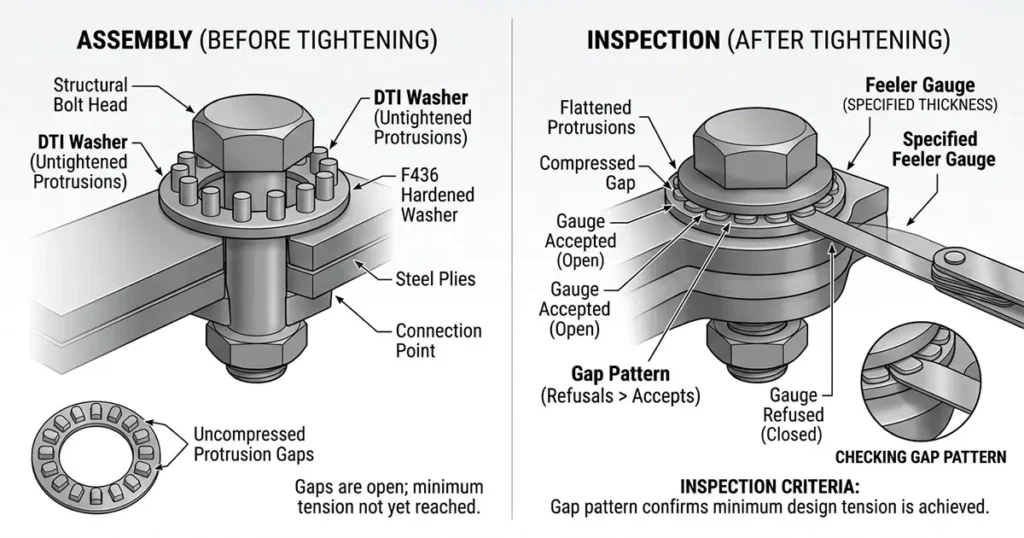
A DTI washer — a direct tension indicator — is a compressible washer with a ring of raised protrusions on one face, installed under a structural bolt head or nut. As the bolt is tightened, the protrusions flatten against a hardened bearing surface and the gaps between them narrow. When the gaps reach the condition the specification defines for the required tension, the bolt has reached the minimum tension the connection was designed for, and an inspector can confirm that with a feeler gauge instead of inferring it from torque.
That is the whole function: a DTI reports one threshold, at installation. It confirms that the fastener reached at least the required minimum pretension. It does not report a tension value in kN or kip, does not measure torque, and does not follow the joint afterwards. Read as a go/no-go indicator, a DTI is a fast and repeatable check. Read as a measuring instrument, it will be asked to do something it was never designed to do.
Two product standards govern the hardware. In U.S. practice it is ASTM F959/F959M, Standard Specification for Compressible-Washer-Type Direct Tension Indicators for Use with Structural Fasteners, Inch and Metric Series. The current edition is F959/F959M:26, published in March 2026, which replaced F959/F959M:17a(2023). European practice uses EN 14399-9:2018, the direct tension indicator part of the EN 14399 high-strength structural bolting series, written for System HR or HV assemblies. They are separate families with their own types, dimensions and assembly rules: an order is placed against one or the other, not against “a DTI” in general.
Neither document is an installation or inspection procedure. Those come from the project specification and, in the U.S., from the RCSC Specification for Structural Joints Using High-Strength Bolts (2025 edition), or from AASHTO bridge construction requirements where the work is a highway bridge. In Europe the execution requirements sit in EN 1090-2 and in the project specification.
What the washer actually is
Physically it is a heavy flat washer with a pattern of small domes, arches or bumps formed on one face. The body carries the bolt load; the protrusions are the calibrated part. F959/F959M fixes what the product has to be, and the list is short enough to check on a certificate: chemical composition of the steel, compression load, outside diameter, number of protrusions, thickness, inside diameter and protrusion tangential diameter. Those are the properties the standard sets, and the ones a receiving inspection can verify against the supplier’s test record.
DTIs are supplied in types matched to the bolt they serve, and the type belongs to the identification. A washer intended for a 120 ksi structural bolt is not the part for a 150 ksi bolt, and the metric series distinguishes types 8.8 and 10.9 in the same way. F959/F959M:26 covers both inch and metric series, with the metric series running from M16 to M36. Ordering by diameter alone therefore leaves the most important field unspecified.
A DTI is also not a hardened washer, and does not replace one. FHWA guidance is explicit: DTI hardness is typically considerably lower than that of a through-hardened ASTM F436 washer, so a DTI shall not be used as a substitute for one. Where the connection has an oversized or slotted hole, or the design otherwise calls for a hardened or plate washer, that washer is still required, and the DTI sits on top of it rather than directly over the opening. Beyond that, the washer arrangement follows the DTI’s position: with the DTI under the turned element, an F436 washer goes between that element and the protrusions; with the DTI under the unturned element, the DTI does not by itself create a washer requirement under the turned element.
| ASTM F959/F959M | EN 14399-9:2018 | |
|---|---|---|
| What it covers | Compressible-washer-type direct tension indicators, inch and metric series | Direct tension indicators for System HR or HV bolt and nut assemblies |
| Current edition | F959/F959M:26, published March 2026; replaced F959/F959M:17a(2023) | EN 14399-9:2018 |
| Where installation and inspection rules come from | RCSC Specification, AASHTO requirements or the project specification | EN 1090-2 execution requirements and the project specification |
How the protrusions turn tension into a visible gap
Torque is an indirect route to tension. The applied torque is split between thread friction, bearing friction and the work of stretching the bolt, and that split moves with lubrication, coating, surface finish and thread condition. Two fasteners tightened to the same torque can therefore sit at different tensions, which is why structural bolting specifications control tension rather than torque. A DTI sits on the tension side of that relationship: it responds to clamping force, not to the effort used to produce it.
The sequence is simple. The washer goes under the bolt head or the nut with its protrusions facing a hardened bearing surface. Snugging pulls the plies together and removes slack, and at that point the protrusions should still be visibly open. Final tightening stretches the bolt, clamp force rises, and the protrusion crowns are pressed flatter against the bearing surface, so the gaps close progressively around the face rather than all at once. F959/F959M sets the compression load the washer must develop for its size and type, and the protrusions are designed so that this load is reached at a defined gap condition — the “specified DTI gaps” against which published DTI research measures bolt preload. In effect the washer is a load cell calibrated to report a single load.
Because the protrusions are arranged around the face in a specified number and tangential diameter, there is not one gap but a ring of them. That is what makes the check usable: the gauge is offered at a series of locations around the washer, and it is the pattern of gaps that accept or refuse the blade that the acceptance criteria are written around. A washer seated on a tilted, painted, grit-covered or otherwise uneven surface tends to show a lopsided pattern — open gaps on one side while the rest have closed — which is why the check says something about the bearing condition as well as about tension.
The indication is also spent as it is used. Once the protrusions have compressed to the acceptance gap, further rotation of the nut keeps stretching the bolt but produces no further calibrated indication. That is why the DTI answers “has the minimum been reached” and not “what is the tension now”.
How a DTI is inspected
Two checks happen at different times, and FHWA describes both. During tightening, the ironworker holding the unturned element also checks the gaps visually, assisted by a feeler gauge, as the work proceeds. After tightening, the project inspector performs the quality assurance check with a gauge, plus a visual survey of the connection for bolts that were missed or could not be tightened. The second check is the one that produces the record.
The feeler gauge check
The gauge is a thin steel blade offered to each gap in turn. Its thickness is not one national number: the applicable specification requires the gauge the DTI manufacturer provides for that washer, and the project’s acceptance procedure adopts it. Many U.S. structural and bridge specifications call for 0.005 in. (0.13 mm), because that is the gap the washers they buy are designed around, but the value that governs is the one stated for the DTI and adopted for the project. If the blade enters a gap, that gap is still open. The inspector works around the washer and records how many gaps accept the blade and how many refuse it; the acceptance criteria that govern the work — the RCSC Specification, or the project or highway agency procedure — then decide whether the fastener is accepted, re-tightened or handled some other way. A washer that refuses the blade at every location is not, on that fact alone, a rejection under the RCSC Specification; how a fully compressed washer is treated varies between project and agency procedures, and it is the project procedure that applies. Devices sold for anchors and signage may call for a different blade thickness, which is another reason the joint specification, not general practice, sets the value.
Self-indicating and squirter designs
Some DTIs carry a compressible colored insert — silicone or a similar polymer — within the protrusion pattern. As the protrusions compress, the insert is squeezed out of the gaps and becomes visible around the washer, so closure can be read without a blade. Inspection is faster, and less dependent on access and light than a gauge. The insert is a manufacturer’s feature rather than a requirement of the base product: the properties F959/F959M sets — material, compression load, dimensions, protrusion geometry — do not include an insert, so a self-indicating design adds an element outside that list. Acceptance therefore rests on the manufacturer’s instructions together with the engineer’s approval, and the signal has to be read exactly as instructed — extrusion at the wrong stage means the washer was compressed too early, not that the bolt is correct.
The verification test that comes first
Before production bolting starts, the assembly and the tightening equipment are proved on a tension calibrator, using the same bolt, nut, washer and DTI configuration and the same tool that the work will use. FHWA’s guidance separates this from the rotational capacity test: the bolt, nut and washer are tested as an assembly there, while the DTI is tested during the installation verification test, and a manual torque wrench is required as tension approaches 1.05 times the minimum required installation tension. What the calibrator shows for a given DTI, bolt grade and tool is what the crew has to reproduce in the steel.
Where DTI washers are used
DTIs appear where the design depends on a specified minimum bolt tension: slip-critical connections, which carry load through friction between the faying surfaces, and other pretensioned connections in structural steelwork. Bridges are the classic case. The FHWA guidance on DTIs is written specifically for bridge structural steel, and AASHTO bridge construction requirements apply to DTIs used in U.S. highway work. Buildings, industrial structures and heavy steel assemblies use them for the same reason.
The device also answers a specific inspection problem. The connection is checked after the wrench has moved on, often by someone who did not watch the tightening, and the evidence has to be visible on the installed fastener. A torque record cannot be checked that way. A DTI can.
They are not a default for every bolt in a structure. The engineer of record specifies them for the connections where minimum pretension has to be demonstrated, and other bolts in the same frame may be tightened and inspected by a different accepted method.
What a DTI cannot tell you
The limits are worth stating plainly, because they follow from the design rather than from a fault in it.
- No tension value. The washer has one calibrated threshold, and the gauge check reports it as a pattern of refusals at the tested locations, judged against the acceptance criteria. There is no scale and no output that a report can quote as tension achieved.
- Nothing about over-tension. Once the gaps close, further rotation keeps stretching the bolt without a proportional change in the indication. A washer with all gaps closed — the fully flattened condition — shows that tightening went past the threshold, but not by how much, and a DTI that has used up its travel is no longer a reliable indicator. Whether a fully compressed washer is accepted, evaluated further or replaced is set by the project’s acceptance procedure, not by the washer itself.
- No monitoring after installation. It is an installation record. There is no continuous readout, and it is not a way of watching relaxation, creep or loss of pretension in service. A joint that loses tension after acceptance will not announce it through the washer.
- No substitute for a hardened washer where one is required. At an oversized or slotted hole, or wherever the design calls for a hardened or plate washer, the DTI does not take its place. The washer arrangement also follows the DTI’s position: with the DTI under the turned element, an F436 washer is required between that element and the protrusions; with the DTI under the unturned element, the DTI alone does not add a washer requirement under the turned element.
- No protection from a bad bearing condition. The indication depends on the washer bearing evenly on a hardened surface. Paint, grit, burrs, a damaged protrusion, the wrong type for the bolt grade, or a washer that is not supported across its face all distort the reading before the gauge is applied. FHWA gives one concrete case: for 1 in. and larger bolts, standard through-hardened washers can have an inside diameter 1/8 in. larger than the bolt, which leaves the DTI under-supported and can produce an erroneous indication; the agency recommends washers with an inside diameter 1/16 in. larger than the nominal bolt diameter for those sizes.
- No interchangeability with non-structural devices. Proprietary DTIs sold for anchors and signage fall outside F959/F959M, work at very different tension levels and may need a different gauge. A structural DTI is not automatically the right part for an anchor either.
How DTI washers differ from other tension indicators
Several products sit close to the DTI in a catalogue and are routinely confused with it.
- Tension control (twist-off) bolts. ASTM F1852 and F2280 bolts carry a splined end that shears at a calibrated tension. The bolt is the indicator and no washer is involved. Both approaches demonstrate installation tension; neither measures it afterwards.
- Turn-of-nut and calibrated wrench. These are tightening methods, not indicators. Their evidence is the rotation applied or the torque used, checked against a verification test; nothing on the fastener itself shows the result.
- Load cells, strain gauges and ultrasonic measurement. These measure tension, and some can log it over time. They answer a different question at a different cost, and belong to verification testing and monitoring rather than to production bolting.
- European DTIs to EN 14399-9. Same function, different family. Dimensions, types and assembly rules are written around System HR or HV, and parts are not ordered across the two systems by nominal size alone.
Specifying a DTI washer for an order
An order line has to identify a specific device, because “DTI washer, 3/4 in.” fits more than one compression load and several finishes. Six fields do the work.
- Standard and edition. ASTM F959/F959M:26, or EN 14399-9:2018 where the project is European. Naming the standard without an edition leaves the supplier to choose one.
- Type, or the bolt grade it must serve. The type has to match the bolt on the drawing. Where the drawing names a bolt grade rather than a DTI type, say so; the mapping belongs on the quotation, where it can be checked.
- Size and dimension system. Diameter, and whether it is the inch or the metric series. F959/F959M treats the two dimension systems separately, so a converted dimension is not a substitute.
- Coating. As specified for the bolt assembly and compatible with the bearing surface the washer will sit on.
- Washer pairing. Whether the DTI will sit under the turned element or the unturned element, because that decides the stack: under the turned element it needs an F436 hardened washer between the element and the protrusions, and under the unturned element the connection’s own washer requirements still apply. Where the hole is oversized or slotted, the plate or hardened washer is required regardless. For 1 in. and larger bolts, check the inside diameter against the DTI’s support requirement rather than assuming a standard washer will do.
- Documentation. A test record carrying the compression load for the size and type supplied, with lot identification. The inspector’s acceptance assumes the washer behaves as the specification says, and the test record is what supports that assumption.
A callout that leaves nothing to be inferred reads like this:
Direct tension indicator washer, ASTM F959/F959M:26, type for F3125 Grade A490 bolt, 7/8 in., mechanically galvanized, with compression load test record.
A DTI answers a narrow question well: at the moment of tightening, did this fastener reach at least the minimum tension the connection needs? Quantifying tension, monitoring it afterwards, or standing in for a hardened washer are outside what the washer can support, and those are the jobs it should not be given.
ChinaBolts supplies ASTM F959/F959M DTI washers in sizes from 1/2 to 1-1/2 in. and M16 to M36, with protective coatings to the project specification. The hardened washers that the connection calls for are a separate line on the same order, and the wider washers range covers the flat, structural and lock types that appear in the same bolting assembly. Send the bolt grade, the DTI type, the diameter and the coating, and the quotation can be written against the standard the inspector will use.