An ASTM F959 DTI washer is specified by type first and diameter second. ASTM F959/F959M-26 covers eight types — Type 325-1, 325-3, 490-1, 490-3, 8.8-1, 8.8-3, 10.9-1 and 10.9-3 — and each one is designated for a particular structural bolt grade and bolt type. Two washers can share the same nominal diameter, the same finish and the same general form and still be wrong for each other’s bolt, because the type, not the size, sets the tension at which the indicating gaps close.
The selection takes two readings from the bolt: its grade — A325, A490, A325M or A490M, which are now grades of F3125/F3125M — and its type, 1 or 3. The DTI type follows from those two. The series and nominal diameter follow from the bolt’s dimensions.
What an F959 Type Designation Encodes
Every F959/F959M type is a two-part code, and both parts refer to the bolt rather than to the washer. The four grade families named in the prefix are the ones the eight types are built around; they are not every grade in F3125/F3125M-26, which also furnishes Grade 144 in the inch series.
The prefix names the grade family the washer is built for: 325 for inch-series A325, 490 for inch-series A490, 8.8 for metric A325M, 10.9 for metric A490M. It is not a washer property class, not a hardness value and not a size. A Type 325 DTI is not a 325 HV washer, and the number says nothing about the steel the washer is made from.
The suffix names the bolt type: -1 for Type 1 bolts and assemblies, -3 for Type 3. Older drawings and catalogues often write “Type 325” where the current standard writes “Type 325-1”. Read the short form as Type 1 only when the drawing says so, because the two suffixes are different products.
One term is worth keeping straight. “Type” is a raw-material classification in F3125/F3125M and a bolt-matching designation in F959/F959M. The DTI suffix has to agree with the bolt’s type, but the two fields are not interchangeable on a drawing.
The Eight Types and the Bolts They Serve
The current edition, F959/F959M-26, was approved in March 2026 and replaced F959/F959M-17a(2023). It covers eight types in nominal diameters from 1/2 through 1 1/2 in. and M16 through M36. Four grade families, two bolt types, one DTI type for each combination. The pairings below are written into the scope of the standard, and they are the basis for every selection decision that follows.
| DTI type | Series | For use with | Bolt type |
|---|---|---|---|
| 325-1 | Inch | F3125 Grade A325 Type 1 bolts, or Grade F1852 assemblies | Type 1 |
| 325-3 | Inch | F3125 Grade A325 Type 3 bolts, or Grade F1852 Type 3 assemblies | Type 3 |
| 490-1 | Inch | F3125 Grade A490 Type 1 bolts, or Grade F2280 assemblies | Type 1 |
| 490-3 | Inch | F3125 Grade A490 Type 3 bolts, or Grade F2280 Type 3 assemblies | Type 3 |
| 8.8-1 | Metric | F3125 Grade A325M Type 1 bolts | Type 1 |
| 8.8-3 | Metric | F3125 Grade A325M Type 3 bolts | Type 3 |
| 10.9-1 | Metric | F3125 Grade A490M Type 1 bolts | Type 1 |
| 10.9-3 | Metric | F3125 Grade A490M Type 3 bolts | Type 3 |
Five points in that table are worth flagging before an order goes out.
- The metric types serve the metric grades only. Type 10.9 is not “the metric 490”, and neither metric type is a substitute for an inch-series washer.
- Type 3 washers may be qualified two ways. F959/F959M allows a Type 3 DTI to be furnished either to a chemical composition requirement or to a Corrosion Resistance Index, at the manufacturer’s discretion. Both routes comply, so the certificate should name the route used rather than only the type.
- The DTI range and the bolt range do not line up at the bottom. A325M and A490M heavy hex bolts are furnished from M12 to M36, while F959M DTI sizes start at M16. An M12 metric structural bolt has no standard F959M DTI size.
- They do not line up at the top either, for twist-off assemblies. F1852 and F2280 assemblies are furnished up to 1 1/4 in., while DTIs run to 1 1/2 in. At 1 3/8 and 1 1/2 in., the 325 and 490 types pair with heavy hex bolts only.
- A325 and A490 are no longer separate standards. F3125/F3125M consolidated A325, A325M, A490, A490M, F1852 and F2280 into one specification, first issued in 2015. The DTI types still carry the older grade numbers.
A grade without a type of its own. F3125/F3125M-26 also furnishes Grade 144 (Group 144), inch series only and in sizes 1/2 to 1 1/4 in. F959/F959M-26 has not added a Type 144: the eight types in the table above are the complete list. The Grade 144 pairing comes from the installation requirements rather than from the DTI standard. The RCSC 2025 Specification treats Group 144 as having the same installation pretension as Group 150, and permits ASTM F959 Type 490 DTIs with it — Type 490-1 for Type 1 bolts, Type 490-3 for Type 3. That is an application RCSC allows, not a ninth F959 type, and a Grade 144 order still has to name one of the eight.
Why ASTM F959 Type 325 and Type 490 Are Not Interchangeable
A DTI does not measure tension. It closes a ring of gaps at a load set by the geometry and material of its protrusions, and the crew and the inspector read those gaps. That closing load is a property of the washer, fixed in F959/F959M as a compression load requirement for each type and size — not a property of the bolt it is put on. How DTI washers indicate tension is covered separately; the point that matters for selection is that the washer, not the bolt, decides when the gap closes.
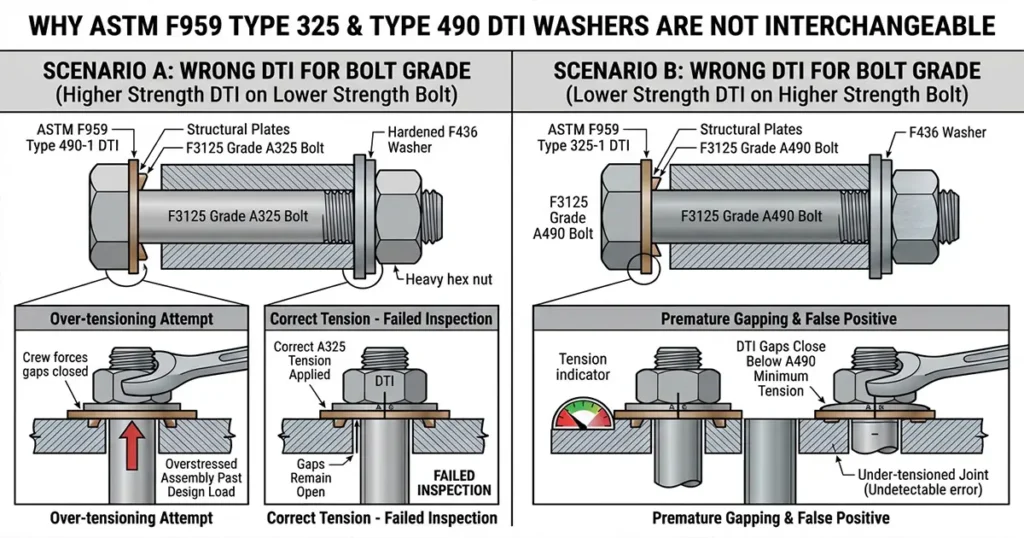
An ASTM F959 Type 325 washer and a Type 490 washer of the same nominal size are not interchangeable, because the two types are built for different tension levels. A490 assemblies are tensioned to a higher minimum pretension than A325 assemblies of the same diameter, and the grades’ specified minimum tensile strengths differ by 25%: 120 ksi against 150 ksi, and 830 MPa against 1040 MPa.
The failure runs both ways.
Put a Type 490 DTI on an A325 bolt and its gaps will not close at A325 installation tension. Either the crew keeps turning to close them — over-tensioning the assembly past the level the grade was designed for — or the gaps stay open and a correctly tensioned bolt fails inspection. Put a Type 325 DTI on an A490 bolt and the reverse happens: the gaps close below the pretension the A490 assembly is supposed to reach, the connection reads as accepted, and the joint stays under-tensioned. That second error leaves no visible trace afterwards.
The parts are not distinguishable by eye. Same nominal size, similar dimensions, the same finish options; the difference is in what the protrusions do under load. The type has to come from the marking where the washer carries one, and otherwise from packaging, lot documentation and the test report.
Nor is the closing load a figure that can be carried from one edition to the next. Tests reported in the AISC Engineering Journal found that DTIs made to F959-96 indicated higher preloads at the specified gaps, and with less scatter, than washers made to F959-90 — a difference in the washers’ calibration rather than in the grade of bolt being tensioned. The compression load requirement of the edition named on the order governs, by type and by size.
Type 8.8 and 10.9: Metric Types Tied to Metric Grades
The 8.8 and 10.9 labels read like ISO 898-1 property classes, and that is a common source of confusion. In F959/F959M they identify the metric structural grades the washer serves: Type 8.8-1 and 8.8-3 for F3125 Grade A325M bolts, Type 10.9-1 and 10.9-3 for Grade A490M. A325M is furnished at 830 MPa minimum tensile strength, A490M at 1040 MPa.
The label is not a permission slip. An ISO 898-1 class 8.8 or 10.9 bolt carries a general mechanical property designation, while A325M and A490M are structural grades with their own material, heat-treatment, testing and marking requirements in F3125/F3125M. A DTI designated for A325M is matched to an A325M assembly, not to any bolt whose head happens to carry “8.8”.
The -3 Suffix: Weathering Steel at Both Ends
Type 3 bolts are made from weathering steel, and F959/F959M designates the -3 washers for them. The suffix is not a finish option and not a coating code: it pairs the washer’s material with the bolt’s.
The standard leaves manufacturers two routes to demonstrate it — a chemical composition requirement or a Corrosion Resistance Index — at their discretion. Two compliant Type 3 DTIs from two suppliers can therefore qualify by different routes. On a weathering-steel bridge or an exposed connection, ask which route the lot was certified to and keep the answer with the test report, because the two routes do not describe the same evidence.
A Type 325-1 washer under an A325 Type 3 bolt is not a substitution a supplier can make quietly. It puts a non-weathering component into a connection whose corrosion performance was specified as a system, and the DTI sits in the load path under the head or nut where it is exposed. If a -1 part is proposed against a -3 requirement, that is a deviation for the engineer of record to decide, not an equivalent.
Inch and Metric Series Are Separate Selections
F959/F959M-26 states that the values in either unit system are to be regarded separately as standard, that they may not be exact equivalents, and that combining values from the two systems may result in non-conformance. F3125/F3125M carries the same clause for the bolts.
For selection, series is a field rather than an approximation. The clause exists because the two systems are specified independently: the metric types are dimensioned and load-rated in the metric series, for metric assemblies, and the inch types likewise. Mixing the two in one connection is a specification error rather than a substitution, however close the nominal sizes look.
From Drawing to Order Line
A DTI selection is finished when the order line is unambiguous. Work through these in order.
- Bolt standard, grade and type. Resolve the drawing’s callout to F3125/F3125M-26, then to a grade and a type. If the drawing still says A325 or A490, resolve it to the F3125 grade before choosing the washer. A Grade 144 callout takes a Type 490 DTI under RCSC’s allowance: 490-1 for Type 1 bolts, 490-3 for Type 3.
- DTI type. Take it from the bolt grade and bolt type in the table above, not from the washer’s diameter and not from the previous job.
- Series and nominal diameter. Confirm the bolt diameter sits inside the DTI range for that series: 1/2 to 1 1/2 in., or M16 to M36.
- Finish. The type says nothing about coating. State plain, zinc-coated or the project’s coating system, and keep it consistent with the bolt and with the weathering requirement where there is one.
- Hardened washer. A DTI is not a substitute for one. FHWA notes that DTI hardness is typically well below that of a through-hardened F436 washer, and requires a hardened or plate washer at oversized and slotted holes even where a DTI is used; for 1 in. and larger bolts it calls for a washer bore 1/16 in. over nominal so the DTI is fully supported. F436/F436M hardened washers are usually a separate line on the same order.
- Stack height and bolt length. The DTI’s full height sits in the grip, so it changes the bolt length and the thread engagement check. Bolt length with a DTI in the stack is a calculation, not a lookup.
- Acceptance criteria. Gauge thickness and acceptance limits come from the project specification and from the RCSC Specification for Structural Joints Using High-Strength Bolts, not from the washer’s type.
An order line that covers all seven reads like this:
DTI washer to ASTM F959/F959M-26, Type 325-1, 3/4 in., mechanically galvanized; compression load test report per lot, stating the type tested.
Anything shorter — “F959 washers, 3/4 in.” — leaves the supplier to choose the type, and what arrives may be whatever type is in stock. That is how a Type 490 box ends up under an A325 bolt.
Where the Type Check Sits on Site
F959/F959M-26 expects the protrusions to bear against a hardened surface — a bolt head, a hardened nut or a hardened washer — and points to the RCSC specification for installation. FHWA’s guidance for bridge structural steel recommends placing the DTI under the bolt head when the nut is the turned element, because a DTI under the turned element can indicate slightly less accurately as the washer slides across the protrusions.
None of the installation steps recovers a wrong type. A correctly seated, correctly gauged Type 490 washer on an A325 bolt is still indicating the wrong tension, and it will keep doing so through every inspection. Type selection sits upstream of the installation procedure, which is covered separately in how to install and inspect DTI washers.
The type is the first line of the specification because it is the line that decides what the washer will prove. Read the bolt’s grade and type, confirm the DTI type against the standard’s scope, and put both on the order.
For sourcing, the ASTM F959/F959M DTI washers page covers the DTI range, and a quote request that states the bolt grade and type, the DTI type and the nominal size can be quoted as specified. Hardened washers, plate washers and the rest of the washer range can ship on the same order.