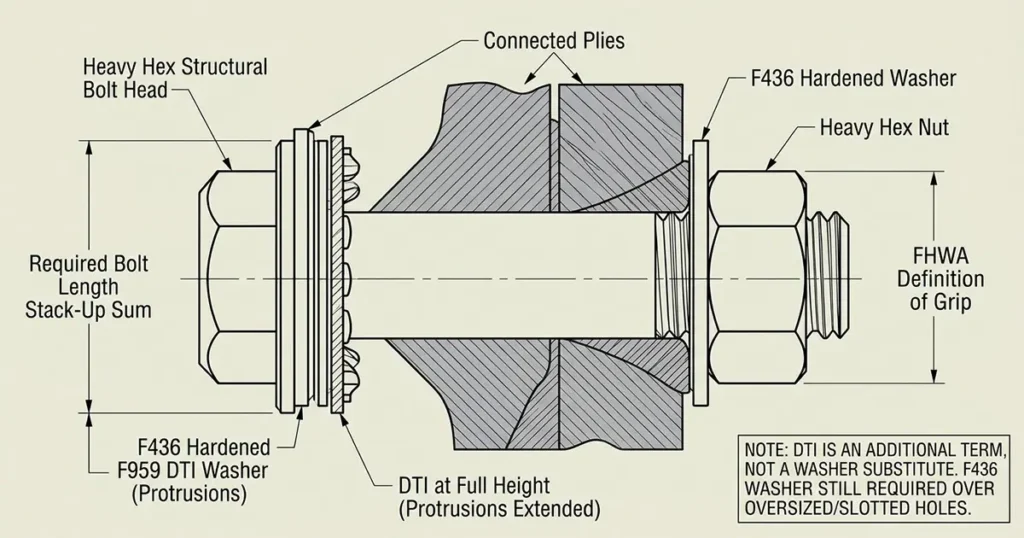
Structural bolt length with a DTI washer is a stack-up calculation, not a plate-thickness lookup. The length has to cover the connected material, every washer in the joint, the direct tension indicator at its full height, the nut, and the thread you want beyond the nut. Miss one term and the assembly either runs out of thread before the washer compresses, or leaves more bolt outside the nut than the detail can take.
The DTI is what separates this from an ordinary length check. It is the only component in the stack whose thickness changes during installation, and it changes in both directions that matter: the stack is thickest at the start, when the nut has the least thread to work with, and thinnest at the end, when the stick-out is what an inspector sees. A length that is right at one of those states can be wrong at the other.
Two definitions are worth keeping apart, because length errors often come from mixing them. FHWA’s structural fastener guidance measures bolt length from the bearing face under the head to the end of the bolt, and defines grip as the distance between the head bearing face and the nut bearing face. In a DTI assembly the DTI, and any washer with it, sit inside that grip, so the grip shown on a design drawing — usually just the connected plies — is not the stack the bolt has to span.
The dimensions come from one family of documents. ASME B18.2.6, Fasteners for Use in Structural Applications, tabulates the inch-series heavy hex structural bolt, heavy hex nut, F436 hardened washer and F959 direct tension indicator together, with B18.2.6M covering the metric series. Bolt property and thread requirements come from ASTM F3125/F3125M, the DTI from ASTM F959/F959M, and the washers from ASTM F436/F436M and ASTM F3394/F3394M. What the finished joint has to achieve — washer arrangement, assembly orientation, thread position, DTI acceptance — is governed by the RCSC Specification for Structural Joints Using High-Strength Bolts, current edition 2025.
Build the stack before opening a catalog
Length selection starts with a list of everything the bolt passes through, in the order it passes through it. The sum is the required bolt-length stack-up, and it is a maximum, not a typical value.
| Component | Counts toward the length? | Where the thickness comes from |
|---|---|---|
| Connected plies, including filler and shim plates | Yes, at maximum thickness | Connection drawing |
| F436/F436M hardened washer | Yes, once for each washer in the assembly | F436/F436M dimensions, or the measured thickness of the parts supplied |
| Plate washer at an oversized or slotted hole | Yes | Connection detail and project specification |
| Beveled washer on a sloped seat | Yes | Connection detail and project specification |
| F3394/F3394M backup or reaction washer | Yes, where the detail requires one | Connection detail and project specification |
| DTI to F959/F959M | Yes, at full height | F959/F959M dimensions and the parts supplied |
| Heavy hex nut | Yes | Nut dimensions for the grade, as tabulated in B18.2.6/B18.2.6M |
| Thread beyond the nut | Yes | Project acceptance criteria; FHWA guidance for bridgework |
None of the rows is filler, and none can be dropped because the joint “normally” does without one. Whether a beveled washer, a plate washer or a backup washer is present is decided by the connection detail and the governing specification, not by what the last order looked like. Because RCSC governs the finished joint, its requirements settle which of the available lengths is acceptable, and a shop convention does not override them. Where the project specification adds a requirement of its own — a particular plate washer, a stricter protrusion — that requirement enters the same sum.
How much the DTI contributes
A DTI is a washer with protrusions on one face, and those protrusions flatten as the assembly is tensioned. At the start of tightening the DTI is at full height, so the stack is at its thickest and the nut sits at its outermost position on the thread. That full height is the figure that belongs in the length calculation.
Sizing on the compressed thickness is a common arithmetic error in DTI assemblies, and it fails late. The joint snugs up, the DTI begins to close, the nut arrives at the end of the thread, and the washer never reaches its acceptance gap. The bolt is then blamed for a tensioning fault that was really a length fault.
The compression travel also explains a stick-out reading that looks wrong. If a bolt is sized so that the minimum protrusion is only just met at full DTI height, then after compression the protrusion equals that minimum plus the travel. Some extra stick-out on a DTI assembly is therefore normal geometry rather than proof of over-tensioning, although FHWA treats excess stick-out on a tightened bolt as a signal to look further. Read the stick-out against the assembly, not against a number carried over from a job without a DTI.
A DTI is not a washer, and adding one does not remove a washer the joint already needs. FHWA’s DTI guidance is explicit that DTIs are not to be used as a substitute for hardened steel washers, because their hardness is typically much lower than that of an F436 through-hardened washer. The DTI is an additional term in the stack, not a replacement for one.
Why nominal thicknesses leave the bolt short
The calculation is a worst-case sum. Every component in the stack is supplied to a thickness tolerance, and the assembly needs the bolt to work at the thickest state, not the average one. Substituting catalog nominal values, or one “typical” washer thickness for a part bought to a range, removes the margin that the tolerance band was providing.
Coatings work the same way. Galvanizing and mechanical coatings add material to the bolt, nut, washer and DTI, and they change the fit between nut and thread. A length that assembles cleanly in plain finish should not be assumed to assemble cleanly in a coated finish.
Where a governing document prescribes an allowance for a component, that allowance is what belongs in the sum. An allowance is normally set so that the assembly works across the tolerance band and still leaves the required protrusion; a nominal thickness does not do that job, and a rule of thumb borrowed from another assembly does not either.
Lengths are then supplied in fixed increments, so a calculated requirement almost never lands on a stocked size. Round up. Rounding down because the next size “looks long” is the other error to avoid, and the rounded length still has to be checked at both states: full thread for the nut before tightening, acceptable protrusion after.
Thread engagement, thread length and the shear plane
Length and thread length are two different numbers, and only one of them appears in a catalog description. ASTM F3125/F3125M fixes the thread length that comes with each bolt length, and that thread length decides where the thread run-out falls in the joint. Short bolts can carry thread closer to the head, so an unthreaded shank that is present at one length can be gone at a shorter one.
That matters wherever the design takes advantage of threads excluded from the shear plane: the unthreaded shank has to cross the shear plane, and putting a DTI and extra washers into the stack moves the thread relative to the joint. The check is made on the length actually being ordered, once the stack is final.
Orientation belongs to the same decision. FHWA recommends placing the DTI under the bolt head of assemblies that will be tightened by turning the nut, and accepts other arrangements where the installation instructions and state requirements allow them. Reversing the assembly leaves the total stack unchanged, so the length calculation does not move, but it moves the thread to the opposite face of the joint, which is exactly what a threads-excluded design is sensitive to.
For the end state, FHWA gives a recommended stick-out from flush to three threads, tied to having three to five threads inside the grip. That is guidance rather than a substitute for the project’s acceptance criteria, and the arithmetic behind it is simple: three thread pitches on a 3/4-10 bolt come to 0.300 in. It is not a default allowance to add to every stack, and it does not replace the stack-up.
Holes and washers that add thickness
Oversized and slotted holes change the washer content of the stack, and therefore the length. FHWA states that hardened washers or plate washers are required over oversized and slotted holes in steel bridgework even when a DTI is used, and that the DTI must sit on the washer rather than directly over the opening. A plate washer is generally thicker than the standard hardened washer it replaces, so an assembly sized on a standard-hole stack comes up short when the hole turns out to be oversized. The plate and structural washers used at those holes are a different item from the F436 washer in a standard hole, with their own thickness to add.
Large diameters bring a second washer issue. FHWA notes that through-hardened washers for 1 in. and larger bolts can have an inside diameter 1/8 in. larger than the bolt, which leaves a DTI under-supported and produces an erroneous indication; its guidance for those assemblies is a plate washer or a special hardened washer with an inside diameter 1/16 in. larger than the nominal bolt diameter. The current F436/F436M edition and the project specification decide what applies to a given order, but the consequence for length is the same: the washer in the stack may not be the standard one.
Beveled washers on a sloped seat, and backup or reaction washers to ASTM F3394/F3394M where the detail calls for them, are further thickness terms. A beveled washer has to be oriented to the slope, and each of these parts has to be the one the detail calls for rather than whatever flat washer is in the bin, because the thickness and the bearing face both change.
Inch and metric are two calculations
The two series are separate documents, separate tolerances and separate stock. ASME B18.2.6 covers the inch products and B18.2.6M the metric equivalents. ASTM F3125/F3125M carries the inch grades at 120, 144 and 150 ksi alongside metric grades at 830 and 1040 MPa, F959/F959M covers both series of DTI under different type designations, and the washers are split the same way between F436/F436M and F3394/F3394M.
Converting a length from one series to the other produces a size that is not stocked, a thread engagement nobody designed, and a DTI that may not match the bolt. Keep the two series in separate columns of the same calculation sheet, keep their components with them, and state the series on the order line.
Checking a length you have been quoted
The calculation is short enough to be run as a check on someone else’s answer, which is where it earns its keep in purchasing.
- Rebuild the stack from the drawing — plies including filler plates, every washer, the DTI, the nut, and the hole type.
- Replace nominal thicknesses with the prescribed allowance or the tolerance-adjusted value for each component, and put the DTI in at full height.
- Add the nut height and the protrusion the project requires.
- Round up to the next available length in the correct series, and note what the rounding added.
- Check the thread length for that length: full nut engagement before tightening, and the thread run-out on the correct side of the shear plane.
- Check the end state — protrusion after compression, wrench and socket clearance, and whether the extra stick-out suits the detail.
The failures are recognizable once the sum is explicit.
| What the assembly shows | Likely cause in the length choice |
|---|---|
| Nut reaches the end of the thread and the DTI is still open | Stack sized on the compressed DTI height, or a washer left out of the sum |
| DTI closes, but the nut is not fully engaged | Bolt too short for the stack |
| Stick-out far beyond the compression travel | Length rounded up more than one increment, or a component counted twice |
| Thread run-out inside the shear plane | Thread length or assembly orientation not checked for the length ordered |
The gap checks that follow installation are a separate subject, covered in how to install and inspect DTI washers; none of them can rescue a bolt that was never long enough.
Writing the order line
A bolt length only means something as part of an assembly, so the order line should describe the assembly: the series, the diameter and thread pitch, the length, the standard and grade, the coating, and the washers and DTI that go with it, with the configuration taken from the drawing rather than chosen at the supplier.
Something in this form: 3/4-10 × ___ in. heavy hex structural bolt to ASTM F3125 Grade A325 Type 1, hot-dip galvanized, with F436 hardened washer and F959 Type 325-1 DTI, assembly per drawing. The length is the one number in that line that has to be calculated; the rest is selection.
ChinaBolts supplies ASTM F959/F959M DTI washers in the types that pair with F3125 grades, and the F436 hardened washers that sit alongside them in the stack.
The length is a property of the assembly, not of the plate. Once a DTI is in the stack, the question stops being “what length fits this grip?” and becomes “what length leaves a fully engaged nut at the start of tightening and an acceptable protrusion at the end?” Only the stack-up answers that.