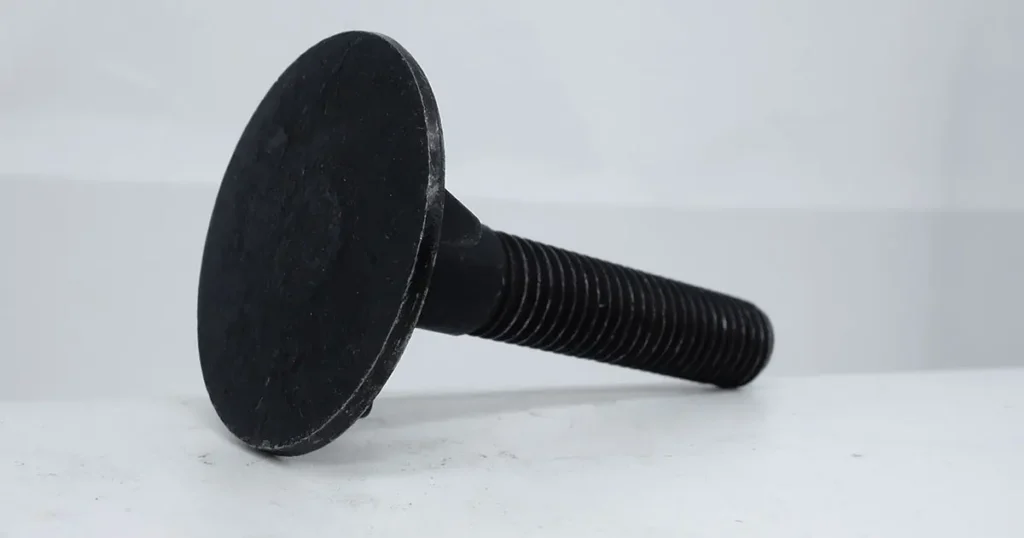
Elevator bolts are usually compared by their heads: the flat disc, the domed disc, the one with teeth. That is the least useful way to choose one, because the head is only the visible result of a decision made underneath it. The decision is how the bolt is held still while the nut is tightened.
All the designs in this article solve that one problem. The installer works from inside the bucket, and the bolt head finishes on the pulley side of the belt, where nobody can reach it. If the bolt turns with the nut, the joint never tightens. So each pattern gives the bolt something to grip: a square shoulder, a set of ribs, two teeth, lugs under a domed head, or a hexagon that a tool can hold.
Which of those works depends on four things: how thick the belt is, what condition the hole is in, what shape the bucket back has, and how tight the pulley clearance is. The designs below are answers to those conditions. They are not a ranking.
Only One of These Names Is a Standard
DIN 15237 is a current German standard, DIN 15237:1980-01, published under the English title Continuous mechanical handling equipment; seating screws and cupped washers for the attachment of components to belts. It runs to two pages, dates from January 1980, and replaced DIN 15237:1954-04. It has not been withdrawn, and no later edition or successor document replaces it.
Two things follow from that title. First, the standard covers a pair: the seating screw, which is the elevator bolt itself, and the cupped washer that goes under its head. The washer is part of the subject, not an accessory added later. Second, Norway No. 1, No. 3 Eclipse, Reliance, Fanged, Easifit and Ref 70 are trade pattern names, not standards. A purchase order that treats them as equivalent designations is describing shapes, not a specification.
The same thread size does not fix the head, either. Trade catalogues list an M8 elevator bolt with a 24 mm head and another with a 30 mm head, both offered against DIN 15237. The standard number alone will not tell a supplier which of those you need, so head diameter has to be written into the order as a dimension.
How Each Design Stops the Bolt Turning
The installation geometry is the same for all of them. The head bears on the inner surface of the belt, and the washer and nut sit inside the bucket. A correct installation leaves the head sitting just below the belt surface, with nothing standing proud to catch a pulley or a casing plate. Everything the bolt does to resist rotation happens either in the few millimetres between the underside of the head and the belt, or at the tip of the shank.
The square shoulder: Norway No. 1
The Norway No. 1 pattern is a flat head with a square shoulder formed underneath it. The bolt passes through a round hole, and the four corners of the square press into the belt material around that hole. It is the square-peg-in-a-round-hole principle, and it works because the belt is softer than the bolt.
The engagement is only as good as the belt around the hole. A clean, round hole in a belt of adequate thickness gives the shoulder four corners of solid material to bed into. An enlarged or elongated hole gives it almost nothing: the shoulder turns in the clearance, and the nut spins the bolt instead of tightening it. The wide head spreads clamping load and reduces pull-through on thin belting, and the pattern suits both recessed and flat-backed bucket holes.
A radial star under a smaller head: No. 3 Eclipse and Reliance
The No. 3 Eclipse and Reliance patterns use a smaller flat countersunk head, with a six-point radial star formed on the underside. The star gives some resistance to rotation where it bears on the belt. This design also carries a slot for a flat-head screwdriver, and the slot is in the head rather than in the neck.
The smaller head is why the pattern suits small-diameter pulleys: there is less head diameter to pass round a tight bend. The cost is bearing area, because a smaller head spreads less clamping load than the wide Norway style, which matters on thin belts and at high clamp loads. Names in this family are not applied consistently between catalogues, so specify the head and neck form rather than relying on the name.
Teeth: fanged elevator bolts
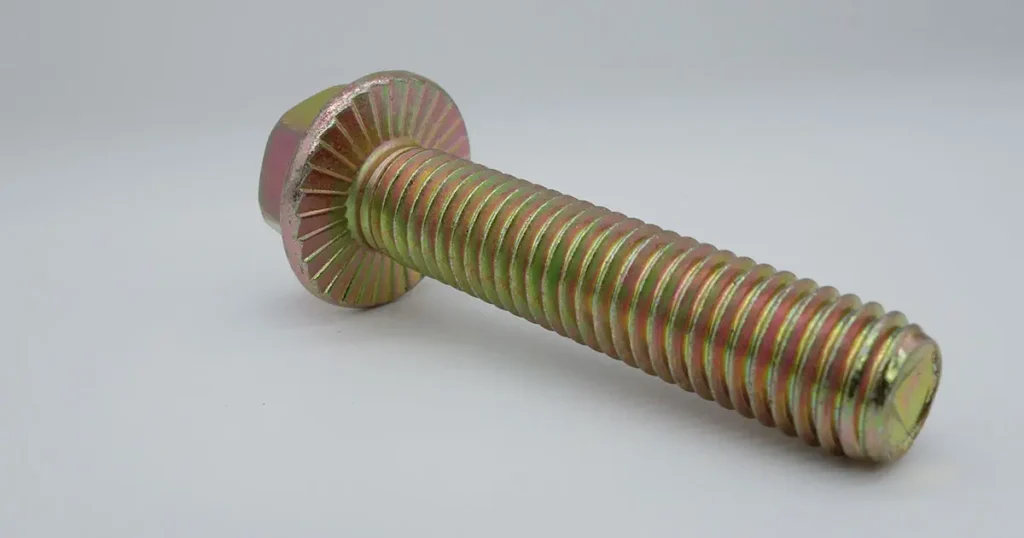
A fanged bolt carries two sharp teeth on the underside of a wide, flat head. The teeth are intended to penetrate the belt cover and carcass, and once they do the head cannot turn, so the nut can be run down. That is a more positive grip than a shoulder or a rib provides, and it is why fanged bolts are used in high-vibration grain service, normally with a nylon-inserted lock nut. The flat head also reduces the risk of the head pulling through the belt, and the pattern suits recessed and non-recessed bucket holes alike.
The condition is belt thickness. If the teeth are longer than the belt is thick, they cannot embed within it. The head stands off the surface, the teeth pass through the carcass instead of gripping it, and the advantage of the design disappears while its disadvantage remains, which is local damage to the belt. Teeth also leave marks, and on a belt that is re-bucketed repeatedly those marks are where torn holes begin.
Lugs under a domed head: Ref 70 and DIN 15237 Euro bolts
Ref 70 uses a dished head with four lugs on the underside, paired with a matching large oval washer. The lugs resist rotation, and the domed underside seats into the recess of a pressed steel bucket. It is specified for steel buckets in heavy-duty work on pulleys over about 500 mm in diameter, and it is not recommended for flat-backed plastic buckets, particularly on thin belts: a plastic back has no recess for the dome, and the plastic creeps under the ring of contact.
The DIN 15237 Euro bolt is the same idea with two lugs instead of four, and with a small set of defined pairings. Its domed underside is designed for pressed steel buckets with recessed holes, where the recess around the hole accepts the dome. Recessed steel bucket: large domed washer. Flat steel bucket: small flat washer. Plastic bucket: large flat washer. Take the washer out of the equation and the bolt bears on a narrow ring instead of a face.
A hexagon on the shank: Easifit
Easifit bolts do not rely on the belt at all. The end of the shank is formed with a hexagon, and a special ratchet grips it, holding the bolt still while the nut is tightened. The tool is part of the system, available as a hand ratchet or in a pneumatic version.
Because nothing has to bite into the belt, the hex tip solves the problem the other designs cannot: re-using holes. On a repair where the buckets are replaced and the belt is kept, the original holes are usually enlarged or elongated, and a square shoulder or a set of teeth has nothing left to grip. The hex tip does not care what the hole looks like. The cost is the tool. It has to be on site, and it has to be the right one for the bolt size.
Six Elevator Bolt Types Side by Side
The six elevator bolt types in this comparison are best read as a matching exercise, not a ranking. Each row names what the design needs from the joint, and the last column names the condition under which it stops being the right choice.
| Design | How it resists rotation | What it needs from the joint | Where it stops working |
|---|---|---|---|
| Norway No. 1 | Square shoulder bedding into the belt around a round hole | Sound belt of adequate thickness around the hole | Enlarged or elongated holes; the shoulder turns in the clearance |
| No. 3 Eclipse / Reliance | Six-point radial star under a smaller flat countersunk head | Belt contact for the star; a small head where clearance is tight | Thin belts and high clamp loads, because the smaller head spreads less load |
| Fanged | Two teeth penetrating the belt cover and carcass | Belt thicker than the teeth, so they embed inside it | Thin belts, where the teeth pass through instead of gripping |
| Ref 70 | Four lugs under a dished head, plus large oval washer | Steel bucket, larger pulleys, heavy-duty service | Flat-backed plastic buckets, especially on thin belts |
| DIN 15237 Euro | Two lugs under a domed head, seated in the bucket recess | Recessed pressed steel hole, or the correct washer | Flat back with no washer, where the dome bears on a ring |
| Easifit | External hexagon on the shank, held by a special tool | The matching ratchet on site | Nothing in the joint; the tool dependency is the limit |
Matching the Bolt to the Bucket Back
Bucket backs come in three forms, and each gives the bolt head a different bearing situation.
- Recessed pressed steel. The recess is made for the dome. A Ref 70 with its oval washer, or a DIN 15237 Euro bolt with a large domed washer, seats into it and is supported on a full ring at the correct depth.
- Flat steel. There is no recess, so the bolt needs a flat face or a washer that converts the dome into one. A Norway pattern, a fanged bolt, or a Euro bolt with a small flat washer all work here.
- Flat-back plastic. Plastic creeps under a narrow contact ring, so the load has to be spread. Norway and fanged patterns work; a Euro bolt needs a large flat washer; the Ref 70 dome is the wrong shape for this back.
A common wrong substitution is a DIN 15237 Euro bolt dropped into a flat-backed plastic bucket because the thread and length match. The dome has nowhere to seat. Without a large flat washer the head bears on a circle of plastic, which creeps and then cracks; with the washer the same bolt is serviceable. The bolt was rarely the problem. The missing washer was.
Belt Thickness, Hole Condition and Pulley Size
Two measurements at the joint decide most of the choice: the belt thickness at the hole, and the condition of the hole itself.
Thickness governs every biting design. A square shoulder needs belt material at least as deep as the shoulder height. A fang needs the belt to be thicker than the tooth. A domed head needs either a recess or a washer that substitutes for one. Where the belt is thin, the designs that spread load over a wide head do better, and the designs that depend on penetration do worse.
Hole condition governs the rest. Holes drilled or punched at the belt maker are round and matched to the shank. Holes that have carried buckets for a while are worn oval by movement, and the clearance that develops is what defeats a square shoulder or a radial star. Once a hole is elongated, the anti-rotation feature has to come from somewhere other than the belt material at the hole, which in practice means a bolt held from its shank rather than its head, such as the hex-tip Easifit type.
Pulley diameter matters for a different reason. A small pulley bends the belt sharply, and every bolt head in the belt has to pass round that bend without standing proud. This is why the smaller-head patterns are used where clearance is tight, and why the heavy domed patterns are specified for larger pulleys, where a thicker belt and a wider head have room to work.
Replacement Work Asks a Different Question
A new build and a re-bucket are not the same problem. On a new build, the belt holes are new and the full range of designs is available. On a re-bucket, the belt stays and its holes are already worn, so the choice narrows to the designs that do not depend on gripping fresh belt material: the hex-tip bolt first, and a fanged bolt only if the belt is thick enough to take the teeth again.
Where the belt is replaced as well, the original pattern can be restored, because the holes will be cut to match it. That is the point at which it is worth reconciling the specification with what is actually on the elevator, rather than repeating whatever was ordered last time.
Two practices belong with any of these designs. The first is a run-in re-tightening: after the elevator has run for a few hours, the nuts are checked and tightened, because a new belt beds down and thins under the heads. The second is keeping the nut and washer as a set with the bolt. A DIN 15237 screw supplied with a plain nut and no cupped washer is not the assembly the standard describes, and a mismatched washer changes the bearing geometry the head was designed around.
Writing the Order So It Cannot Be Misread
Because three of the four names in the title are trade names, an order that says only "fanged" or only "DIN 15237" leaves the supplier to fill in the gaps. The gaps are where the wrong bolt arrives. Specify:
- Pattern and neck form, described rather than named where the name is ambiguous: square shoulder, ribs, two teeth, two lugs under a dome, four lugs, external hex.
- Thread and size. Metric ranges run M6 to M12 on coarse thread; North American ranges run 1/4 in to 1/2 in UNC. Both are ordinary coarse threads, as on other bolts, and M7 is a normal size in this family even though it is rare in general fastener ranges, so do not read it as a misprint.
- Length, worked out from the stack rather than copied from the old bolt: belt thickness, plus bucket back thickness, plus washer thickness, plus nut thickness, plus about 6 mm of thread beyond the nut.
- Head diameter, because the same thread size is offered with more than one head.
- Property class. Class 4.6, 4.8 and 5.8 are all offered in this product family, and the class sets the torque the bolt will accept. A torque figure quoted without a class is not a specification.
- Material and finish, with the nut and washer in the same material family to avoid a galvanic pair at a wet joint.
- The washer and nut, by type: cupped or domed washer, large flat washer, plain hex nut or nylon-insert lock nut.
- The tool, if the choice is a hex-tip bolt, in the right size and with a spare.
Done that way, the order describes a bolt and the joint it goes into. Left at a pattern name, it describes only a shape, and the details that decide whether the assembly stays tight are left to whoever packs the box.
The One Question That Settles It
Ask what will hold the head still on this belt, at this hole, with this bucket back. If the answer is the belt material around the hole, choose by thickness: a square shoulder or ribs where the belt is sound and round, teeth only where the belt is thicker than they are. If the answer is the bucket recess, choose a domed, lugged pattern and the washer that goes with it. If the answer is nothing on the belt, because the hole is already worn, choose the hex tip and put the tool on site.
That question also explains most field failures. A bolt that spins, a head that sits proud, a plastic bucket back that cracks around the hole: each is the same failure, a design asked to grip something that was not there. For the standard pattern and its dimensions, the DIN 15237 elevator bucket bolts page lists the sizes and options that are normally stocked in this family.