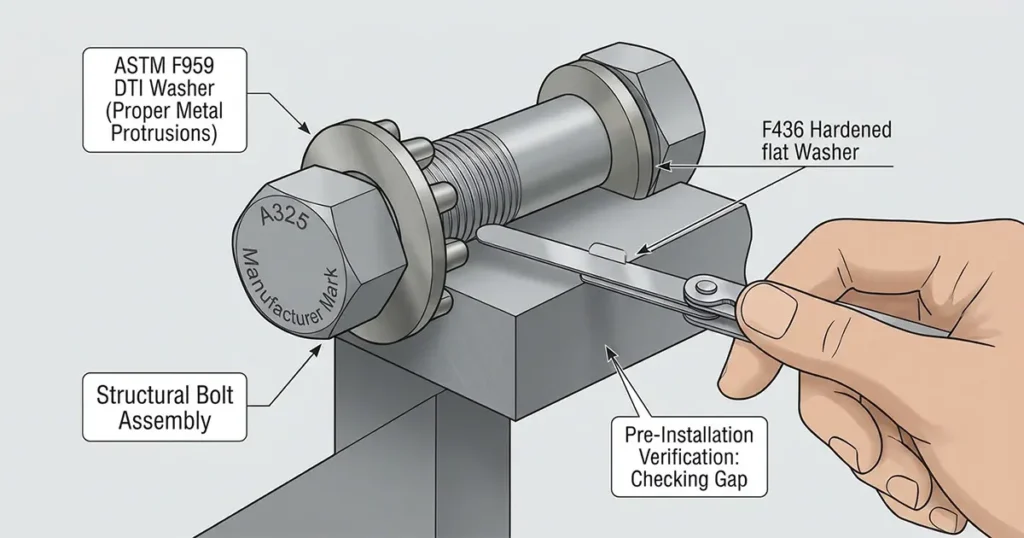
A DTI washer arrives with more paper than a plain washer, and much of it does not mean what buyers assume. The document usually called an ASTM F959 DTI washer test report is a manufacturer’s record of compression-load results for a production lot. It is not issued by ASTM, it is not a third-party inspection, and it says nothing about whether the bolting assembly will reach the required tension when it is installed.
To verify one, check four things in order: that the report cites the current edition and the exact product ordered, that it is tied to a specific production lot, that the cartons on the dock carry that same lot, and that the project’s own pre-installation verification has been arranged separately. The first three establish product conformity. None of them replaces the fourth.
The obligation to hold reports is usually a project requirement rather than a product one. The RCSC Specification for Structural Joints Using High-Strength Bolts (2025 edition) requires that “test reports documenting conformance to the applicable specifications for all bolting components and matched bolting assemblies shall be available to the Engineer of Record and Inspector prior to assembly or erection of structural steel.” That is why the paperwork has to be checkable at receipt, not after erection has started.
What F959/F959M-26 covers, and where it stops
ASTM F959/F959M-26, Standard Specification for Compressible-Washer-Type Direct Tension Indicators for Use with Structural Fasteners, Inch and Metric Series, was published in March 2026 and replaced F959/F959M-17a(2023). It is a product specification: eight DTI types in nominal sizes from 1/2 in. through 1-1/2 in. and M16 through M36, with requirements for chemical composition, compression load, outside diameter, number of protrusions, thickness, inside diameter and protrusion tangential diameter.
The eight types are 325-1, 325-3, 490-1, 490-3, 8.8-1, 8.8-3, 10.9-1 and 10.9-3. The type is tied to the bolt, not chosen freely: Type 325-1 is for F3125 Grade A325 Type 1 bolts or Grade F1852 assemblies, Type 325-3 for their Type 3 equivalents, and Types 490-1 and 490-3 for A490 and F2280 assemblies. RCSC Table 2.3 applies those Type 490 indicators to Group 144 bolting components as well as Group 150, because they share the same installation tension requirements. The metric Types 8.8 and 10.9 serve A325M and A490M bolts, with the -1 and -3 suffixes again following bolt Type 1 and Type 3. Type 3 DTIs may be furnished to a chemical composition requirement or to a Corrosion Resistance Index at the manufacturer’s discretion, so a Type 3 report should state which basis was used.
Two boundaries matter at goods-in. The specification defines the product, not the buyer’s documentation package: what you are entitled to receive, and when, comes from the purchase order and the project specification. And it is not an installation document. F959/F959M points to the RCSC Specification for installation, and the RCSC’s pre-installation verification section states that the test is not intended to verify conformance with the individual ASTM standards.
Four documents that are not interchangeable
At receipt, a certificate of compliance (also called a certificate of conformance), a lot test report, a carton label and a site test record are often treated as alternative proof of the same thing. They answer different questions.
| Document | What it establishes | What it cannot establish |
|---|---|---|
| Manufacturer’s production-lot test report | That sampled DTIs from a stated lot met the F959/F959M compression-load requirement for the type and size on the report | That the cartons delivered are from that lot, or that the assembly will reach the required pretension on site |
| Certificate of compliance | That the supplier declares the goods conform to the standard and the order | Which tests were run, on what sample, with what values |
| Package and part marking | Which lot a carton belongs to, and whether it matches the report | Whether the lot was tested at all |
| Pre-installation verification record | That the assembly, method and tools developed the required pretension on site | Whether the components conform to F959/F959M, because the RCSC test is not intended to verify conformance with individual ASTM standards |
Mixing them up produces two common failures. A certificate is accepted where a lot report does not exist, and a passing site test is used to release components whose lot documentation never arrived. Neither substitution survives an audit, and neither protects the connection.
Fields to check on an ASTM F959 DTI washer test report
A report is usable only if it is specific enough to be checked. The fields below are what a receiving inspector needs. Not all of them come from the product standard — the heat number and purchase order reference, for example, normally come from the mill certificate and the order — but all of them are needed to make the report attributable to the parts.
| Field | Compare it against | What a mismatch means |
|---|---|---|
| Standard and edition | The designation and edition on the purchase order: F959/F959M-26, not “F959” alone | A report against F959/F959M-17a(2023) does not demonstrate conformity to the 2026 edition. Ask for a conformance statement to the edition you specified rather than assuming the two are interchangeable. |
| DTI type | One of the eight types, matched to bolt group and bolt type; RCSC Table 2.3 assigns 325-1 or 325-3 to Group 120 and 490-1 or 490-3 to Group 144 and Group 150 | A type mismatch is a wrong-part problem. Paperwork cannot correct it. |
| Nominal size and series | 1/2 in. through 1-1/2 in., or M16 through M36, with the series stated; the standard treats inch-pound and SI values as separate systems | An M22 report attached to 7/8 in. cartons is not a partial match. |
| Coating | The coating on the purchase order, and for any coating other than mechanically galvanized zinc or thermally diffused zinc, the DTI manufacturer’s approval | An unapproved coating sits outside what the specification allows, and the report results may not represent the delivered parts. |
| Lot identification | The same lot string on the report, the carton label and the receiving record | Without a lot number the report cannot be applied to any specific carton. |
| Compression-load results | Values, the gap condition at which they were measured, the number of specimens, and pass or fail against the edition’s requirement | A report that states conformance without results cannot be checked, and cannot be challenged if the washers fail later. |
| Material and Type 3 basis | Heat number, and for Type 3 whether composition or a Corrosion Resistance Index was used | A Type 3 claim without its basis is incomplete. |
| Quantity and PO reference | The quantity covered against the quantity delivered | A report for 5,000 pieces does not cover a 12,000-piece shipment. |
| Issuer, date and signature | Who tested the lot, when, and whether the laboratory is the manufacturer’s or an independent one | An undated or unsigned report cannot be tied to the production run it describes. |
Matching the documents to the cartons
The report proves a lot; the carton identifies one. The receiving check is the join between them.
- Every carton. The label should carry the manufacturer, DTI type, nominal size and lot number. Compare the string character for character with the report: a lot number that differs by one digit is a different lot.
- One lot per carton. A consolidated shipment containing several lots is normal. A carton carrying two lot numbers, or none, is not: at that point the packaging cannot tell you which report applies.
- Sample the parts. If the washers carry a manufacturer’s mark, check a sample against the label. If they do not, the carton label is the only link in the chain, and it should be photographed and logged at receipt.
- Log it. Record lot number, report reference, quantity and storage location as the goods are booked in. Without that log, a question raised three months later has no answer.
Keeping the lot intact until installation
Traceability usually survives the border and fails in the warehouse. It has to survive further than that, because the site test is sampled by lot.
The RCSC Specification requires protected storage, limits the quantity drawn from storage to what is expected to be installed during the work shift, and requires unused components to be returned at the end of it. Those rules assume the lot label travels with the goods. Once cartons are opened and tipped into a bin, two lots of the same type and size are visually identical, and the compression-load report still applies only to the lot it tested.
If lots do get mixed, separate what can still be identified from the marking, re-identify only against written confirmation from the manufacturer, and treat the remainder as unverified. Re-labelling from a delivery note or from memory is how a conforming lot becomes an unverifiable one.
Why the report cannot replace pre-installation verification
The RCSC Specification separates the two functions deliberately. Pre-installation verification testing is performed at the site of installation, before bolting assemblies from verified lots are placed in the work, on a sample of not fewer than three complete bolting assemblies for each combination of diameter, length, grade and assembly lot. For the DTI method, the assembly is pretensioned and a feeler gauge of the correct thickness, supplied by the DTI manufacturer, is inserted between the protrusions. The minimum number of entries is set in Table 7.2 of the specification, and if it cannot be met, the cause is resolved before the assemblies are used.
Its purpose is not to check the washer against F959. The commentary says so directly: the test is not intended to verify conformance with the individual ASTM standards. It exists because component tolerances, lubrication, coating, storage and tooling combine into an installation behaviour that no single component’s report can predict.
The consequence is practical. A failed report is a supplier and lot problem: replace the lot or obtain the missing evidence. A failed site verification is an assembly, method, storage or tooling problem: resolve the cause before more assemblies are placed. Treating either failure as the other sends the corrective action to the wrong party.
When the documents do not match
The decision rules are simpler than the situations that produce them.
- No report for the lot. Hold the lot and request the report from the manufacturer, quoting the lot number — not from the trader, who may not hold it. If it cannot be produced, reject the lot or arrange agreed testing; a certificate of compliance is not a substitute.
- The report names a different edition, type or size. Treat it as no report for that lot, and ask the manufacturer to confirm the position in writing.
- The markings do not match the report. Quarantine the cartons. Do not re-mark them; obtain written lot identification from the manufacturer, or return the goods.
- Several lots are mixed and unidentifiable. Segregate what can be identified. The rest is unverified material and should be replaced rather than released on the strength of a report for one of the lots.
- The report covers only part of the quantity. Release only the covered quantity and hold the balance until its own evidence arrives.
Writing the requirement into the purchase order
Most of these problems are prevented at the order stage rather than at receipt. A clause that leaves nothing to inference specifies:
- the standard and edition, ASTM F959/F959M-26;
- the DTI type, nominal size, dimensional series and coating;
- lot marking on every carton, with the lot number also on the report;
- a compression-load test report for each lot, showing results, the test basis and the lot number;
- a certificate of compliance naming edition, type, size, coating and lot, where the project requires one;
- test reports available before shipment or before erection; and
- who performs pre-installation verification, and that the records are retained.
A workable line reads: “Direct tension indicator washer, ASTM F959/F959M-26, Type 490-1, 7/8 in., mechanically galvanized; each carton marked with manufacturer and lot number; compression-load test report per lot showing results against ASTM F959/F959M-26; certificate of compliance naming edition, type, size, coating and lot; test reports available before erection.”
Documentary conformity is a chain rather than a certificate. The edition, the type, the lot, the carton and the site verification each close a different gap, and incoming inspection exists to confirm that none of them has been papered over. ChinaBolts supplies ASTM F959/F959M DTI washers in the eight types and both dimensional series, alongside the wider washers range used with them.