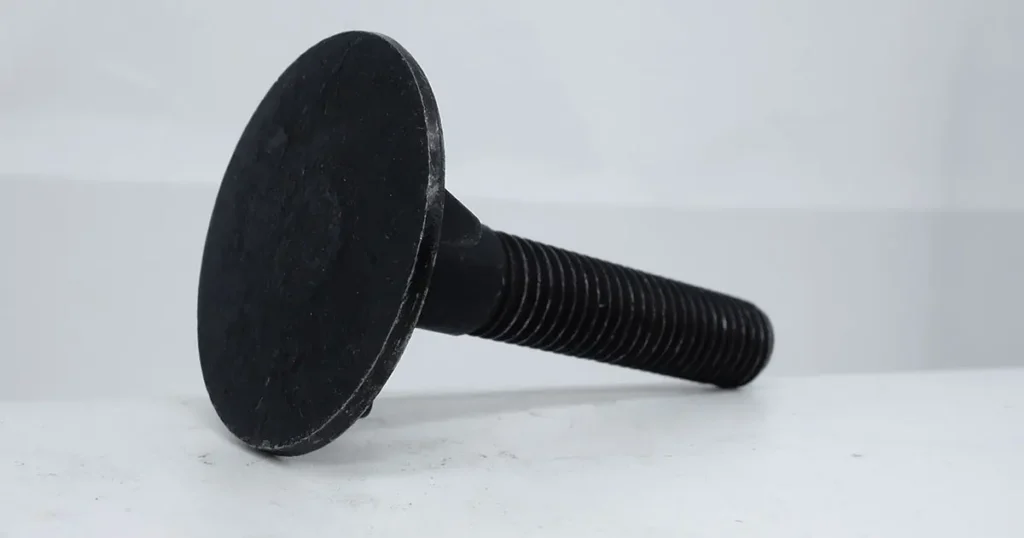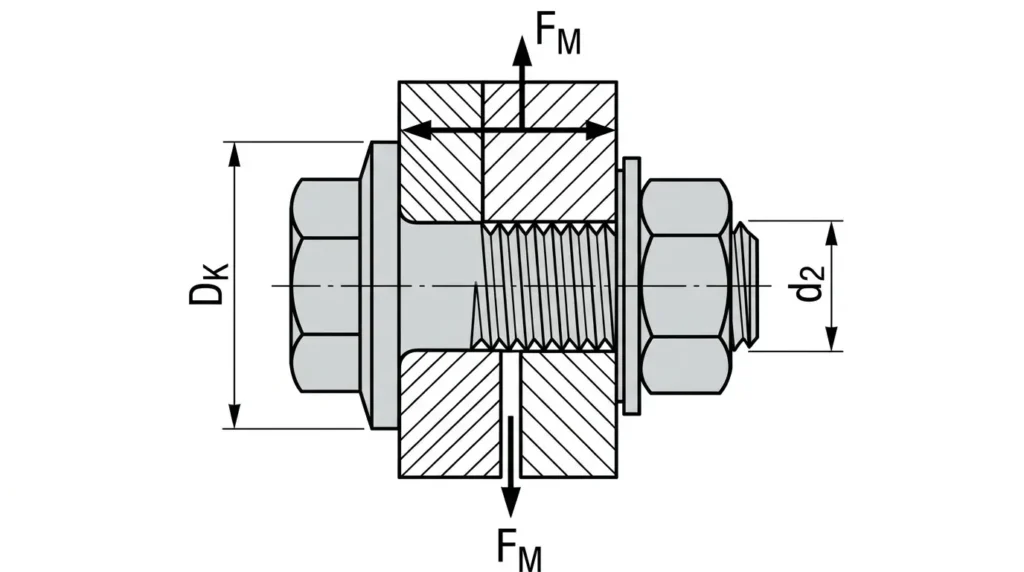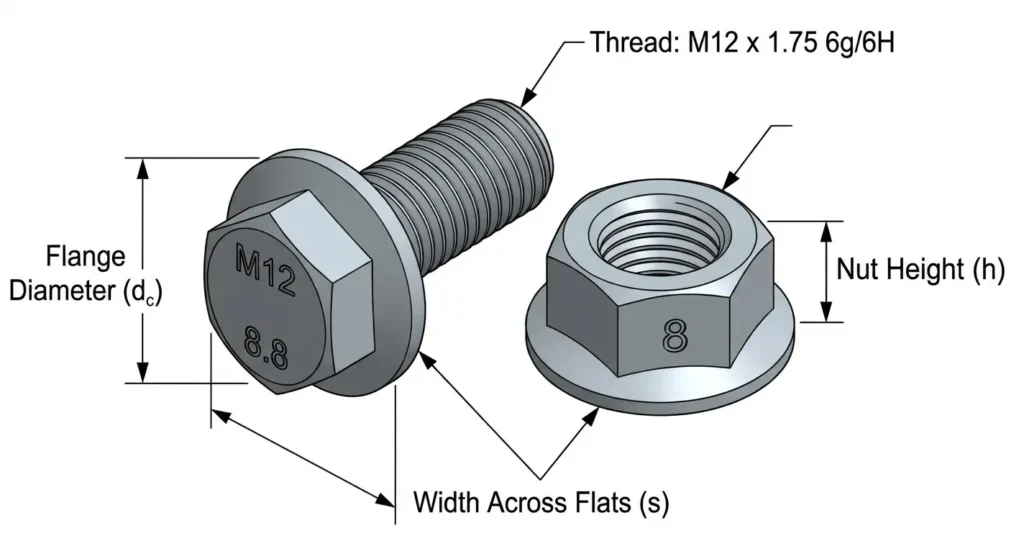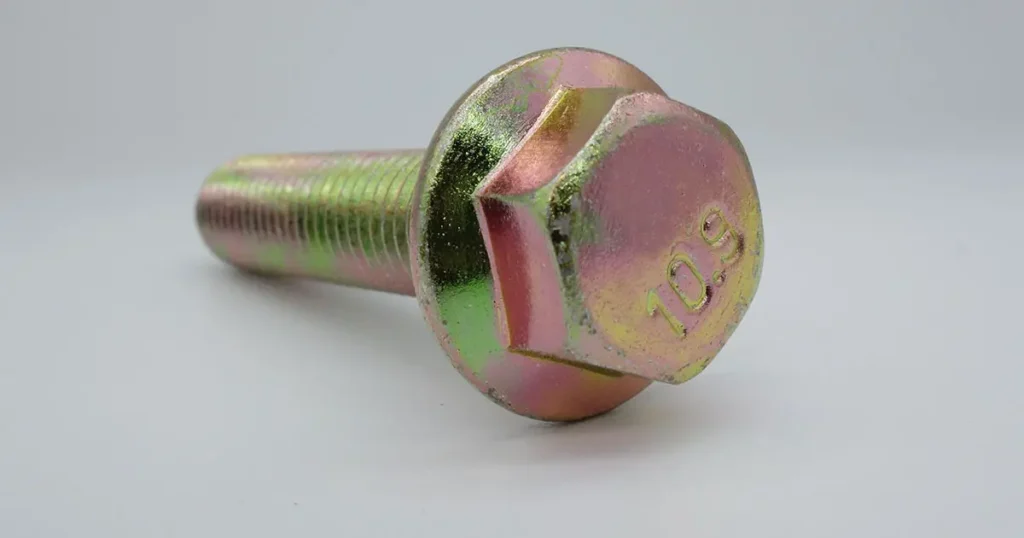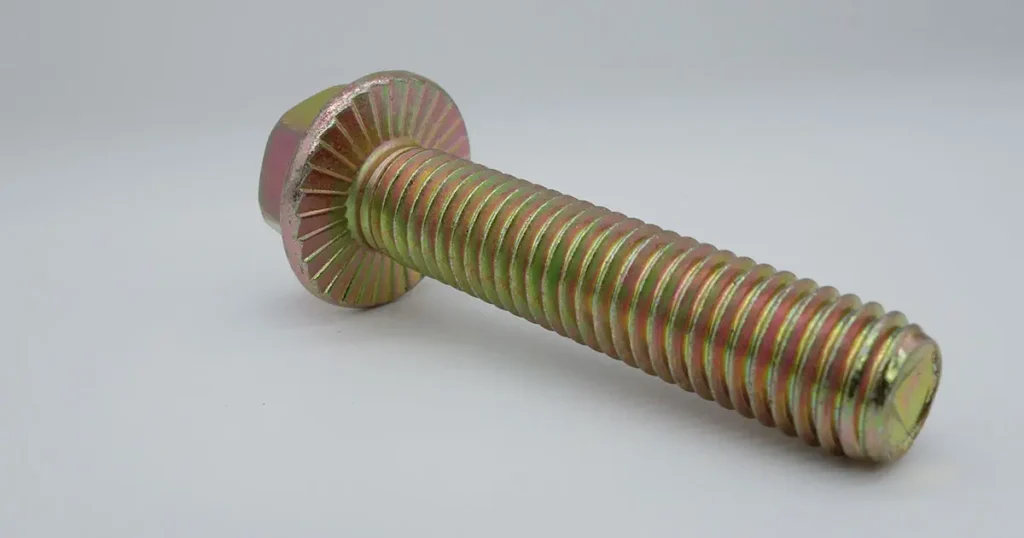
A hex flange bolt is a hexagon-head bolt with a circular collar — the flange — formed as part of the head, directly beneath the bearing face. The fastener itself, not a separate washer, provides the surface that presses on the joint. That one feature explains most of what the product is for: it spreads clamp load over a wider ring of material and removes a loose part from the assembly.
This article covers the family as buyers and designers actually meet it: what the flange does to a joint, where its effect stops, how plain and serrated faces differ, why a “flange bolt” in piping is a different product, and which fields a purchase order has to carry. It is not a dimension chart for one standard — those tables belong with the standard, and they only make sense once the product is understood.
What the flange does to the joint
Tightening a bolt stretches it. The stretched shank pulls the head down onto one side of the joint and the nut or tapped hole up against the other, and the parts between them are clamped together. The clamp force leaves the bolt through the bearing face under the head and enters the part at whatever area that face covers.
Contact pressure is that force divided by the bearing area. The bearing area of any bolt head is a ring: the outer boundary is the bearing-face diameter, the inner boundary is the clearance hole. A flange increases the outer diameter without changing the hole, so the ring gets wider and the pressure under the head falls.
The arithmetic is worth doing once, because the effect is larger than the diameter difference suggests. An M10 flange bolt to EN 1665 has a minimum bearing-face diameter of 19.6 mm. On an 11 mm clearance hole, the ring is about 207 mm². The same clamp force spread over a 16 mm face — roughly the width across flats of an M10 hexagon, used here only as an illustration — would sit on about 106 mm².
| Bearing face on an M10 bolt, 11 mm clearance hole | Bearing area | Contact pressure at 30 kN clamp load |
|---|---|---|
| 19.6 mm (EN 1665 flange, minimum) | ≈207 mm² | ≈145 MPa |
| 16 mm (illustrative plain head) | ≈106 mm² | ≈283 MPa |
Roughly double the area, roughly half the pressure. That matters wherever the part under the head is softer or thinner than the bolt: aluminium castings and extrusions, sheet metal, painted or coated panels, plastics and composites, and cast iron with a small machined pad. Lower pressure means less indentation, less flattening of the surface, and less of the preload lost when the joint settles.
Settling is not a detail. Even a well-tightened joint loses tension as surface roughness flattens under the contact areas, and the loss is greater where local pressure is higher. Bolt Science describes this embedding effect and its contribution to preload loss in its bolted joint tutorial. A wider bearing ring is one of the cheap ways to reduce it.
What the flange does not do
The flange changes the bearing interface. It does not change the bolt’s tension, and a surprising number of specification arguments come from expecting it to.
- It does not create clamp force. Preload comes from tightening the bolt against the joint, and it depends on diameter, property class, thread friction and under-head friction. The flange changes the last of these and the way the load is spread, not the strength of the bolt.
- It does not guarantee that the joint stays tight. Self-loosening comes from relative movement between the clamped parts, from preload loss, or from both. The shape of the flange addresses neither mechanism.
- It does not stop embedding on soft materials. It lowers the pressure, which reduces indentation and creep. A soft material under a hard flange still creeps, and a thin panel still dishes if the flange overhangs unsupported material.
- It does not bridge a slot or an oversized hole wider than the flange itself. Coverage has to be checked against the worst-case hole position and the minimum flange diameter, not the nominal size.
- It does not seal. A flange is a bearing surface, not a gasket. Joints that must hold liquid or gas need a defined sealing element.
- It does not automatically replace a hardened washer. The flange is part of the bolt and its hardness follows the bolt’s class and heat treatment. A washer can be selected separately for hardness, thickness, diameter, material or surface finish.
One consequence is easy to miss at the bench. Removing a washer removes an interface, and under-head friction is part of how torque turns into tension. A joint converted from bolt-and-washer to a flange bolt may reach a different preload at the same wrench setting, so the torque value should be re-established for the actual stack rather than carried across.
Hex flange bolt compared with a hex bolt and washer
The comparison is often framed as “flange bolt versus washer”, which hides the useful part. A flange is a washer-sized bearing surface that is present on every part, the same diameter every time, and cannot be left out. A separate washer is a bearing surface that can be chosen, and that can carry functions the flange cannot.
| Consideration | Integral flange | Separate washer |
|---|---|---|
| Bearing diameter | Fixed by the product standard or drawing | Selectable, including larger than the flange |
| Part count at assembly | One part | Two parts, one of which can be dropped or forgotten |
| Bearing-face hardness | Follows the bolt class | Selectable, including hardened grades |
| Other functions | Load distribution only | Sealing, insulation, spring action, slot bridging, wear face, locking |
| Surface condition | Same face every time; plain or serrated | Face condition depends on the washer supplied |
| Service replacement | Bolt and bearing face replaced together | Washer can be replaced on its own |
That table gives the practical rule. If the washer was there to spread load over a flat, sound surface, a smooth flange of adequate diameter can usually do the same job and simplify the assembly. If the washer was doing something else — sealing, isolating dissimilar metals, adding spring travel, covering a slot, providing a replaceable wear face or a harder bearing surface — the flange does not reproduce it, and removing the washer changes the joint rather than simplifying it.
The other point is that “flange” is not one diameter. Flange-bolt series differ in head and flange dimensions even at the same thread size, so a flange bolt bought against one document may present a smaller bearing ring than the one the drawing was designed around. Check the bearing-face diameter, not just the thread.
Plain and serrated flanges
The difference is in the face that touches the part. A plain flange has a smooth annular bearing face. A serrated flange has radial teeth formed or cut into that face, so the bolt stands on the crests of the teeth rather than on a continuous ring.
That changes three things at once. Contact area drops to the tooth crests, so local pressure rises. The teeth bite into the mating surface during tightening, which is what resists rotation. And the surface is marked where the teeth land, including through paint, plating or a conversion coating.
Those consequences decide where each face belongs:
- Plain flange: painted or coated panels, machined and sealing faces, aluminium and thin sheet, visible surfaces, and joints that will be opened and re-tightened. Nothing is cut, so the coating and the surface finish survive.
- Serrated flange: brackets and structures where the surface is not cosmetically or functionally critical, the material is hard enough for the teeth to bite, and some resistance to rotation is wanted during handling and service. The coating under the teeth is damaged, so corrosion protection at that spot has to be considered.
Two cautions belong here. The first is that a serrated flange cannot be combined with a washer to protect the surface: the washer sits between the teeth and the part and takes away the engagement the teeth were there to provide. The second is that serrations are not a vibration-proof lock. They resist rotation by mechanical engagement, and how much they resist depends on tooth geometry, surface hardness, clamp load and the movement the joint actually sees. They do not maintain preload, and they do not replace a properly tensioned joint. Where a joint needs a defined locking function, specify that function — a prevailing-torque nut, an adhesive, or a locking washer such as a DIN 25201 wedge lock pair — and validate it in the joint rather than inferring it from a serrated face.
Serration geometry is also not captured by the words “flange bolt”. Tooth count, depth, angle and direction vary between suppliers, and two serrated bolts that look alike can behave differently on the same surface. If the serrations matter, they belong on the drawing or in the purchase order.
“Flange bolt” in piping means something else
In piping and pressure equipment, a “flange bolt” usually means a bolt used to join two pipe flanges. That fastener has no integral collar. The flange belongs to the pipe or the valve, not to the bolt, and the bolting is commonly a stud with a nut at each end, or a heavy hex machine bolt, sized and specified by the piping or flange standard rather than by a fastener product standard.
The confusion is real in both directions. A search for flange bolts returns pipe-flange bolting charts, and a quotation for “flange bolts” can arrive as studs if the buyer and supplier read the term differently. The physical check is simple: if there is no collar under the head, it is not the product this article describes. If the application is a flanged pipe joint, the order needs stud diameter and length, thread, nut grade and quantity, washers where the specification requires them, and the coating system — a different list from the one below.
Where hex flange bolts are used
The product earns its place where a wider bearing face is useful and where losing a washer costs time. Typical settings include:
- Automotive and off-highway assembly: brackets, body and chassis attachments, engine and transmission accessories, where parts are fed automatically and a loose washer is a defect rather than an inconvenience.
- Machinery and equipment: motors, gearboxes, pumps, frames, guards and covers, often bolted to painted or coated sheet and castings.
- General industrial fastening: cabinets, racks, panels, supports and fixtures, where a repeatable bearing surface speeds assembly and simplifies the bill of materials.
Within those settings, the reason is usually one of three: the joint is soft or thin and needs the area, the assembly needs one part instead of two, or the recess is too shallow or too narrow for a washer to sit correctly. None of those reasons is universal, which is why the product sits alongside plain hex bolts in the wider bolts range rather than replacing them.
Which standard the part comes from
In metric trade the family is covered mainly by two European documents. EN 1665 covers hexagon bolts with flange, heavy series, threads M5 to M20 and property classes 8.8, 10.9 and A2-70, and was corrected in 2007. ISO 4162:2012 covers the small series from M5 to M16, product grade A for the bolt and grade B for the driving feature, with classes 8.8 to 10.9 and A2-70; it replaced the 1990 edition, which is cancelled.
DIN 6921:1983-06 is still quoted on many older drawings and stock lists. It has been withdrawn, and EN 1665 is its successor in the DIN framework, so a drawing that still cites DIN 6921 is describing a part that should now be ordered against the current document or drawn explicitly. The DIN Media record gives the edition and date. For the Japanese market, JIS B 1189 covers the same product family, and inch-series flange bolts follow inch dimensional and grade specifications rather than any of these.
The reason to name the document in an order is not bookkeeping. Heavy and small series differ in head and flange dimensions at the same thread size, and the older German document differs again. If the drawing, the sample and the quotation are on three different documents, the bolts can all be M10 and still not match the joint.
Where a drawing still cites DIN 6921, the matching product reference is DIN 6921 hexagon flange bolts, with the flange and head dimensions taken from the drawing rather than assumed from the standard number.
How to specify a hex flange bolt
“M10 flange bolt” is not a specification. Two suppliers can fill it with different series, flange diameters, thread lengths, classes, coatings and bearing faces. The following fields close that gap.
- Product standard or drawing: the document and its edition, whether that is EN 1665, ISO 4162, JIS B 1189, an inch-series specification or a customer drawing. If the part is non-standard, the drawing has to carry the flange dimensions.
- Thread: nominal diameter, pitch (coarse unless a fine pitch is intended), tolerance class, and whether the thread is full length or partial.
- Length: measured from under the head. The flange is part of the head, so it does not add to the grip. Check the grip against the actual stack, then confirm thread engagement in the nut or tapped hole at the tightened position.
- Property class and material: 8.8 and 10.9 for carbon and alloy steel, A2-70 for stainless, or a material specification where the application demands one. The mating nut must have a compatible nut property class for the bolt. For tapped holes, the parent material strength and effective thread engagement must be sufficient to develop the required joint load; a tapped hole is not assigned the bolt’s property class.
- Finish: zinc plating, zinc flake, hot-dip galvanizing or stainless passivation, with the coating thickness or system stated. Hot-dip galvanizing changes thread fit and needs the appropriate allowance; it also changes friction, so torque values have to match the finish supplied.
- Bearing face: plain or serrated. If serrated, the tooth pattern belongs in the specification, together with any instruction about the mating surface.
- Head and clearance: hexagon head as standard, with 12-point or other heads as variants. Confirm the flange outside diameter clears ribs, walls, weld beads and recesses, and that the socket clears the surrounding material.
- Marking and documents: class marking on the head, lot identification, and the inspection documents the order requires.
A complete order line then reads something like: hex flange bolt, ISO 4162, M10 × 40, property class 8.8, zinc flake coating, plain flange, full thread, 5,000 pieces, inspection certificate to EN 10204 3.1. Every field in that line changes either the fit, the strength, the corrosion performance or the friction, and none of them can be inferred from the words “flange bolt”.
What to decide before the next order
Start with the joint rather than the bolt. If the surface is sound and flat and the only reason for a washer was load distribution, a smooth flange of adequate diameter removes a part and a step from the assembly. If the surface is soft, slotted, coated for a reason, or likely to be opened repeatedly, work out what the washer or the surface actually has to survive before changing the fastening.
Then pin the part down: series and standard, thread and length, class, finish, bearing face, and the flange diameter that has to fit the recess. A hex flange bolt is a simple product with an unusually large number of ways to be wrong, and most of them are decided on the purchase order rather than in the joint.