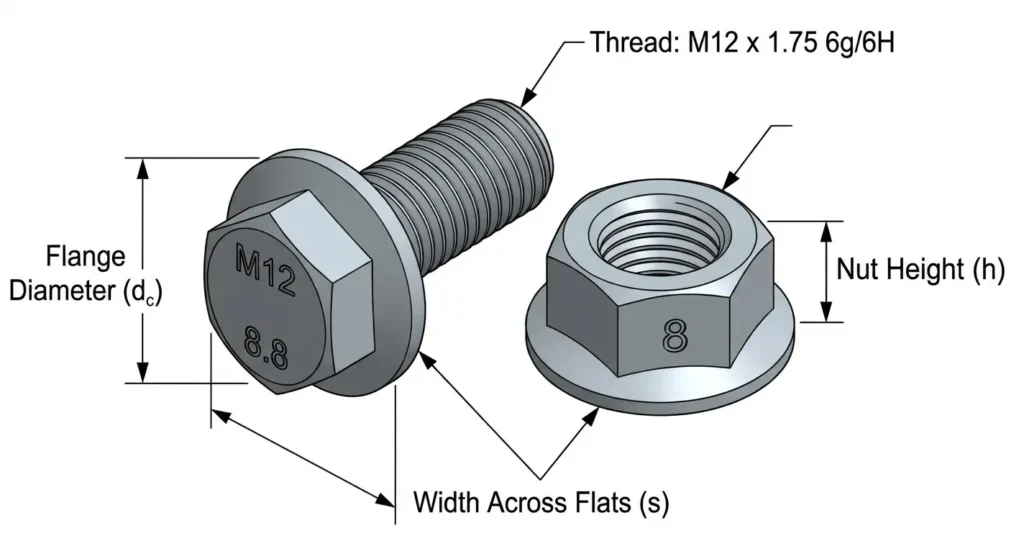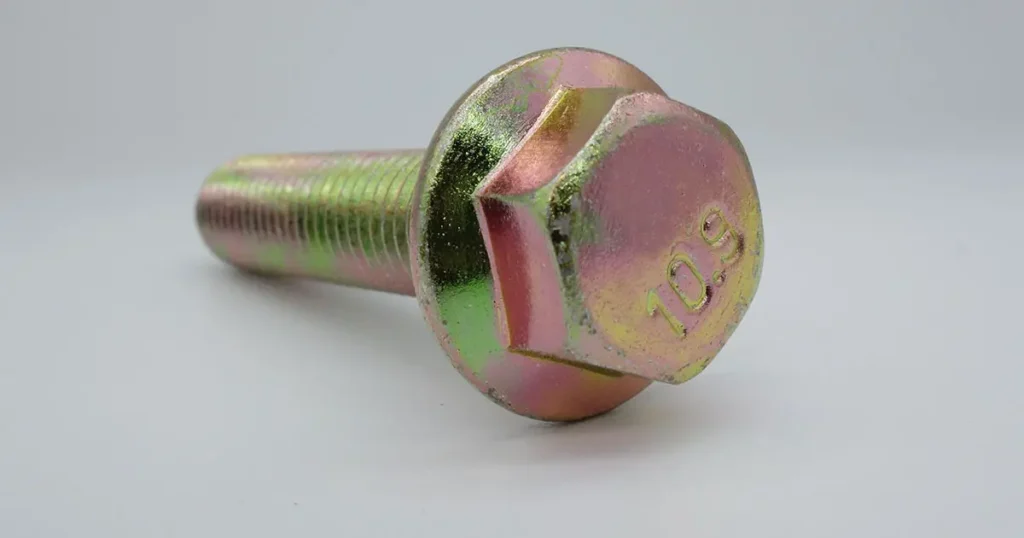
Three standard numbers, one product family, and three different heads. DIN 6921, DIN EN 1665 and ISO 4162 all specify a metric hexagon bolt with an integral flange, and at the same nominal diameter all three carry the same coarse thread, so the same nut and the same tapped hole accept any of them. What changes is the head: the width across flats, the head height, the flange diameter and the bearing face diameter. Those four dimensions decide which socket is needed, whether the head clears the component next to it, and how much surface carries the clamp load.
So the three cannot be treated as equivalent, and the cross-reference heard most often — DIN 6921 replaced by EN 1665 — is not a dimension-for-dimension replacement either. DIN 6921:1983-06 is withdrawn, and DIN EN 1665:1998-11 took its place in the German framework. Yet from M10 upward the older bolt has a smaller hexagon and a lower head than the document that succeeded it. ISO 4162:2012 is a different product again: the small series, with a hexagon smaller than EN 1665’s at every diameter and a smaller flange than either.
Three standards, three different statuses
The three documents were written at different times, for different frameworks, and only one of the three is a current standard in the German framework — and that one is not DIN 6921.
| DIN 6921 | DIN EN 1665 | ISO 4162 | |
|---|---|---|---|
| Title | Hexagon flange bolts (Sechskantschrauben mit Flansch) | Hexagon bolts with flange — Heavy series | Hexagon bolts with flange — Small series — Product grade A with driving feature of product grade B |
| Edition and status | 1983-06, withdrawn | EN 1665:1997, published in Germany as DIN EN 1665:1998-11; corrected by AC:2007 | 2012, current; replaced ISO 4162:1990 |
| Diameter range | M5 to M20 | M5 to M20 | M5 to M16 |
| Thread | Metric, 6g; coarse pitch plus fine pitches from M8×1 to M20×1.5 | Metric coarse, 6g | Metric coarse, 6g |
| Property classes | 8.8, 10.9, 12.9; A2-70 | 8.8, 10.9; A2-70 | 8.8, 9.8, 10.9; A2-70 |
| Product grade | A | A | A, except e and s, which are grade B |
The records are worth opening rather than taking on trust. DIN 6921:1983-06 is still catalogued under that number and edition, with no later German edition behind it. DIN EN 1665:1998-11 is the German edition of EN 1665:1997, whose published scope is M5 to M20 with property classes 8.8, 10.9 and A2-70 (adoption record). ISO 4162:2012 is the current ISO document, published in July 2012, covering M5 to M16 with property classes 8.8 to 10.9 and A2-70, and it replaced the 1990 edition.
Two details in that table are easy to skim past. The first is the ISO title: ISO 4162 is product grade A except for the driving feature, which is grade B — and the driving feature is the hexagon, dimensioned by s and e, the two dimensions a socket touches. Those two dimensions carry a wider tolerance band than the same dimensions on a grade A product. The second is the property-class column: fine pitch and class 12.9 appear only in the DIN 6921 list, and EN 1665 does not list 9.8 at all. A class or a pitch that a drawing inherited from a DIN 6921 part therefore has no home in either current standard.
The replacement was not a copy
The relationship between DIN 6921 and EN 1665 is often summarised as “DIN 6921 is the old number, EN 1665 is the new one”. In the German framework that is roughly right: DIN 6921:1983-06 is marked UNGÜLTIG — withdrawn — and DIN EN 1665:1998-11 is the flange-bolt standard that took its place. The dimension tables, however, do not line up.
What carried over unchanged is substantial. The flange diameter dc is identical at every size from M5 to M20 — 11.8, 14.2, 18, 22.3, 26.6, 30.5, 35 and 43 mm — and the bearing face diameter dw is identical too, from 9.8 mm at M5 to 39.9 mm at M20. The thread lengths are identical, including the 57 mm and 65 mm long-bolt values at M16 and M20. A DIN 6921 bolt and an EN 1665 bolt of the same size therefore sit on the same surface and carry the same thread.
What changed is the head above that flange. At M6 and M8 the two documents agree on both width across flats and head height. At M5 the EN 1665 head is 0.4 mm taller. From M10 upward the hexagon grows by one size and the head gets taller; the gap widens with diameter: 15 mm against 16 mm across flats at M10, 27 mm against 30 mm at M20, and a head height 0.3 mm to 1.8 mm greater depending on size. A bolt made to the old number and a bolt made to the new one are the same fixing in the same hole; they are not the same head, and at M10 and above they do not take the same tool.
Width across flats: the dimension that decides the tool
Width across flats is the first thing to compare, because it is the dimension a fitter notices. At M5, M6 and M8 the DIN 6921 and EN 1665 hexagons are the same: 8, 10 and 13 mm. Above that they separate. ISO 4162 sits below both: against EN 1665 its hexagon is 1 mm smaller at M5, 2 mm at M6 and 3 mm at every size from M8 to M16, while against DIN 6921 it is smaller from M5 to M12 and equal at M14 and M16.
| Size | s DIN 6921 | s EN 1665 | s ISO 4162 | k DIN 6921 | k EN 1665 | k ISO 4162 |
|---|---|---|---|---|---|---|
| M5 | 8 | 8 | 7 | 5.4 | 5.8 | 5.6 |
| M6 | 10 | 10 | 8 | 6.6 | 6.6 | 6.8 |
| M8 | 13 | 13 | 10 | 8.1 | 8.1 | 8.5 |
| M10 | 15 | 16 | 13 | 9.2 | 10.4 | 9.7 |
| M12 | 16 | 18 | 15 | 11.5 | 11.8 | 11.9 |
| M14 | 18 | 21 | 18 | 12.8 | 13.7 | 12.9 |
| M16 | 21 | 24 | 21 | 14.4 | 15.4 | 15.1 |
| M20 | 27 | 30 | – | 17.1 | 18.9 | – |
The practical consequences start at M10. A 15 mm socket will not drive a 16 mm head, and a workshop whose flange-bolt stock is mixed between the old DIN number and the EN number needs two spanners for the same nominal size. At M14 the DIN 6921 hexagon (18 mm) happens to match ISO 4162’s, and at M16 the two match again at 21 mm, so the pattern is not a simple ranking: it has to be read size by size. The direction of the change is not unusual either — the DIN 933 to ISO 4017 transition changed head widths at four sizes, and the wrench was the visible consequence there too.
Across corners, e, follows the same pattern but is a different kind of number. Socket size is set by s, the width across flats; e is a minimum across-corners dimension (e min) that defines the head geometry the standard guarantees — in EN 1665 and ISO 4162 it is verified by gauging the hexagon — not the largest diameter the head can reach. At M10 the minimum across-corners dimension is 16.5 mm on DIN 6921, 17.62 mm on EN 1665 and 14.08 mm on ISO 4162: minimum values, not maximum clearance diameters. A real head can sit anywhere in the permitted band above that minimum, so installation clearance has to be checked against the permitted maximum head envelope together with the drawing or the supplier’s dimensions, not against e min. The tool fit and the space around the head still differ between the three standards; the difference is read from s for the socket and from the permitted maximum for the clearance.
Head height adds a second, separate constraint. At M10 the head is 9.2 mm tall on DIN 6921, 10.4 mm on EN 1665 and 9.7 mm on ISO 4162. The taller EN 1665 head takes 1.2 mm more height above the joint face — enough to matter where a flange bolt sits under a cover or beside a boss — and it gives the socket 1.2 mm more hexagon to grip. Neither figure is a strength difference. Property class sets the strength; head height sets the clearance and the depth of engagement the tool gets.
Flange diameter and bearing face: where ISO 4162 separates
The flange is the reason these bolts exist, and on this dimension the DIN and EN tables agree completely. If the question is whether an EN 1665 bolt can stand in for a DIN 6921 bolt on bearing area, the answer is yes at every size: the two documents use the same flange and the same bearing face.
| Size | dc DIN 6921 / EN 1665 | dc ISO 4162 | dw DIN 6921 / EN 1665 | dw ISO 4162 |
|---|---|---|---|---|
| M5 | 11.8 | 11.4 | 9.8 | 9.4 |
| M6 | 14.2 | 13.6 | 12.2 | 11.6 |
| M8 | 18 | 17 | 15.8 | 14.9 |
| M10 | 22.3 | 20.8 | 19.6 | 18.7 |
| M12 | 26.6 | 24.7 | 23.8 | 22.5 |
| M14 | 30.5 | 28.6 | 27.6 | 26.4 |
| M16 | 35 | 32.8 | 31.9 | 30.6 |
| M20 | 43 | – | 39.9 | – |
ISO 4162 does not share that geometry. Its flange runs from 11.4 mm at M5 to 32.8 mm at M16, and its bearing face from 9.4 mm to 30.6 mm. The difference looks small in millimetres and is larger in area: at M10 the contact annulus, calculated from dw and the 10 mm shank as a plain annulus, is about 196 mm² for the ISO 4162 flange against 223 mm² for the DIN 6921 and EN 1665 flange — roughly 12% less area carrying the same preload. On a thin panel, a soft casting or a slotted hole, that is the difference that appears as indentation or loss of preload rather than as a part that will not fit.
The flange also replaces a washer, so a joint designed around a hexagon bolt and a flat washer has one less layer in the stack once a flange bolt is used. That changes what a given nominal length actually clamps, and the flange — not the washer — becomes the bearing surface: 22.3 mm at M10 for DIN 6921 and EN 1665, 20.8 mm for ISO 4162.
The shank side is common to all three
Below the head the documents are much closer than their reputations suggest. All three use a 6g metric thread, and all three use the same standard thread lengths: 16, 18, 22, 26, 30, 34, 38 and 46 mm at M5 to M20 for lengths up to 125 mm; 28 to 52 mm for lengths from 125 to 200 mm; and 57 mm and 65 mm for M16 and M20 above 200 mm. Those are the familiar 2d + 6, 2d + 12 and 2d + 25 bands that the hexagon bolt standards use — the same bands as DIN 931 and ISO 4014 — so an M12 × 80 flange bolt carries 30 mm of thread whichever of the three numbers is on the drawing.
That is the part of interchangeability that genuinely holds: a flange bolt of any of the three standards screws onto the same nut and into the same tapped hole at the same nominal size, and the clamp length for a given nominal length is the same. The differences are in coverage rather than in thread geometry. DIN 6921 lists fine pitches alongside coarse ones; EN 1665 and ISO 4162 are coarse-thread documents. ISO 4162 stops at M16 while the other two run to M20. And the class lists differ, as the first table showed, which matters when a drawing asks for 9.8 or 12.9.
Interchangeability, direction by direction
Because the thread and the thread length are shared but the head is not, the substitution question has to be asked in a direction. The table below states what survives and what has to be checked for each move.
| Move | Unchanged | What has to be checked | Assessment |
|---|---|---|---|
| DIN 6921 → EN 1665 | Thread, thread length, flange diameter, bearing face | Hexagon +1 to +3 mm from M10; head 0.3 to 1.8 mm taller; socket changes at M10 and above | Same joint, different tool and different head envelope. Workable where clearance allows, but not a drop-in part |
| EN 1665 → DIN 6921 | As above | Smaller hexagon and lower head; the source is a withdrawn standard | Fits the same joint and takes less space, but the part is no longer to a current document |
| DIN 6921 or EN 1665 → ISO 4162 | Thread and thread length only | Flange 0.4 to 2.2 mm smaller; bearing face 0.4 to 1.3 mm smaller; hexagon below EN 1665 at every size and below DIN 6921 from M5 to M12 | Not a bearing-face substitute. Where the flange is the bearing surface, the contact area changes |
| ISO 4162 → EN 1665 | Thread and thread length | Head and flange larger; socket changes; clearance around the head reduces | Fits the thread, may not fit the space around the head |
Two cautions sit outside that table. The first is that property class does not carry across automatically: 9.8 and 12.9 are not listed by EN 1665, so a part in either class is outside that standard’s list and needs a drawing or a specific agreement. The second is that a substitution changes the part that is fitted, not the joint that was designed. A flange bolt with a smaller bearing face, or a lower head, can still leave the joint under-preloaded if the tightening method and the tooling were built around the original head.
Why the cross-reference tables mislead
Most substitutions start with a cross-reference table, and that is the weakest link in the chain. A line reading “DIN 6921 = EN 1665 = ISO 4162” is a name match, not a dimension match: it is true that all three are hexagon flange bolts in overlapping diameter ranges, and false that the bolts are interchangeable at a given size. Many such tables are compiled from catalogue descriptions rather than from the standard documents, which is why the dimensional differences above never appear in them.
Some tables go further and give DIN 6921 an ISO number, 8100. ISO’s 8100 series is the lift standard — ISO 8100-1 covers the safety rules for lifts — so that line cannot be read as a flange-bolt product standard, and a drawing citing it has no dimensional table behind it. Where an ISO reference is wanted for these bolts, the accurate statement is narrower: ISO 4162 covers the small series, and the heavy series is a European product, EN 1665.
What to put on the enquiry or the order
Since the differences are dimensional, the fix is a line that carries the dimensions. Seven fields cover it:
- Standard and edition: EN 1665:1997 (DIN EN 1665:1998-11), ISO 4162:2012, or DIN 6921:1983-06 where the part is legacy.
- Size and pitch: nominal diameter, plus pitch where a fine thread is required — which effectively means a DIN 6921 or bespoke part.
- Nominal length: with the thread length band that applies, since b changes above 125 mm and again above 200 mm.
- Property class: 8.8 or 10.9 for EN 1665; 8.8, 9.8 or 10.9 for ISO 4162; A2-70 for stainless in either.
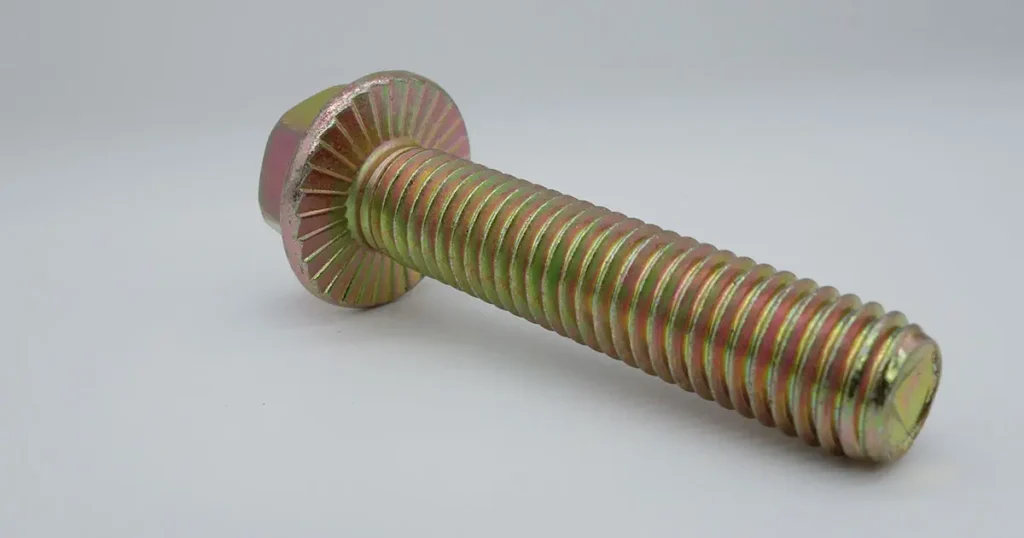
- Head form: plain flange, or the Grooved design (Ho) that DIN 6921 itself covers, specified by adding Ho to the DIN 6921 callout; serrated or special locking profiles outside that standardised grooved design need a drawing or explicit dimensions rather than a standard number.
- Coating: the finish the joint needs, stated against the relevant coating standard rather than as a colour.
- Documentation: the inspection document and marking the order has to carry.
The standards write their own designations compactly. EN 1665 designates a heavy-series bolt as, for example, “Hexagon bolt EN 1665 – M12 × 80 – 8.8”, and ISO 4162 writes “Hexagon flange bolt ISO 4162-M12×80-8.8”. Both are complete only because the standard number fixes the head. Where the standard number is DIN 6921, that certainty has gone: the number no longer points to a current document, and the drawing has to govern the dimensions.
The substitution decision in one paragraph
The three standards share a thread, a nut and a thread length, which is why a substitution starts easily and then surprises people at the head. DIN 6921 and EN 1665 are the same flange and the same bearing face on a different hexagon and a different head height; ISO 4162 is a smaller flange on the same thread, with a smaller hexagon at every size up to M12. Treat DIN 6921 to EN 1665 as a head-and-tool change in a joint that stays the same, treat either of them to ISO 4162 as a bearing-area change that brings a tool change with it up to M12, and treat ISO 4162 to EN 1665 as a clearance change as the head and flange grow. None of the three is a drop-in replacement for another at a size where the head differs, and the drawing, not the cross-reference, decides.
ChinaBolts supplies DIN 6921 and DIN EN 1665 hexagon flange bolts from M5 to M20, alongside the wider bolts range. The class ranges differ by document: DIN 6921 lists 8.8, 10.9, 12.9 and A2-70, while EN 1665 lists 8.8, 10.9 and A2-70 — a 12.9 part made to EN 1665 dimensions is a special item by agreement, not a standard EN 1665 product. Send the standard, edition, size, length, class and head form with the enquiry, and the line can be quoted against the document it names rather than against a cross-reference.