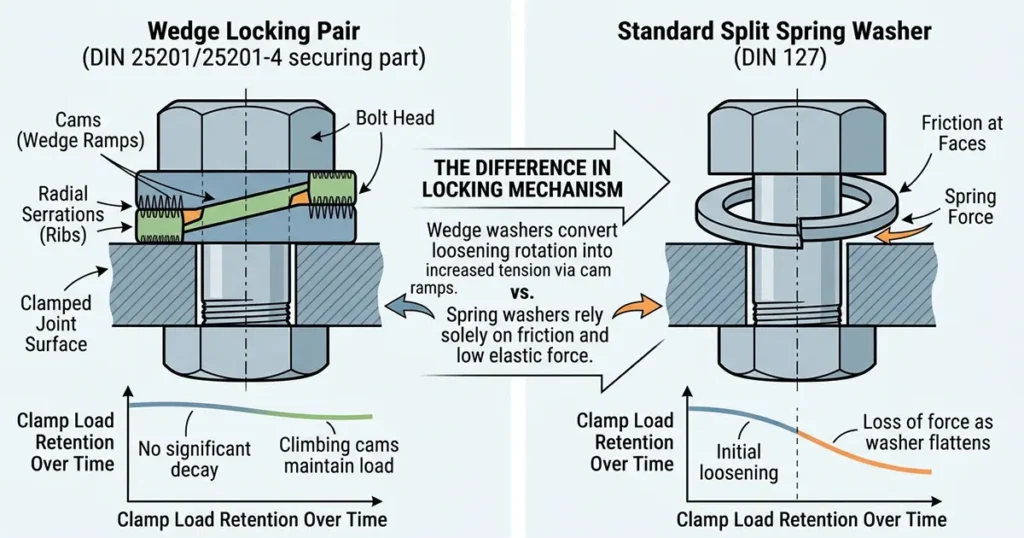
A wedge lock washer does not rely on friction to hold a joint. It is supplied as a matched pair, and the pair turns any loosening rotation into axial expansion: the bolt is stretched a little further instead of being allowed to turn. That conversion, not grip, is the mechanism.
Each washer carries wedge-shaped cams on one face and radial serrations on the other. Stacked cam to cam, with the serrated faces outward against the bolt head or nut and against the joint, the pair acts as a rotation-to-tension converter. How wedge lock washers work, in that sense, is a question of geometry rather than of surface grip.
The name needs one clarification first. DIN 25201 is a seven-part German design guide for bolted joints on railway vehicles, not a washer product standard; the washer designation is trade usage that has grown around the securing part of that series. DIN 25201’s scope and current editions are set out separately, including the withdrawn 1986 text and the European standard the series is now being aligned with.
The two faces do different jobs
The pair only works because its two faces are not interchangeable. One side slides, the other side grips.
| Face | Faces | What it does |
|---|---|---|
| Cam face (wedge ramps) | The cam face of the other washer, cam to cam | Slides and rides up under relative rotation, forcing the pair to grow thicker |
| Serrated face (radial ribs) | The bolt head or nut, and the joint surface | Embeds in the bearing surface so the washer cannot rotate with the fastener |
The serrations are as important as the cams. If both washers could rotate freely against their contact surfaces, the pair would simply turn with the fastener and no cam would ever climb. The ribs remove that option by biting into the bearing surface on each side: the outer washer is effectively fixed to the bolt head or nut, the inner washer to the joint. Every small relative rotation between fastener and joint is then forced through the cam interface.
That is also why the pair has a fixed orientation, and why the two halves are normally bonded together. The bond is a handling aid, not the locking mechanism; a pair that has separated can be restacked, but only cam to cam, and the outward faces must stay serrated.
Why the cams beat the thread
A thread is an inclined plane wrapped around a cylinder. Undoing a fastener means rotating it down that incline, and the axial distance it gives back per turn is fixed by the pitch. The angle of the incline is small.
| Coarse metric thread | Pitch (mm) | Basic pitch diameter d2 (mm) | Helix angle |
|---|---|---|---|
| M6 | 1.0 | 5.350 | 3.4° |
| M8 | 1.25 | 7.188 | 3.2° |
| M10 | 1.5 | 9.026 | 3.0° |
| M12 | 1.75 | 10.863 | 2.9° |
| M16 | 2.0 | 14.701 | 2.5° |
| M20 | 2.5 | 18.376 | 2.5° |
The helix angle is the arctangent of the pitch divided by pi times the basic pitch diameter (λ = arctan(P / (π × d2))), using the ISO 724 basic values for coarse metric threads. The result is that a coarse thread is, in effect, a very shallow ramp: between roughly 2.5 and 3.5 degrees across the sizes in the table.
The cam ramps on a wedge-locking washer are far steeper. When the pair is forced to rotate, it has to climb them, and the axial rise per degree of cam rotation is larger than the axial movement the thread gives back per degree of rotation. The difference has to be absorbed somewhere: the clamped parts are already compressed, so the bolt stretches and the clamp load rises. Attempted loosening therefore increases the tension holding the joint together instead of reducing it.
This is the design condition usually stated as the cam angle being greater than the thread helix angle. If it were not, the washer would behave as a shim with a friction coefficient, and the joint would loosen as it would without one. The exact cam angle is a product parameter that differs between designs and sizes; the relationship to the thread, not the number itself, is what makes the part work.
Two practical consequences follow. The pair is not a permanent lock: a wrench applies enough torque to climb the cams, and the fastener can be removed in the normal way. And the resistance it offers is not a fixed friction torque that gets used up; it grows as rotation is attempted, which is why the mechanism survives repeated small movements rather than fading after the first one.
What the joint gets from this is preload retention. The clamp load the bolt was tightened to is not merely left alone to decay; each attempt to rotate the fastener is answered by a rise in tension, so the joint holds its assembled preload until something outside the washer — settlement, creep, thermal movement — removes it.
What actually loosens a bolted joint
A preloaded bolt rarely comes undone because a steady load turns it. The movement that unloads joints is transverse slip between the clamped parts: relative motion across the joint face, repeated many times. Junker’s 1969 work on self-loosening under vibration identified that transverse movement as the mechanism that loosens joints, and it is still the basis for how locking elements are tested.
That is why the relevant test is a transverse vibration test rather than a torque test. The procedure is standardised as DIN 65151 for aerospace fasteners, and a transverse loading test for aerospace bolted connections is published as ISO 16130:2015. For rail-vehicle joints, DIN 25201-4, Securing of bolted joints (2021-11), is the part of the series that deals with preventing loosening, and its 2021 edition added an annex containing a test procedure for demonstrating the loosening resistance of a secured joint.
In such a test the joint is cycled transversely and the clamp load is followed. A friction-based lock is being asked to hold clamp load while the two clamped surfaces slide against each other, which is the one condition friction at the washer faces cannot address. A wedge-locking pair is not asked to prevent the slip either. It is asked to stop the slip from turning into progressive rotation.
Why a split spring washer behaves differently
A DIN 127 spring lock washer is a spring, not a wedge. It stores elastic energy when it is compressed and resists rotation through friction at its two faces plus the spring force it can still deliver. Both contributions are small compared with the clamp load in a preloaded joint, and neither acts on the transverse slip itself.
As the joint faces embed and settle, the washer flattens and the force it can add back falls, at exactly the point where the joint needs it. Its resistance is consumed by the movement rather than renewed by it. That is the mechanical difference from a wedge, which turns the same movement into additional tension.
None of that makes a split spring washer the wrong part everywhere. It is inexpensive, it is adequate in joints with little transverse movement and a short service life, and it is simple to fit. The distinction is not good versus bad; it is which failure mode the part actually addresses.
The same distinction separates wedge-locking pairs from other locking families. Serrated and toothed washers bite into the surface, nylon-insert and prevailing-torque nuts add friction in the thread, and thread-locking adhesives cure in the thread clearance. Each addresses a different link in the chain, which is why the washers range is organised by type rather than by standard number.
Where the wedge stops working
The mechanism depends on a small number of conditions, and each of them is a property of the joint rather than of the washer.
- Hardness. The ribs have to embed. A hardened, case-hardened, chrome-plated or hard-coated mating surface can be harder than the washer; the ribs then polish it instead of biting, and the pair becomes a friction joint with two extra interfaces.
- A flat, clean seat. Paint, scale, a burr around the hole or a dished face holds the washer off the surface, and a pair that is not seated cannot control anything.
- Material under the ribs. On a slot, an oversized hole or a counterbore that is too small, the ribs land on air or on an edge. An enlarged outside diameter pair or a flanged fastener may be needed.
- Preload. The pair preserves clamp load; it does not create it. If the bolt is not tightened to the value the joint specifies, there is nothing for the wedge to hold.
- Losses that are not rotation. Embedding of the joint faces, gasket creep, differential thermal expansion and stress relaxation at temperature all reduce clamp load without the fastener turning. No locking washer restores that load.
- A joint that moves by design. Where the clamped parts are meant to slide relative to each other, there is nothing for the ribs to anchor against.
- Service environment. Coating damage where the ribs bite, corrosion, and the temperature limits of the washer material all belong in the specification.
None of these is a defect in the washer. They are the reason vibration resistance is a property of an assembly rather than of a part, and they are why the orientation and seating checks in the wedge lock washer installation guide decide more outcomes than the washer’s own dimensions.
What to ask before you treat the claim as verified
When a supplier, drawing or catalogue says a joint is secured against loosening, the useful question is what was demonstrated and how.
| Question | Why it changes the answer |
|---|---|
| Which test procedure? | DIN 65151, ISO 16130 and the DIN 25201-4 annex are different procedures; a result only means something against the procedure named. |
| At what preload? | Loosening resistance is measured on a preloaded joint; a test at a low clamp load says little about a service joint. |
| How many cycles, and what is the pass criterion? | No loosening needs a definition: a clamp-load retention limit, a rotation limit, or a visual check. |
| What were the mating surfaces? | The ribs depend on what they embed in; a test on hardened platens is not a test on painted sheet. |
| What are the hardness, material and coating of the washer? | The ribs must be harder than the seat, and the coating decides corrosion performance and touch-up needs. |
A statement that a part is DIN 25201 tested does not answer any of those questions on its own. The designation identifies a design-guide series and the securing part of it; it does not report a result. The framework is also moving: a draft revision E DIN 25201-4:2026-09 is aligning Part 4 with EN 17976:2024, the European standard for bolting of rail vehicles and components. Neither document changes what a washer does; both change what a project may ask you to demonstrate.
What the mechanism means when you specify the part
A wedge-locking pair is the right choice when the joint has a hard, flat seat on both sides, a bolt that can be preloaded, and a history of loosening driven by vibration or transverse movement. It is the wrong choice when the seat is soft, when the joint is designed to move, or when the loss of clamp load comes from settlement rather than rotation.
The dimensions, hardness and coating are not fixed by the DIN 25201 name. They come from the product drawing and from the joint specification. Where the joint is being specified rather than repaired, the DIN 25201 wedge lock washers page lists the sizes, materials and finishes available, and the enquiry is more useful when it carries the seating area, the surface condition and the preload the joint will run at.
The pair turns each attempt at loosening into more tension rather than less. Everything that decides whether that works — the seat, the hardness, the preload, the joint design — sits outside the washer.