A drawing or purchase specification that says only “DIN 25201” no longer points to one document. The number now belongs to a seven-part German standard series for bolted joints on railway vehicles and their components, and the single standard that carried the number in 1986 was withdrawn in 2006.
The practical consequence is easy to miss. Supplier pages routinely print “DIN 25201 wedge lock washer” above a size chart, and buyers then treat the number as though it fixed the washer’s dimensions. None of the seven parts is a washer product standard. DIN 25201 is written around the bolted joint — how it is classified, designed, secured, protected and installed — and a size chart published under that heading is supplier product data.
In short: DIN 25201 is a German design guideline for rail-vehicle bolted joints published in seven parts, the 1986 edition is withdrawn, no ISO equivalent exists, and the European framework that now covers the same ground is EN 17976:2024.
What DIN 25201 covers
The official title of the series is “Design guide for railway vehicles and their components – Bolted joints”, published in German as “Konstruktionsrichtlinie für Schienenfahrzeuge und deren Komponenten – Schraubenverbindungen”. Part 1, the current edition of which is 2015-12, sets the frame: it applies to the selection and application of bolted joints in the field of rail vehicles, and it defines the risk classes and categories into which those joints fall.
Part 2 (2015-12) states the material boundary. It applies to bolted joints with screws and nuts made of steel to DIN EN ISO 898-1 and DIN EN ISO 898-2, and with material-related restrictions it can also be used for connections with A2 and A4 stainless screws and nuts to DIN EN ISO 3506-1 and DIN EN ISO 3506-2. The same abstract adds that the standard does not exempt the designer from experimental or numerical (FEM, BEM) investigation to verify the result, and that this applies in particular to critical connections.
Two limits follow from that wording. DIN 25201 is a rail-vehicle document, not a general fastener standard, and it is a design guideline, not a certificate that a particular joint is adequate.
The seven parts, and which edition is current
DIN Media, the publishing arm of DIN, lists seven parts and marks every one of them current. They do not share a date.
| Part | Title | Latest edition |
|---|---|---|
| DIN 25201-1 | Classification of bolted joints | 2015-12 |
| DIN 25201-2 | Design – Mechanical applications | 2015-12 |
| DIN 25201-3 | Design – Electrical application | 2004-06 |
| DIN 25201-4 | Securing of bolted joints | 2021-11 |
| DIN 25201-5 | Protection against corrosion | 2005-06 |
| DIN 25201-6 | Connecting dimensions | 2015-12 |
| DIN 25201-7 | Installation | 2004-06, plus Corrigendum 1 (2007-06) |
The dates matter more than the part numbers. A specification that says “DIN 25201-2” without a year may be pointing at the 2006 edition, which was replaced in 2015; “DIN 25201-4” without a year may mean the 2004 edition, which was revised in full in 2021. The same applies to Part 6, where the 2005 edition has been withdrawn and replaced by the 2015 edition.
The series is also still moving. DIN has published a draft revision of Part 4 as E DIN 25201-4:2026-09. Its change note says the draft aligns the part with DIN EN 17976, replaces the “risk classes” terminology of the DIN series with the “safety needs” terminology of that European standard, and transfers the content of its Section 5 into Section 6 of EN 17976. Nothing in that draft changes what is currently published, but it shows where the content is heading.
The 1986 edition is withdrawn, not current
Before the series there was a single standard. DIN 25201:1986-11 was titled “Railway vehicles – Retention of bolted assemblies – In general”, and its published summary sets the scope as the application and effectiveness of securing elements in dynamically loaded bolted joints: “This standard refers to the application and the efficiency of safety elements in dynamic screw connections.”
That document is withdrawn. The annulment date recorded by the Spanish standards body AENOR is 2006-04-01. The replacement is the part series: the replacement notes on Parts 3, 5 and 6 name DIN 25201:1986-11 together with DIN 25202:1992-04 and DIN 25203:1992-04 as the documents they supersede, so the old single standard and two related documents were absorbed into the parts at once.
This is where most PDF confusion starts. A file headed “DIN 25201” may be the 1986 text, a 2004 or 2005 part, or a current part, and the header is the only place that says which. Check the edition line before quoting a clause from it.
Why wedge lock washers carry the DIN 25201 name
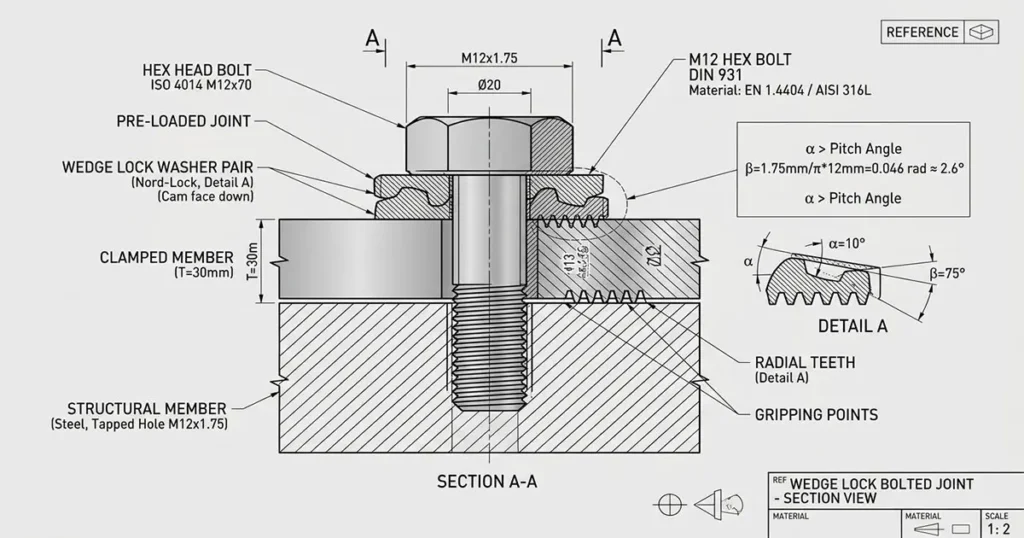
The 1986 standard was about securing elements, and securing is still part of the series: Part 4, “Securing of bolted joints”, 67 pages, current edition 2021-11. That continuity is the likely origin of the trade usage — the number that once described how to secure a bolted joint on a rail vehicle is the number that catalogue pages now print above a wedge-locking washer.
Part 4 is written around the joint. The 2021 revision added a normative annex containing a test procedure for demonstrating the loosening resistance of secured bolted joints, plus two informative annexes covering self-loosening and fatigue strength under transverse load, and verification for joints with rare high transverse loads. The part tells you what a secured joint has to demonstrate and how to test it. It is not a washer catalogue.
For a buyer, the consequence is practical. A size chart headed “DIN 25201” — WL3, WL4, WL5 and so on — is product data. The numbers that decide whether the part fits are the inside diameter, outside diameter, thickness of one washer and of the assembled pair, cam geometry, hardness and coating, and those have to come from the drawing or from product data agreed with the supplier. Wedge lock washers are one family among several locking and plain types; where a drawing names a different product standard, that standard governs the dimensions.
The same pattern turns up elsewhere: a DIN number attached to a product the standard does not actually specify. DIN 1624 is a withdrawn standard for cold-reduced steel strip that still appears in tee nut listings, which is why the edition and the subject of the cited document both need checking, not just the number.
The category is broad — plain, spring, tooth and wedge-locking designs solve different problems — so it is worth separating the locking function from the dimensional specification before an enquiry goes out. The washers range on this site is organised by type rather than by standard number.
Is there an ISO equivalent?
No. DIN 25201 is German national standardisation: the seven parts carry DIN numbers only, none has been published as an EN or ISO document, and ISO has not adopted the series. The ISO standards that appear inside it are fastener standards — ISO 898-1 and ISO 898-2 for the mechanical properties of steel screws and nuts — and they specify the fastener, not the design of a rail-vehicle joint.
The international movement has happened at European level instead. EN 17976:2024, “Railway applications – Bolting of rail vehicles and components”, was published in Germany as DIN EN 17976:2025-03. Its scope, as published by BSI, specifies “the requirements for designing, strength assessment, assembly and servicing of mechanical and electrical bolted joints made from metallic components and bolts”, and it “is applicable to all rail vehicles”.
So a request for “the ISO equivalent of DIN 25201” cannot be met with a standard number. The realistic routes are to work to EN 17976 where the project is European, to keep working to the applicable DIN part where the customer’s specification names it, or to convert the requirement into a project specification that states dimensions, material, coating and test evidence. That is the same discipline that applies whenever a legacy number is being replaced — the checks used for a DIN 3570 U-bolt replacement apply here too, whether the proposed successor is a genuine equivalent or only a similar document.
Getting an official copy
The parts are sold as PDFs by DIN Media and Beuth. German is the original language, and DIN Media lists the parts in German only, so there is no official English edition of DIN 25201; an English text is a translation and should be marked as one and kept under document control. EN 17976, by contrast, is published in an English version as well as the German one.
Copies offered on document-sharing sites carry a different risk. They may be the withdrawn 1986 edition or a superseded part, they come with no update service, and republishing them raises copyright problems. If a quotation or a quality plan cites DIN 25201, the edition cited should be the edition held.
When a drawing says DIN 25201: what to confirm
Work through these in order before an enquiry or an order goes out.
- Part and edition. “DIN 25201-4:2021-11” is a different requirement from “DIN 25201-4”, and “DIN 25201” alone is ambiguous. Ask which part and which year.
- Joint requirement or part requirement. Part 4 addresses the secured joint. If the drawing quotes it for a washer, ask which property of the joint the washer is meant to deliver.
- Dimensions. Inside and outside diameter, thickness of a single washer and of the pair, cam profile, and the seating area the joint can accept.
- Material and hardness. What the drawing specifies, and whether the supplier’s data sheet matches it rather than a generic catalogue page.
- Coating. Part 5 covers protection against corrosion for rail-vehicle bolted joints. The coating system, thickness class and any salt-spray requirement belong on the order, not in a footnote.
- Test evidence. If the claim is loosening resistance, ask which test, to which procedure, with what result. “DIN 25201 tested” on its own does not say anything verifiable.
- Installation. Part 7 (2004-06, with Corrigendum 1 of 2007-06) covers installation; EN 17976 also covers assembly and servicing.
- Project rules. Where the end customer is a European rail operator or builder, EN 17976 may be the governing document and the DIN parts supporting references only.
DIN 25201 answers a question about joints, not about washers. Reading it that way is what keeps a legitimate legacy reference on a drawing from turning into the wrong washer on a rail-vehicle joint.