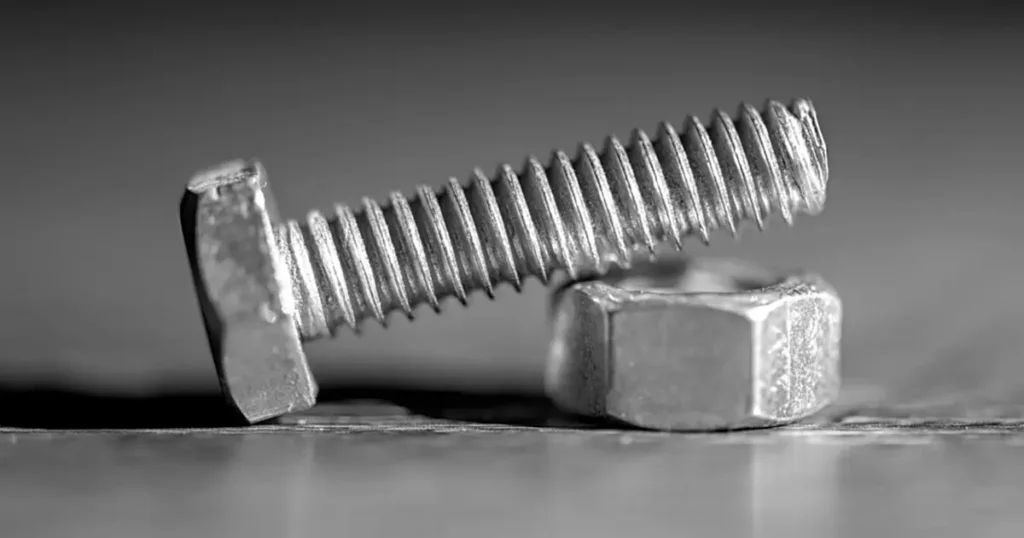
A DIN 933 bolt does not have a grade of its own. DIN 933 is a dimensional standard for a metric hexagon head bolt threaded up to the head. It fixes the shape of the part and leaves strength and material to other documents. The grade comes from ISO 898-1 when the bolt is carbon or alloy steel — property classes 4.8, 5.6, 8.8, 10.9 and 12.9 — or from ISO 3506-1 when it is stainless steel, where the designation combines a stainless steel grade with a property class, as in A2-70 or A4-80. A “DIN 933 grade 8.8” bolt is therefore two specifications stacked: DIN 933 geometry, plus an ISO 898-1 property class.
The standard number is not current either. DIN 933:1987-09 is withdrawn, and the product it describes is covered today by ISO 4017:2022, published in Germany as DIN EN ISO 4017:2022-10. That matters to the grade question directly, because ISO 4017 draws the boundary in its own scope: it specifies the characteristics of the screw and states that property classes and stainless steel grades can be selected from ISO 898-1 or ISO 3506-1. Neither the withdrawn DIN document nor the current ISO document defines a strength grade by itself.
The short version for anyone holding a drawing or a purchase order:
- Is there a DIN 933 grade? No. DIN 933 fixes the product form, the thread and the dimensions. Strength is a separate specification that has to be stated alongside it.
- Which grades get quoted against DIN 933? 8.8 is the usual stock class for steel. 10.9 and 12.9 are the higher alloy-steel classes, and 4.8 is still sold for light-duty work. Stainless is quoted as a stainless steel grade plus a property class: A2-70, A4-70, A4-80.
- Where do those numbers come from? ISO 898-1 for carbon and alloy steel, ISO 3506-1 for corrosion-resistant stainless steel.
- Is A2 a grade? A2 is a stainless steel grade, and on its own it says nothing about strength. “DIN 933 A2” is an incomplete specification; A2-70 is complete, and so is A4-80.
What the DIN 933 number actually fixes
DIN 933:1987-09 carried the title M 1,6 to M 52 hexagon head screws threaded up to the head; product grades A and B, and its record carries the status UNGÜLTIG — withdrawn. It was replaced through DIN EN 24017:1992-02 by the ISO 4017 line, and the current documents are ISO 4017:2022 and its German edition DIN EN ISO 4017:2022-10. The succession itself, and the four head sizes where the old and current dimension sheets disagree, is worked through in DIN 933 vs ISO 4017.
Read as a specification rather than a part number, the DIN 933 designation answers a narrow set of questions.
| Fixed by DIN 933 | Not fixed by DIN 933 |
|---|---|
| Product form: hexagon head, thread up to the head | Property class — 4.8, 8.8, 10.9, 12.9 |
| Metric coarse pitch thread | Chemical composition and heat treatment |
| Product grades A and B — a dimensional tolerance split | Stainless steel grade and property class — A2-70, A4-80 |
| Nominal diameter range M1,6 to M52 | Surface finish and coating |
| Head, thread and length dimensions | Marking, test certificates and inspection level |
The product grade is the term that causes the most confusion here. Grade A and grade B in this product family are tolerance grades, not strength grades: grade A covers threads up to M24 and nominal lengths up to 10d or 150 mm, whichever is shorter, and grade B covers everything above that limit. A DIN 933 grade B bolt is not stronger than a grade A bolt of the same property class. It is a larger or longer bolt held to a wider dimensional tolerance.
The withdrawn DIN document handled everything outside dimensions by cross-reference, which shows how the split was always intended. Its catalogue record lists DIN 13-1, -12 and -15 for the thread, DIN ISO 898-1 for mechanical properties, DIN ISO 4759-1 for tolerances, the DIN 267 parts for technical delivery conditions and DIN 962 for the designation system. Among those cross-references is DIN 267-11, the technical delivery conditions for corrosion-resistant stainless steel fasteners at the time. Stainless bolts are covered today by DIN EN ISO 3506-1:2020-08, the German edition of ISO 3506-1:2020.
Property class, product grade and material group
These three labels get used interchangeably in catalogues, and they mean different things. Keeping them apart removes much of the confusion around DIN 933 grades.
| Term | Example | What it controls |
|---|---|---|
| Product grade | A, B | Dimensional tolerance class of the finished product. Not a strength statement. |
| Property class (steel) | 8.8, 10.9, 12.9 | Tensile strength, yield or 0.2% proof strength, elongation, hardness, and the permitted material and heat treatment |
| Stainless steel grade | A2, A4 | Which stainless steel grade the bolt is made from |
| Stainless designation | A2-70, A4-80 | Stainless steel grade plus property class — the complete description of a stainless bolt |
This is where the popular shorthand breaks down. “DIN 933 A2” and “DIN 933 A4” give the stainless steel grade but not the property class, and two A4 bolts of the same size and length can be A4-50, A4-70 or A4-80, with minimum tensile strengths of 500, 700 and 800 MPa. A quotation or enquiry that says only “DIN 933 A2” or “DIN 933 A4” has not specified the strength at all.
On the steel side the same question has a different answer. The standard number does not answer it, and neither does the property class on its own: for carbon and alloy steel, the property class sets the applicable mechanical-property requirements and the permitted material and heat-treatment requirements, but it does not identify one specific steel grade. For stainless steel the two blocks stay separate — A2 or A4 identifies the stainless steel grade, and 50, 70 or 80 identifies the property class.
DIN 933 bolt grades in carbon and alloy steel
Property classes for metric bolts, screws and studs come from ISO 898-1:2013, the current edition. The standard specifies the mechanical and physical properties of carbon and alloy steel fasteners tested at an ambient temperature of 10 °C to 35 °C, and it notes that the values may not be retained at higher or lower temperatures. It applies to coarse pitch threads from M1,6 to M39 and fine pitch threads from M8×1 to M39×3.
| Property class | Rm nominal (MPa) | Rm minimum (MPa) | Yield or 0.2% proof strength, minimum (MPa) | Elongation after fracture, minimum | Core hardness (HV) |
|---|---|---|---|---|---|
| 4.8 | 400 | 420 | 340 (ReL) | 14% | 130–220 |
| 8.8, up to M16 | 800 | 800 | 640 (ReL) | 12% | 250–320 |
| 8.8, over M16 | 800 | 830 | 660 (ReL) | 12% | 255–335 |
| 10.9 | 1000 | 1040 | 940 (Rp0.2) | 9% | 320–380 |
| 12.9 | 1200 | 1220 | 1100 (Rp0.2) | 8% | 385–435 |
Values as specified in ISO 898-1 and reproduced in fastener technical references such as this ISO 898-1 mechanical properties table. Property classes 5.6, 5.8, 6.8 and 9.8 also exist in the standard, but they are not what a DIN 933 enquiry normally carries.
The two digits are a strength code, not a material code. In “8.8”, the first digit is one tenth of the nominal tensile strength in MPa and the second is the yield ratio: 800 MPa nominal tensile strength, multiplied by 0.8, gives 640 MPa nominal yield strength. The same reading gives 1000 × 0.9 = 900 MPa for 10.9 and 1200 × 0.9 = 1080 MPa for 12.9. The nominal figures exist to make the designation system work; the minimum figures in the table above are the levels a test certificate has to meet, which is why they sit slightly higher.
The classes differ in what material is permitted. For 8.8 and 10.9, ISO 898-1 accepts carbon steel with additives such as boron, manganese or chromium, quenched and tempered carbon steel, or quenched and tempered alloy steel. Class 12.9 is where the material question has to be settled before quoting: the alloy steel route requires one of the following alloying elements at or above the stated minimum — 0.30% chromium, 0.30% nickel, 0.20% molybdenum or 0.10% vanadium — or at least 70% of the combined minima where two or more are present. The quenched and tempered classes must also have enough hardenability for the core of the threaded section to be approximately 90% martensite immediately after quenching.
The diameter range is worth checking on large sizes. ISO 898-1 covers coarse threads up to M39. DIN 933 runs from M1,6 to M52, so the largest DIN 933 sizes sit outside the diameter range of the property-class standard. The designation system can still be applied there provided all of the chemical and mechanical requirements are met, but on a large-diameter enquiry it is better to state that explicitly than to leave it to be assumed.
Marking is part of the specification. The property class and the manufacturer’s identification mark are what identify a delivered bolt, they are normally struck on the head, and they are the first thing to check when a delivered lot is questioned.
DIN 933 stainless grades: A2, A4 and property classes 50, 70 and 80
Stainless bolts are specified under ISO 3506-1:2020, which sets mechanical and physical properties for corrosion-resistant stainless steel bolts, screws and studs with coarse pitch threads M1,6 to M39 and fine pitch threads M8×1 to M39×3, and specifies property classes against austenitic, martensitic, ferritic and duplex steel grades.
The two austenitic stainless steel grades that matter for DIN 933 hex bolts are A2 and A4. A2 is the chromium-nickel grade commonly described as 304-type, used indoors and in mildly corrosive service. A4 is the chromium-nickel-molybdenum grade commonly described as 316-type, and the molybdenum addition is what makes it the choice in chloride-bearing conditions — coastal and marine exposure, many process and chemical duties, and wash-down areas. The standard also lists the A1, A3 and A5 austenitic grades, the C1, C3 and C4 martensitic grades, F1 ferritic and the duplex grades, but they are far less common as stock hex bolts.
The strength of a stainless bolt is expressed as a two-digit property class appended to the stainless steel grade.
| Designation | Property class | Thread diameter range | Rm minimum | Rp0.2 minimum | Elongation after fracture, minimum |
|---|---|---|---|---|---|
| A2-50, A4-50 | 50 | up to M39 | 500 MPa | 210 MPa | 0.6d |
| A2-70, A4-70 | 70 | up to M24 | 700 MPa | 450 MPa | 0.4d |
| A2-80, A4-80 | 80 | up to M24 | 800 MPa | 600 MPa | 0.3d |
Values as specified in ISO 3506-1 for austenitic grades A1 to A5, in the same form as this stainless steel bolt grades chart. The number after the hyphen is one tenth of the minimum tensile strength: 70 means 700 MPa, 80 means 800 MPa.
Two consequences of that table matter commercially.
A2 and A4 are stainless steel grades, not property classes. They sit within the austenitic stainless steel group, and the number after the hyphen is the property class. “DIN 933 A2” and “DIN 933 A4” are incomplete specifications; “DIN 933 A2-70” and “DIN 933 A4-80” are complete ones. Austenitic stainless takes its strength from cold working rather than heat treatment, and the standard applies property classes 70 and 80 only up to M24 — so an A4-80 quotation for a large diameter is worth questioning rather than accepting.
Stainless is not a strength substitute for 8.8. A4-80 carries the same 800 MPa figure as property class 8.8, but the number that governs a preloaded joint is proof strength: A4-80’s minimum 0.2% proof strength is 600 MPa, A2-70’s is 450 MPa, and property class 8.8 has a minimum yield strength of 640 MPa up to M16. If a joint was designed around 8.8 bolts, moving to A2-70 or A4-80 reduces the stress at which the bolt begins to yield and changes how much preload the assembly can hold. Specify stainless because the service environment requires it, and then check the joint against the class that has been chosen. Austenitic stainless is also more prone to galling during tightening than a plated steel bolt, so lubricated or coated product is common on assembly lines.
What a DIN 933 grade number does not mean
A few readings of the grade number come up often enough to be worth ruling out.
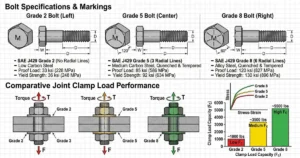
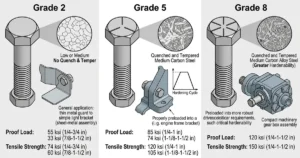
- 8.8 is not “Grade 8”. SAE J429 Grade 5 and Grade 8 belong to a different system, with its own strength levels, head marking and test requirements. The designations are not interchangeable with ISO property classes, and “Grade 8.8” is not a designation that exists in either system.
- The class is not a steel grade. “8.8” does not mean 8.8 mm, does not mean HRC 8.8, and does not name a steel such as 35CrMo or 40Cr. Mill-specific steel designations describe what a particular producer used; the property class describes what the finished bolt has to do. More than one steel can meet 10.9, and the class — not the steel name — is what belongs on the purchase order.
- The class does not fix the finish, the thread tolerance or the documentation. Plain, zinc plated, hot dip galvanised and zinc flake are separate selections, the usual external thread tolerance is 6g unless something else is stated, and the inspection and certification level is agreed separately.
- A product grade is not a property class. Grade A and grade B are tolerance grades, and a “DIN 933 grade B” callout says nothing about strength.
- Other grade systems work differently. ASTM A193 grades such as B7 and B7M are specified for high-temperature and pressure-boundary service, and the difference between A193 B7 and B7M is a reminder that a grade letter or number always carries its own standard behind it rather than a universal strength meaning.
Coating, and where the grade changes what is permitted
The finish is not a free choice once the class is fixed. Hydrogen embrittlement is a recognised risk in high-strength fasteners, and ISO 4042:2022 covers electroplated coating systems on fasteners and specifies the requirements and recommendations that minimise that risk. For fasteners conforming to ISO 898-1 the measures required are set by property class in Clause 4.4 and Table 3, not by a single hardness threshold: below property class 10.9, no supplemental process verification or product testing with regard to hydrogen embrittlement is required, and no baking is necessary; for class 10.9 the standard permits either supplemental process verification and/or product testing with regard to hydrogen embrittlement, or baking; and for class 12.9 it requires supplemental process verification and/or product testing with regard to hydrogen embrittlement together with baking, subject to the provisions and exceptions the standard sets out. ISO 4042:2022 also gives hardness-based guidance as a general indication, in which 360 HV and 390 HV are the relevant boundaries. Controlling the heat treatment and the plating process is what keeps the risk down, and even then complete elimination cannot be guaranteed — service conditions such as corrosion contribute as well.
Hot dip galvanising is treated as a separate case rather than another finish option. ISO 898-1 notes that additional material requirements apply to fasteners that are to be hot dip galvanised and refers to ISO 10684. The finish also changes friction, and therefore the tightening torque that produces a given preload — so the property class and the coating belong in the same conversation, not in two separate columns on an enquiry.
Specifying a DIN 933 bolt grade
- State the product form and the governing document. A fully threaded hexagon head screw to ISO 4017 is the current description; “DIN 933 form” is acceptable where the drawing is historical.
- State the thread size and length — for example M16 × 60.
- State the property class, or the complete stainless designation. 8.8, 10.9 or 12.9 on the steel side; A2-70, A4-70 or A4-80 on the stainless side. Not “A2” or “A4” on their own.
- State the finish — plain, zinc plated, hot dip galvanised, zinc flake or black oxide.
- State the thread tolerance class where the application needs something other than the usual 6g.
- State the marking and documentation requirements — property class and manufacturer identification on the head, a test certificate with heat traceability, third-party inspection or a particular packaging specification.
- Flag any size outside the property-class diameter range. Above M39, name the class and confirm that the chemical and mechanical requirements are met.
A complete callout therefore carries more than the standard number:
Hexagon head screw ISO 4017 — M16 × 60 — property class 10.9 — hot dip galvanised
For stainless, the same callout reads Hexagon head screw ISO 4017 — M16 × 60 — A4-80 — plain.
Conclusion
DIN 933 answers a shape question, not a grade question. The standard that carries the name is withdrawn, its content survives in commercial usage as a description of a fully threaded metric hexagon head bolt, and the strength and material of the bolt come from ISO 898-1 for carbon and alloy steel or ISO 3506-1 for stainless steel. The classes most often quoted with DIN 933 are 8.8, 10.9 and 12.9 on the steel side and A2-70, A4-70 and A4-80 on the stainless side; 4.8 and the class 50 stainless designations cover lighter duties.
Two points are worth carrying away. The class is the specification: 8.8 is 800 MPa nominal tensile strength with a 0.8 yield ratio, giving 640 MPa nominal yield strength, and the minimum values a test certificate has to show sit slightly above the nominal ones. And a stainless steel grade is not a property class: A2 and A4 say what the bolt is made of, while A2-70 and A4-80 say what it is made of and how strong it is — and stainless at class 70 or 80 is still not strength-for-strength equivalent to property class 8.8 at the proof strength that governs a preloaded joint.
ChinaBolts supplies metric hex bolts in both fully threaded and partially threaded configurations, including DIN 933 hex head bolts fully threaded in classes 4.8, 8.8, 10.9, 12.9, A2-70 and A4-80. Send the size, length, property class or complete stainless designation, finish and documentation requirements, and request a quote.