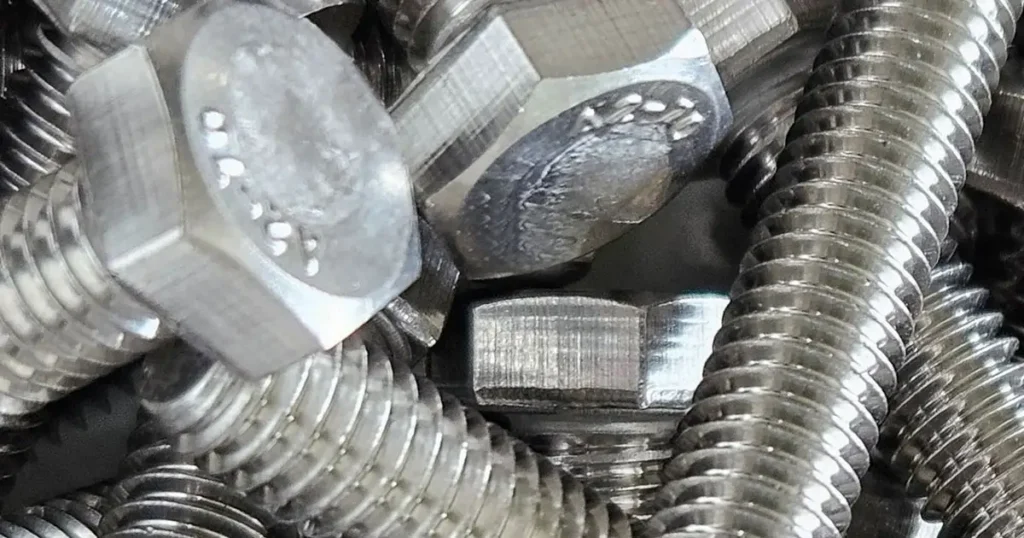
DIN 933 and ISO 4017 are not the same standard, and they are not universally interchangeable. DIN 933 is a withdrawn German standard for a metric hexagon head screw threaded up to the head. ISO 4017 is the current international standard for that product, published in its sixth edition in June 2022. The two describe the same part, but DIN 933 and ISO 4017 differ at four thread diameters — M10, M12, M14 and M22 — in the width across flats, and that difference was not first introduced by ISO 4017:2022, so a nominal swap from a DIN 933 callout to an ISO 4017 callout is not automatically a dimension-for-dimension swap.
The short version for anyone holding a drawing or a purchase order:
- Are ISO 4017 and DIN 933 the same? No. They are corresponding documents in the same product family. DIN 933 is withdrawn; ISO 4017 is current. The product form is the same, the diameter range is not, and four head diameters differ.
- Can one be substituted for the other? Usually, but the head dimensions at M10, M12, M14 and M22 have to be checked first, because the wrench size changes.
- Is “DIN 933” still a valid thing to buy? Yes, as a commercial description. A very large share of stock still made to the old German dimension sheet is sold under that name. It is not a current standard.
What each standard actually is
The DIN document is DIN 933:1987-09, M 1,6 to M 52 hexagon head screws threaded up to the head; product grades A and B. Its record carries the status UNGÜLTIG — withdrawn — and it is the last edition of that document. There was no later DIN 933. The edition before it, DIN 933(1983.12), had itself been replaced by the 1987 edition.
What replaced it is recorded plainly in the standard’s own catalogue entry: DIN 933-1987 was replaced by DIN EN 24017(1992.02) — the German edition of EN 24017, the European adoption of ISO 4017. That is the beginning of the chain, not the end of it. The European and international documents were aligned afterwards, so the line runs:
- DIN 933:1983-12 — earlier German edition, replaced by the 1987 edition.
- DIN 933:1987-09 — the edition most drawings and catalogue pages still cite. M1,6 to M52, product grades A and B. Withdrawn.
- DIN EN 24017:1992-02 — the European adoption of ISO 4017 published in Germany, and the document recorded as the replacement for DIN 933:1987-09.
- EN ISO 4017 editions of 2001 and 2011 — the aligned EN ISO editions that followed; both are now withdrawn.
- ISO 4017:2022 — current. Published 28 June 2022 as edition 6, revising ISO 4017:2014. The current German edition is DIN EN ISO 4017:2022-10.
This is the first place the “DIN 933 latest edition” question goes wrong. There is no newer DIN 933. The latest edition of the standard that governs this product is ISO 4017:2022.
| Attribute | DIN 933:1987-09 | ISO 4017:2022 |
|---|---|---|
| Product | Hexagon head screw, thread up to the head | Hexagon head screw, thread up to the head |
| Thread | Metric coarse pitch | Metric coarse pitch |
| Nominal diameter range | M1,6 to M52 | M1,6 to M64 |
| Product grades | A and B | A and B |
| Status | Withdrawn (UNGÜLTIG) | Current, edition 6 |
| Current German edition | — | DIN EN ISO 4017:2022-10 |
So the DIN 933 ISO equivalent is ISO 4017, sold in Germany as DIN EN ISO 4017 — and that is the designation to order against today. “DIN 933, similar to ISO 4017” remains a common catalogue line because the trade name outlived the standard, not because both documents are in force.
The part is the same; the range is not
Both documents describe one product form: a hexagon head with a metric coarse pitch thread running up to the head, with no designed plain shank of the kind the partially threaded DIN 931 / ISO 4014 family has. Both use the same product-grade split — grade A for threads up to M24 and lengths up to 10d or 150 mm, whichever is shorter, grade B beyond that — and both are geometric standards that leave material and performance to other documents.
The range is where the two part company at the top end. DIN 933 stops at M52. ISO 4017:2022 covers M1,6 to M64. A size above M52 cannot be quoted against a DIN 933 table at all, because there is no DIN 933 row for it — a point worth checking on any large-diameter enquiry that still cites the DIN number.
For a full dimensional reference rather than a summary, the standard’s own table is the thing to work from; published dimension sheets such as this ISO 4017 dimension table are convenient working copies for day-to-day quoting, but a substitution that changes a drawing should be checked against the standard, not against a reproduced table. That matters for the “DIN 933 ISO 4017 PDF” search as well: the documents are bought, not free. ISO 4017:2022 is sold through ISO and its national member bodies and runs to 11 pages, and the German edition DIN EN ISO 4017:2022-10 is sold by DIN Media. The free tables circulating online are third-party reproductions, and the four sizes below are exactly where they are most likely to be wrong.
The real difference: four head diameters
Most head dimensions carried across from DIN 933 to ISO 4017 unchanged. Four did not. Published cross-reference tables, including this DIN 933 / ISO 4017 data sheet, identify M10, M12, M14 and M22 as the diameters where the width across flats — the spanner size — differs.
| Thread | DIN 933 width across flats | ISO 4017 width across flats | Effect of the change |
|---|---|---|---|
| M10 | 17 mm | 16 mm | ISO head 1 mm smaller |
| M12 | 19 mm | 18 mm | ISO head 1 mm smaller |
| M14 | 22 mm | 21 mm | ISO head 1 mm smaller |
| M22 | 32 mm | 34 mm | ISO head 2 mm larger |
Two things about that table need stating, because they are what the one-line answers on this subject leave out.
The change is not uniform in direction. At M10, M12 and M14 the ISO head is smaller than the DIN head — by 1 mm at each of those three sizes — while at M22 it moves the other way and is 2 mm larger. A substitution therefore has a different consequence depending on which size is involved.
The head height does not change. The published values for head height k at these four diameters are the same on both sides — 6,4 mm at M10, 7,5 mm at M12, 8,8 mm at M14 and 14 mm at M22. The substitution does not alter the height of the assembled joint; it alters which tool fits the head and how much material and clearance sits around it.
On M14 specifically: DIN 933 gives a width across flats of 22 mm and ISO 4017 gives 21 mm, so the ISO head is 1 mm smaller at this size. If a drawing depends on it, read the value off the standard the order is being placed against.
Why this is a purchasing problem and not a terminology one
A 16 mm head and a 17 mm head are not interchangeable at the point of assembly, and one of them may have been there for a long time.
- Wrench and socket sizes. At M10, M12 and M14 the ISO head takes the next size down. Tool kits, torque wrench settings sheets, socket trays and assembly-line fixture clearances built around the DIN head do not fit the same bolt under the new designation.
- Recess and wall clearances. A smaller head means less bearing area under the head, more spanner swing needed relative to the head, and a different relationship to a spot face, counterbore, flange or adjacent wall. Where the DIN head was already tight in a recess, the smaller ISO head may be the fix — and at M22, where the ISO head is larger, it is the opposite risk.
- Washers and nuts. The ISO 4017 head follows the ISO 4032 nut width schedule — 16 mm at M10, 18 mm at M12, 21 mm at M14, 34 mm at M22 — so an ISO bolt pairs with the washer and nut bores of the current framework. The DIN head widths sit on a different schedule at exactly those four sizes. Mixing the two in one joint is where assembly mistakes come from.
- Legacy drawings and tooling. A drawing that says “DIN 933 M10” and a fixture built to it describe a 17 mm hexagon. If the order is fulfilled to ISO 4017 without anyone re-checking the head, the drawing and the delivered part no longer agree — even though the thread, the length and the material are exactly as specified.
None of this argues against switching to ISO 4017. It argues against treating the switch as a paperwork change. The thread does not obstruct substitution: an M10 × 1,5 internal thread takes either bolt. The head is what has to be confirmed.
What the dimensional standard leaves open
Both documents are primarily dimensional. Neither one reaches beyond the part itself, and both say so themselves: ISO 4017:2022 specifies the product’s characteristics and then carries marking, labelling and designation requirements and handles the subjects that sit outside dimensions by reference to other standards. Its scope selects property classes and stainless steel grades from ISO 898-1 or ISO 3506-1, and dimensional options from ISO 888 or ISO 4753; thread tolerances are governed by ISO 965-1, and coatings by ISO 4042 for electroplated finishes, ISO 10683 for zinc flake and ISO 10684 for hot dip galvanising.
The withdrawn DIN 933:1987-09 worked the same way by cross-reference — its catalogue entry lists DIN 13-1/-12/-15 for the thread, DIN ISO 898-1 for mechanical properties, DIN ISO 4759-1 for tolerances, DIN 267-1 and its parts for technical delivery conditions, and DIN 962 for the designation system.
So the standard number on its own does not settle the whole specification. A callout of “DIN 933 M12 × 40” or “ISO 4017 M12 × 40” identifies the product and the geometry, and leaves the following to be stated separately on the order:
- Property class. 4.8, 5.6, 8.8, 10.9 and 12.9 bolts share the same ISO 4017 geometry and behave very differently. Carbon and alloy steel classes come from ISO 898-1.
- Material or stainless grade. Stainless is specified by complete ISO 3506-1 designations such as A2-70, A4-70 and A4-80. The group name on its own — A2, A4 — does not express the property class.
- Finish. Plain, zinc plated, hot dip galvanised and zinc flake are separate selections. Hot dip galvanising adds coating thickness that has to be allowed for in the thread tolerance, and the finish changes friction and tightening torque as well as corrosion life.
- Thread tolerance class, where the application needs something other than the usual 6g external thread.
- Marking and documentation — property class and producer identification on the head, a mill certificate with heat traceability, third-party inspection or specified packaging, where the application calls for them.
A complete callout therefore looks more like this:
Hexagon head screw ISO 4017 — M12 × 40 — property class 8.8 — hot dip galvanised
How to substitute DIN 933 vs ISO 4017 safely
- Find out which document the order is actually being made to. If it says DIN 933, it is a withdrawn designation being used as a shape reference. Confirm that ISO 4017 — normally DIN EN ISO 4017, 2022 edition — is the governing standard, and put that on the paperwork.
- Check the width across flats if the size is M10, M12, M14 or M22. At M10, M12 and M14 the ISO head is smaller; at M22 it is larger. State the width across flats explicitly on the purchase order for these sizes instead of relying on the designation to carry it.
- Check the tooling and the recess before the first delivery, not after. Socket sizes, torque sheets, fixture clearance and bearing-area requirements are where a 1 mm head change becomes a line stoppage.
- Check anything above M52. There is no DIN 933 dimension for it. Those sizes exist only in the ISO framework.
- Keep the head height question separate. It is unchanged at the four affected diameters, so if the assembled height is the constraint, the substitution is neutral on that point.
- Write the full specification, not just the standard number. Size, length, property class or stainless grade, finish, thread tolerance and documentation. Neither DIN 933 nor ISO 4017 supplies any of them.
- Record the substitution. Note on the drawing or the item master which standard and edition the part is now bought to, so the next enquiry does not reopen the question.
Conclusion
DIN 933 and ISO 4017 are corresponding documents for the same product — a metric hexagon head screw threaded up to the head — and they are not the same standard. DIN 933:1987-09 is withdrawn and was replaced through DIN EN 24017:1992-02 by the ISO 4017 line; the current documents are ISO 4017:2022 and its German edition DIN EN ISO 4017:2022-10. The product form and the product-grade structure carried across. The diameter range did not, because DIN 933 ends at M52 and ISO 4017 runs to M64. And the head did not, at four diameters: M10, M12 and M14 have a smaller width across flats in ISO 4017 than in the DIN 933 table, M22 has a larger one, and head height is unchanged at all four.
That is the whole practical answer. Substituting one designation for the other is normally a reasonable move, and it is not a drop-in one: the four head diameters, the tooling and clearance around them, and the property class, material and finish that neither document defines all have to be stated and checked. Treat “DIN 933” as a description of a shape and “ISO 4017” as the standard the shape is now bought to.
ChinaBolts supplies metric hex bolts in both fully threaded and partially threaded configurations, including DIN 933 hex head bolts fully threaded, to either the DIN dimension sheet or the current ISO 4017 head dimensions, in carbon, alloy and stainless steel. Metric hex bolts are available across the standard range and above it. Send the size, length, property class or stainless grade, finish and the width across flats where it matters, and request a quote.