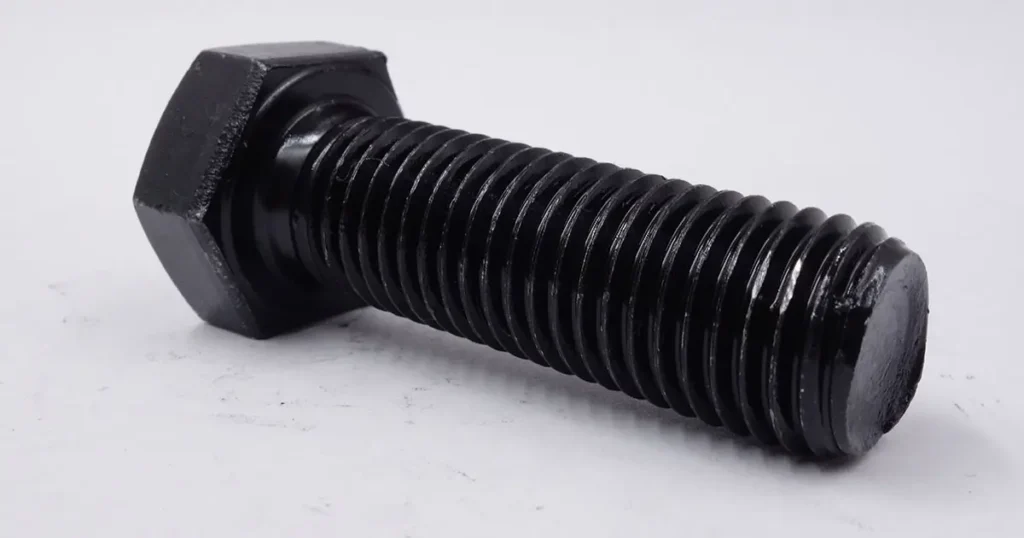
DIN 933 is the German standard designation for a metric hexagon head bolt that is threaded up to the head — a hexagon head and a metric coarse thread running the full length of the shank, with no plain unthreaded section under the head. That is the whole of the DIN 933 meaning: it describes the shape of the part, not its strength grade, material or coating.
Its status is the part most short explanations leave out. DIN 933 is no longer a current German standard. DIN 933:1987-09 has been withdrawn, and the product it described is now covered by DIN EN ISO 4017, Fasteners — Hexagon head screws — Product grades A and B. The current German edition of that standard is DIN EN ISO 4017:2022-10.
The trade term itself has not gone anywhere. Suppliers in Europe and Asia still list, quote and ship “DIN 933” bolts, often with the note “similar to ISO 4017”, and off-the-shelf stock is still commonly produced to the older German dimension sheet. So when a drawing, purchase order or stock list says DIN 933, it is telling you what the part looks like — and leaving you to confirm which standard actually governs it and what else has to be specified.
What DIN 933 designates
DIN 933:1987-09 carried the German title Sechskantschrauben mit Gewinde bis Kopf; Gewinde M 1,6 bis M 52; Produktklassen A und B — “hexagon head screws with thread up to the head; threads M1.6 to M52; product grades A and B”, as recorded in the standard’s own catalogue record.
| What the designation fixes | DIN 933 |
|---|---|
| Product | Hexagon head screw — a hexagon head with a threaded shank |
| Thread | Metric coarse pitch |
| Threading | Full — the thread runs up to the head |
| Product grades | A and B |
| Diameter range in DIN 933 | M1.6 to M52 |
| Status | Withdrawn |
| Current standard for the product | DIN EN ISO 4017 (ISO 4017) |
Read as a designation rather than a part number, the DIN 933 meaning has three commercially useful parts.
- “Gewinde bis Kopf” — thread up to the head is the defining feature. It separates DIN 933 from DIN 931, the partially threaded bolt, and it is the reason the two designations exist separately.
- “Product grades A and B” is a tolerance split, not a strength class. Grade A covers the smaller diameters and the shorter lengths, grade B the rest. Grade A/B is defined on the same basis as the other ISO hex products: grade A for threads up to M24 and lengths up to 10d or 150 mm, whichever is shorter, and grade B beyond that.
- “M1.6 to M52” is where the old table stops. The current ISO document runs from M1.6 to M64, so a size above M52 cannot be quoted against a DIN 933 table at all.
One terminology note, because it causes confusion in translation. German Schraube covers both what English calls a screw and what it calls a bolt, and ISO 4017 uses “screws” in its title while the partially threaded ISO 4014 uses “bolts”. British and Commonwealth catalogues often sell the same part as a “hex head set screw”, and US-influenced catalogues as a “hex cap screw”. DIN 933, ISO 4017, “fully threaded hex bolt” and “fully threaded hexagon head screw” all point at the same part; the wording is not a specification difference.
Is DIN 933 fully threaded?
Yes, in the sense that decides how the bolt is used: the thread runs up to the head. The standard fixes a hexagon head, a shank and a thread that extends to the underside of the head, and it gives no plain shank dimension of the kind the DIN 931 table contains.
It is not literally threaded over every millimetre. The DIN 933 table allows a short transition next to the head where the thread is not full — capped at 4.5 mm at M10 and 5.25 mm at M12 in the published DIN 933 dimension sheet. “Fully threaded” therefore means there is no designed plain section under the head, not that a thread gauge will run the entire length.
| Feature | DIN 933 (ISO 4017) | DIN 931 (ISO 4014) |
|---|---|---|
| Threading | Thread up to the head | Plain shank under the head, thread at the tip |
| Thread length | Shank length less a short transition at the head | Fixed by the standard: 2d + 6 mm up to 125 mm, 2d + 12 mm up to 200 mm, 2d + 25 mm above that |
| Where the thread sits | Throughout the grip length | Only toward the threaded end of the joint |
| Typical use | Tapped holes, varying grip lengths, adjustable engagement | Joints loaded in shear, fatigue-sensitive joints, bearing on plain shank |
The consequence is positional rather than a difference in class strength. At the same nominal diameter, pitch, material and property class, a fully threaded and a partially threaded bolt carry the same thread and the same threaded cross-section, and therefore the same tensile capacity when the joint is loaded in axial tension. What changes is where the thread sits inside the joint. A fully threaded DIN 933 puts thread through the whole bearing length, which is what you want in a tapped hole or where the grip length varies — but it also puts thread in the shear plane and under the bearing face, and under shear, bearing or fatigue loading that position still affects how the connection performs. Partial thread versus full thread is a joint decision, not a preference, and substituting one for the other changes the assembly.
The thread: metric coarse pitch, and the tolerance that goes with it
DIN 933 is written around the ISO metric coarse pitch thread. In the German framework the thread dimensions come from the DIN 13 series — the 1987 DIN 933 record cross-refers to DIN 13-1, DIN 13-12 and DIN 13-15 — so an M12 DIN 933 bolt is M12 × 1.75 unless a special pitch is stated.
Plain-finish product is normally made with an external thread to tolerance class 6g, the ordinary commercial tolerance for a metric coarse external thread. Fine pitch is a different product: the fine pitch hexagon head bolts sit under separate standards such as DIN 960 and DIN 961, and they do not carry the DIN 933 designation.
What DIN 933 does not tell you
This is the part that costs money when it is missed. A standard that fixes only geometry does not fix performance, and DIN 933 does not even attempt to. Its own record shows it working by reference: DIN 933:1987-09 cross-refers to DIN 13 for the thread, DIN ISO 898-1 for mechanical properties, DIN ISO 4759-1 for tolerances, DIN 267 for technical delivery conditions and DIN 962 for the designation system. Everything except the shape is delegated.
An enquiry or a product page that says only “DIN 933 M12 × 40” therefore leaves all of the following open.
- Property class. 4.8, 5.6, 8.8, 10.9 and 12.9 bolts share the same DIN 933 geometry and behave very differently. Steel property classes come from ISO 898-1.
- Material and stainless grade. A2 (304-type) and A4 (316-type) stainless bolts are covered by ISO 3506-1, with complete designations such as A2-70, A4-70 and A4-80. The group name alone does not express the property class.
- Coating. Plain, zinc plated, hot dip galvanised and zinc flake finishes are selected separately, and they affect friction and tightening torque as well as corrosion life. Hot dip galvanising adds coating thickness and has to be allowed for in the thread tolerance.
- Thread tolerance class, where the application needs something other than the usual 6g.
- Marking and documentation. Property class and producer identification on the head, a mill certificate with heat traceability, third-party inspection, or particular packaging.
A complete callout therefore carries more than the standard number:
Hexagon head screw DIN 933 — M12 × 40 — property class 8.8 — hot dip galvanised
or, in the current equivalent, ISO 4017 — M12 × 40 — 8.8 — hot dip galvanised.
DIN 933, ISO 4017, and what replaced what
DIN 933 did not pass straight to the ISO document. The chain runs like this.
- DIN 933:1983-12 — the earlier German edition, replaced by the 1987 edition.
- DIN 933:1987-09 — the edition most drawings and catalogue pages still refer to: threads M1.6 to M52, product grades A and B. Now withdrawn.
- DIN EN 24017:1992-02 — the European adoption of ISO 4017 published in Germany as Hexagon head screws — Product grades A and B. This is the document recorded as the replacement for DIN 933:1987-09.
- DIN EN ISO 4017:2001-03 and the 2011 edition — the EN ISO editions that followed, after European and international fastener standards were aligned. Both are now withdrawn.
- DIN EN ISO 4017:2022-10 — the current German edition of ISO 4017:2022, published on 28 June 2022 as edition 6 and revising ISO 4017:2014.
ISO 4017:2022 covers hexagon head screws in steel and stainless steel with metric coarse pitch threads from M1.6 to M64 in product grades A and B, and points to ISO 898-1 or ISO 3506-1 for property classes and stainless steel grades and to ISO 888 or ISO 4753 for dimensional options. Two changes matter at quotation stage, even though the detailed comparison belongs in a DIN-versus-ISO article.
- The range moved. DIN 933 stops at M52; ISO 4017 runs from M1.6 to M64. Anything above M52 has to be quoted against the current standard, not against a DIN 933 table.
- The head changed at a few diameters. Most head dimensions agree between the two tables, but not all. M10 is the clearest example: the DIN 933 table gives 17 mm across flats, ISO 4017 gives 16 mm. Published comparisons flag M10, M12, M14 and M22 as the sizes to check before treating the two names as interchangeable, and DIN 931 vs ISO 4014 works through the same DIN-to-ISO head pattern in detail.
How to use “DIN 933” correctly when buying
- Treat DIN 933 as a shape reference, not a governing standard. When a drawing, quotation or stock list uses it, confirm which standard and edition the order is being made to — normally ISO 4017, adopted in Germany as DIN EN ISO 4017.
- Confirm the head width where the two tables can differ. State the width across flats for the sizes in play rather than assuming that “DIN 933” and “ISO 4017” describe the same hexagon.
- State the property class, the material or stainless grade, and the coating. None of them come from DIN 933. Where strength matters, the property class is the specification.
- Say whether the thread has to run to the head. If the assembly needs plain shank in the bearing length or the shear plane, that is DIN 931 / ISO 4014 territory, and ordering a fully threaded bolt instead changes the joint.
- Allow for the head-end transition. The thread does not begin exactly at the bearing face; the permitted transition is a few millimetres on small sizes and grows with diameter. If the joint relies on thread running right up to the head, say so.
- Ask for the marking and documentation you need — property class and producer identification on the head, and a mill certificate with heat traceability where the application requires it.
Conclusion
So the DIN 933 meaning in one line: a metric hexagon head bolt threaded up to the head, in product grades A and B over a nominal range of M1.6 to M52, made with a metric coarse pitch thread. It is the German national standard that sat alongside ISO 4017 with national modifications, and it has been withdrawn; the product is covered today by DIN EN ISO 4017, in its 2022 edition.
What the name still gives you is a clear picture of the part: full thread rather than partial thread, no plain shank under the head, a hexagon head, a coarse metric thread, and a short head-end transition that the standard permits. What it does not give you is a complete specification. Property class, material, stainless grade, coating, thread tolerance and documentation all come from other standards — which is why an order that says only “DIN 933” is a starting point rather than a specification.
ChinaBolts supplies metric hex bolts in both fully threaded and partially threaded configurations, including DIN 933 hex head bolts fully threaded and DIN 931 hex bolts with a partially threaded shank, in carbon, alloy and stainless steel. Send the size, length, property class, material and finish, and request a quote.