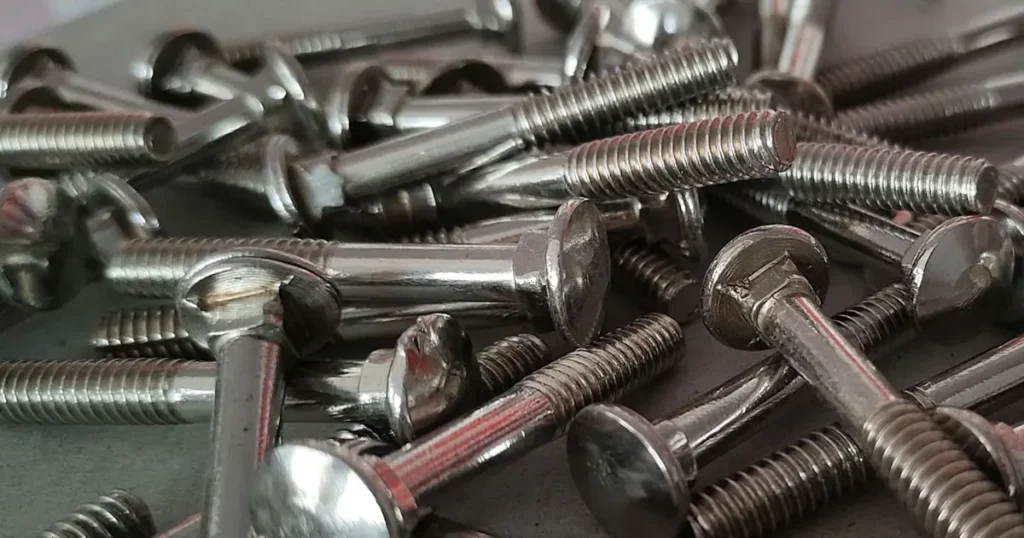
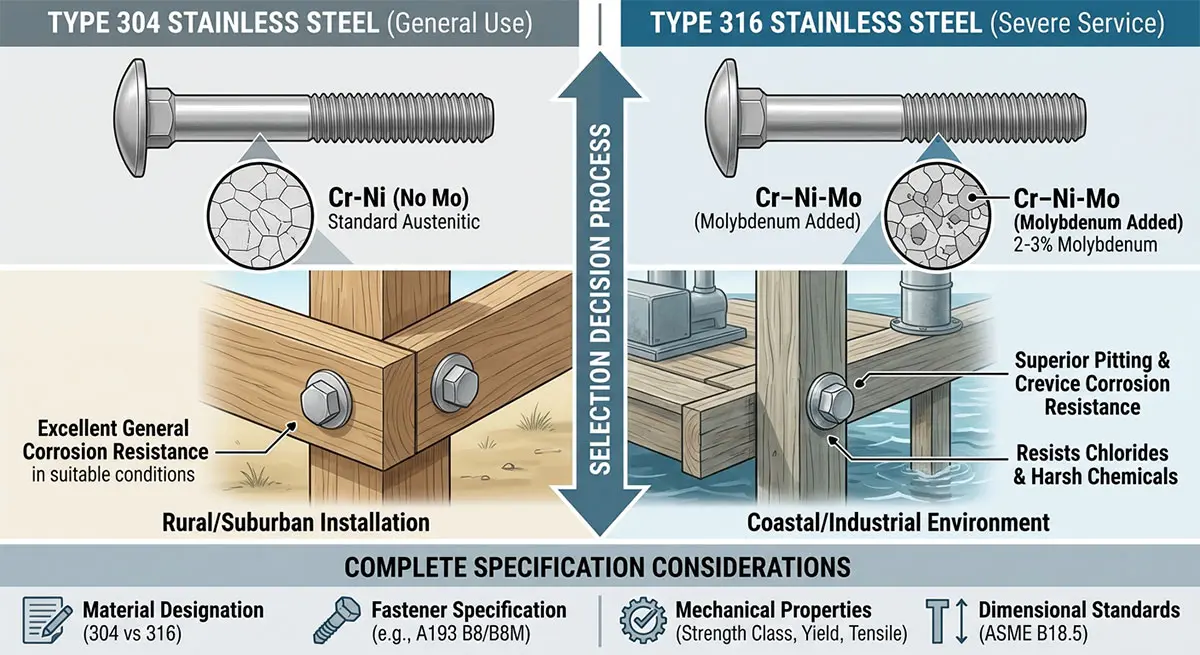
Choosing between 304 and 316 for a stainless steel carriage bolt is a question about exposure, not about which grade is better. 304 covers dry indoor service, ordinary outdoor weathering away from the coast, and most general fabrication. 316 is the grade for chloride-bearing service — salt air, de-icing salts, process chemicals, wash-down with chlorinated water — where 304 begins to pit.
The grade is only one part of the order. A carriage bolt also needs a dimensional standard that fixes its head and square neck, and a material specification that fixes the steel and its mechanical condition. “316 carriage bolt” leaves two of those three open, and an order that leaves them open is not yet a specification.
304 and 316 Side by Side
Both grades are austenitic stainless steels. Visually they are indistinguishable, and a magnet will not separate them reliably. The difference is in the composition, and it only appears in service.
| Point of comparison | 304 | 316 |
|---|---|---|
| Chromium and nickel | About 18% chromium and 8% nickel — the origin of the 18-8 trade name | A little less chromium, more nickel, plus molybdenum |
| Molybdenum | None specified | About 2.0–2.5% in the common grade |
| Calculated PREN (EN equivalents) | 17.5–20.8 | 23.1–28.5 |
| Chloride-bearing water | Pits at lower chloride levels and lower temperatures | Higher threshold, but still attacked in stagnant or warm chlorides |
| Seawater | Not suitable for seawater service | Limited resistance; not corrosion proof, and not for stagnant or heated seawater |
| ISO 3506-1 grade | A2 | A4 |
| Typical service | Indoor, inland atmospheric, general fabrication, dry process areas | Coastal and marine atmosphere, de-icing salt, chemical and process plant, wash-down areas |
| Relative material cost | Lower | Higher, because of the nickel and molybdenum content |
The PREN figures are calculated ranges published by the British Stainless Steel Association for the EN equivalents of these grades (1.4301 for 304, 1.4401 and 1.4404 for 316). They rank the two families. They do not tell you whether either grade will survive a specific joint.
What the Molybdenum Is Doing
The 316 difference is molybdenum: roughly 2.0–2.5% in the common grade, and approaching 3% in the higher-molybdenum low-carbon variants. Molybdenum is what raises resistance to pitting and crevice corrosion in chloride-bearing water. Chromium, nickel, molybdenum and nitrogen all contribute, and the conventional way to rank the combined effect is the pitting resistance equivalent number, PREN = Cr + 3.3Mo + 16N.
The number matters because of the way stainless steel fails. It does not rust evenly the way a painted steel component does. The passive film breaks down locally — at a pit, or in a gap where the water sits and the oxygen cannot reach — and the attack goes inward from there. A 316 bolt in the wrong environment can look sound while a pit grows beneath the head.
PREN is a ranking, not a prediction. Two joints using the same grade can behave differently, because surface finish, crevices, flow, oxygen supply and temperature matter as much as composition. That is why the second question is not “which grade” but “what exactly will this joint see”.
Where 316 Stops Being Enough
316 is the grade that gets specified for marine work, and it is also the grade that gets over-claimed. The British Stainless Steel Association’s guidance on seawater service is direct: 316 types are used widely in marine applications, but their corrosion resistance in contact with seawater is limited and they cannot be considered corrosion proof, because they remain susceptible to crevice and pitting corrosion. The same guidance says 304 should not be considered suitable for seawater service at all.
Crevices are where that limit bites, and a carriage bolt creates two of them. The square neck is driven into timber or seated in a matching square hole, and the domed head bears hard against the clamped surface. Both interfaces are shielded. Water enters by capillary action and stays; oxygen cannot reach the steel to repair the passive film; chloride concentrates as the water evaporates. Mechanical fastening systems are named in that same guidance as a source of crevices, and the square neck is exactly such a system.
The practical consequences follow from that geometry rather than from the grade label:
- A deck, dock board or trailer bed bolt is wet on the head side and stays wet behind the head. 316 raises the threshold at which that becomes a problem. It does not remove the crevice.
- Intermittent wetting with free drainage is much less aggressive than continuous wetting or standing water. A joint that dries out between showers behaves differently from one that holds a puddle.
- Warm chloride is worse than cold chloride. Crevice corrosion risk rises with temperature, and the same guidance advises against 316 in contact with heated seawater.
- Splash zones concentrate chlorides. Evaporation leaves a stronger solution behind than the bulk water contained.
For continuous seawater immersion, the 300-series question is finished. The options move to the higher-alloyed families — super-duplex and 6% molybdenum austenitic grades, which sit at PREN 40 and above — or to a joint design that keeps stainless steel out of permanent seawater. That is a design change, not a grade swap, and no carriage bolt in 316 substitutes for it.
304, 316, 18-8, A2 and A4 Are Different Kinds of Label
Four labels circulate in the same conversation, and they do not do the same job. 304 and 316 are mill-grade designations (UNS S30400 and S31600), and they mean something enforceable only when a material specification names them. 18-8 is a trade name for the austenitic family with roughly 18% chromium and 8% nickel. It describes a family, not a grade, and it commits nobody to a particular specification.
A2 and A4 come from a different system. ISO 3506-1:2020 assigns grades and property classes to corrosion-resistant stainless steel bolts, screws and studs, and the familiar designations such as A2-70 and A4-70 are grade-plus-property-class combinations from that standard. A2 is the austenitic grade that corresponds to 304-type compositions; A4 is the molybdenum-bearing grade that corresponds to 316-type compositions.
That correspondence is broad, not identical. A2 and A4 are composition ranges with mechanical property classes attached, while 304 and 316 are single mill grades. Treating “A4” as a certificate for “316”, or “304” as a synonym for “A2”, is where specification errors begin. The workable rule is to specify in the system of the standard you are buying to: inch-series bolts to ASTM F593 with a 304 or 316 alloy, metric bolts to ISO 3506-1 with a property class such as A2-70 or A4-70.
Three Separate Requirements on the Order
A complete stainless carriage bolt requirement has three parts, and they come from three different documents.
Dimensions. In inch sizes, ASME B18.5, Round Head Bolts (Inch Series) (2012, reaffirmed 2023) covers the general and dimensional data for round head bolts, including the underhead features that hold the bolt while the nut is turned. It does not itself fix material or mechanical properties: the standard requires the use of additional ASTM, ASME, IFI and SAE documents for thread dimensions, materials, mechanical properties and finishes. In metric sizes, DIN 603 cup head square neck bolts are the usual family, and ISO 8678 covers a small-head, short-neck variant. Head and neck proportions differ between these families, so “M10 carriage bolt” does not say which geometry will arrive.
Material. The material specification is what makes “304” or “316” enforceable. For inch-series stainless bolts that is ASTM F593, Standard Specification for Stainless Steel Bolts, Hex Cap Screws, and Studs, which is the document a certificate of compliance refers to. For metric bolts, the grade and mechanical properties come from ISO 3506-1.
Property class and nut. ISO 3506-1 classes of 50, 70 and 80 are what a buyer actually compares, because the class — not the alloy — sets the mechanical requirement. The nut belongs on the order as well: ISO 3506-2 is the parallel part for nuts, and the nut should be the same alloy family as the bolt so that the couple at the thread is not a galvanic one.
Two lines show the difference between a grade and a specification. “M10 × 80 DIN 603 cup head square neck bolts, A4-70 to ISO 3506-1, with A4 nuts” states size, product standard, grade, property class and nut family. In inch sizes, “3/8-16 UNC × 2-1/2 in ASME B18.5 round head square neck bolts, ASTM F593 316, with 316 hex nuts” does the same job. A line that says only “stainless” or only “316” does not.
The small-head metric variant is a separate purchase again: ISO 8678 cup head square neck bolts are not interchangeable with DIN 603 at the same thread size, because the head and neck are dimensioned to a different document.
The Nut and the Metal Next Door
A good grade can still fail because of what it is bolted to. Galvanic corrosion needs two conditions: electrical contact between two metals of different potential, and a conductive liquid bridging them. If the joint is dry, the cell cannot form. If the joint is wet — and a carriage bolt’s job is often to sit in a wet joint — the cell forms, and the less noble metal corrodes.
Stainless steel sits near the cathodic end of the galvanic series; zinc, aluminium and carbon steel are anodic to it. So the stainless bolt is normally the survivor, and the zinc coating, the aluminium sheet or the galvanised bracket is what corrodes. Relative area matters: a small anode against a large cathode corrodes quickly.
That is the argument against pairing a stainless carriage bolt with a zinc-plated nut in a wet joint. The nut is a small anode at the thread and at its bearing face, the bolt and the clamped structure are a much larger cathode, and the nut is the part that goes first. Specify a stainless nut of the same alloy family instead.
The other two combinations are less alarming than they look. Galvanised steel in contact with stainless is not normally considered a serious risk except in severe marine environments, where an insulating barrier is usually enough. Stainless fasteners into aluminium are normally considered safe, because the aluminium is the large area and the fastener the small one; the reverse — an aluminium fastener holding stainless parts — is the arrangement to avoid. Even in marine work, uninsulated stainless bolts have pitted the aluminium components they clamped, while on the same assembly bolts with sound insulating washers caused no pitting in the surrounding aluminium.
One point in the other direction: contact with carbon steel or aluminium can, in effect, cathodically protect the stainless steel at the expense of the other metal. That protects the bolt by consuming the structure, which is rarely the trade anyone intends.
What Stainless Does Not Fix
Galling. Austenitic stainless steels are soft and ductile, and stainless threads gall — cold-weld and seize — where the contact pressure is high and lubrication is poor. The classic case is a stainless nut run onto a stainless bolt without lubricant. Assembly lubricant and a controlled tightening speed reduce the risk, but once a stainless thread has galled, forcing it further damages both threads; it is a behaviour of the material, not a defect in the batch.
Rust that is not the bolt’s fault. Brown staining on a stainless carriage bolt is often iron contamination, not corrosion of the bolt: carbon steel tooling, wire brushes, grinding dust or a steel storage rack leave free iron on the surface, and it rusts as soon as it gets wet. Separate tools, clean handling and passivation after fabrication address the cause. The BSSA notes that ASTM A380 and A967 cover iron-contamination testing, and that a ferroxyl test detects free iron on the surface.
Identification. Appearance and a magnet do not establish the grade. Both alloys are austenitic, and a cold-worked bolt may respond slightly to a magnet without being 316. A catalogue line that reads “SS304” or “SS316” is an offer, not a specification: it tells you what the seller intends to ship, not which document the steel was made to. The grade is established by a certificate of compliance naming the material specification and grade, supported by heat analysis, or by positive material identification on incoming goods.
Checklist Before the RFQ
- Classify the exposure. Dry indoor, inland atmospheric, coastal atmosphere, splash zone, immersion, or chemical and wash-down. Note the temperature as well as the chloride source.
- Look for trapped water. Can the joint drain? Will the square neck and the head sit in a pocket that stays damp?
- Choose the grade on that basis. 304 unless chlorides are present; 316 where they are; neither for continuous seawater immersion.
- Fix the dimensions. Product standard, thread size and pitch, and length under the head. Confirm which family the drawing calls for, and measure the shank and length rather than assuming.
- Name the material specification and property class. ASTM F593 with 304 or 316 for inch sizes, ISO 3506-1 with A2-70 or A4-70 for metric.
- Specify the nut and check the mating metal. Same alloy family, and an insulating barrier where the neighbouring metal is zinc-coated or aluminium and the joint stays wet.
- Ask for the paperwork. Certificate with heat analysis, or positive material identification, before the cartons are opened.
The grade question has a short answer: 304 unless chlorides are present, 316 where they are, and neither where the joint spends its life in seawater. The order is longer, because the dimensional standard, the material specification, the property class and the nut each have to be written down. For the standard inch and metric families, the bolts range shows the dimensional options; the grade, the property class and the nut still belong on the drawing, and that part is the buyer’s to specify.