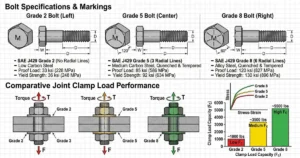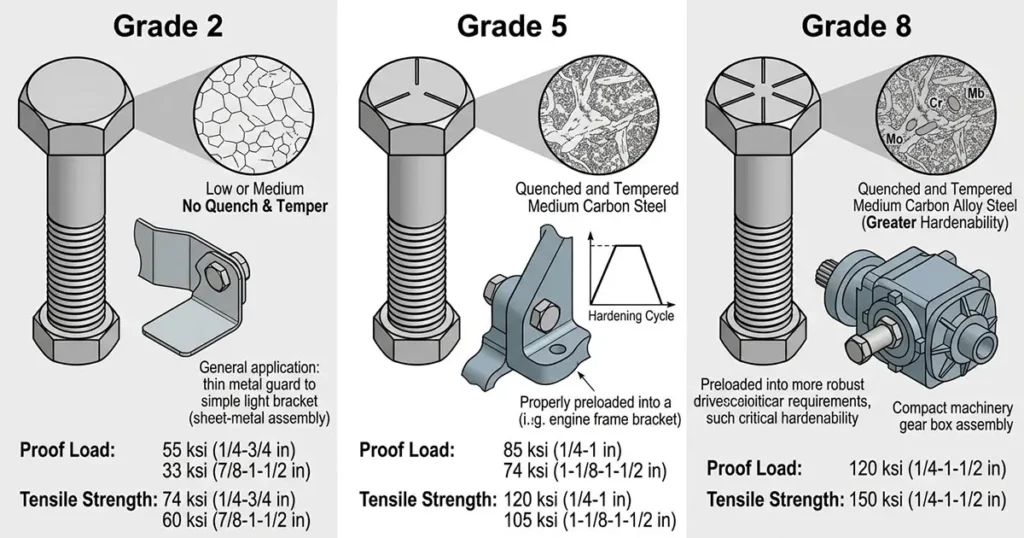
Grade 8 is the strongest of the three SAE J429 grades, Grade 5 is next and Grade 2 is the lowest. At 1/4 to 3/4 in the standard sets minimum tensile strengths of 150 ksi, 120 ksi and 74 ksi. That ranking does not change, but it answers only the first question a buyer has.
A bolt is one part of a joint. Fitting a Grade 8 bolt to an assembly designed around Grade 5 does not make the assembly 25% stronger; it leaves the nut, the tapped thread, the washer, the clamped material and the tightening method exactly as they were, and in many joints one of those is already the limiting part.
This comparison of Grade 2 vs Grade 5 vs Grade 8 bolts covers the steel and the strength behind each grade, where each one fits, and what has to be re-checked when one grade is substituted for another.
How Grade 2, Grade 5 and Grade 8 compare
All three come from one standard. The current edition of SAE J 429 was published in May 2014 and is catalogued by SAE as J429_201405. It sets the mechanical and material requirements for inch-series steel bolts, screws, studs and U-bolts up to 1-1/2 in, and the grades are that one document applied to different steel and heat-treatment conditions.
| Grade | Material and heat treatment | Minimum proof load (ksi) | Minimum tensile strength (ksi) | Head marking |
|---|---|---|---|---|
| Grade 2 | Low or medium carbon steel, no quench-and-temper requirement | 55 (1/4–3/4 in) 33 (7/8–1-1/2 in) | 74 (1/4–3/4 in) 60 (7/8–1-1/2 in) | No radial grade lines |
| Grade 5 | Medium carbon steel, quenched and tempered | 85 (1/4–1 in) 74 (1-1/8–1-1/2 in) | 120 (1/4–1 in) 105 (1-1/8–1-1/2 in) | Three radial lines |
| Grade 8 | Medium carbon alloy steel, quenched and tempered | 120 (1/4–1-1/2 in) | 150 (1/4–1-1/2 in) | Six radial lines |
The two strength columns do different jobs. Proof load is the stress a lot must withstand in the proof-load test without permanent set, and it is the value a preloaded joint is designed against. Tensile strength is the maximum stress the bolt sustains before it fractures. A joint tightened to a sensible preload works well below tensile strength, which is why the Grade 5 to Grade 8 step is better described by its proof load than by its breaking load.
Read the diameter brackets before the numbers. Grade 2 is a 74 ksi grade only to 3/4 in; from 7/8 in to 1-1/2 in it is a 60 ksi grade. Grade 5 holds 120 ksi to 1 in and drops to 105 ksi above that. Grade 8 holds 150 ksi across the whole range, and J429 stops at 1-1/2 in. A quotation that carries the small-size figure across a larger diameter is quoting a value the standard does not assign to that part.
The size bands also change the gap between grades. Through 1 in, Grade 8 carries 25% more minimum tensile strength than Grade 5, and about twice the 74 ksi of a small Grade 2. At 1-1/8 in the gap between Grade 5 and Grade 8 widens to about 43%, because Grade 5 has stepped down and Grade 8 has not.
Between Grade 5 and Grade 8 there is no general answer to which is better. Grade 5 is the right grade when its proof load covers the preload the joint needs. Grade 8 is the right grade when that preload is not enough at the diameter available, and the rest of the joint can carry the higher load. Both answers come from the joint, not from the grade number.
These are minimum values for a lot, not a load rating for a bolt. The force a bolt carries is the stress multiplied by its tensile stress area, which depends on diameter and thread series, and the capacity of the assembly is set by its weakest part. J429 Table 1 also sets yield strength, elongation, reduction of area and hardness for every grade and diameter band, and it adds a length rule: Grade 2 bolts and screws of 1/4 to 3/4 in diameter and over 6 in long are held to Grade 1 properties. The full table is set out in What Is SAE J429.
What separates the grades in the steel
Grade 2 is a low or medium carbon steel, and J429 does not require a quench-and-temper cycle for it. Its strength comes from the steel specification and the way the part is formed.
Grade 5 is a medium carbon steel that is quenched and tempered. The heat treatment is a requirement of the grade, not a manufacturing preference, and it is what takes the part to the 120 ksi level.
Grade 8 is a medium carbon alloy steel, also quenched and tempered. The alloying additions — chromium, molybdenum or comparable elements — give the steel the hardenability to reach 150 ksi through the section at the larger diameters in the range.
The grades are therefore not visible on the outside. A Grade 2 and a Grade 8 hex bolt of the same nominal size can share every dimension in ASME B18.2.1 and differ only in steel, heat treatment and head marking. Process control also matters more as the grade rises: at 150 ksi, decarburisation during forging, overheating in heat treatment, and hydrogen picked up in acid cleaning or electroplating have less margin before they change how the part behaves on test or in service.
Where each grade is the right choice
Grade 2 suits general-purpose joints that are not designed around high preload: guards, covers, light brackets, sheet-metal and wood assemblies, and maintenance hardware where strength is not the design driver. It is also the grade to specify when the drawing calls for a low-carbon, unhardened bolt. Grade 2 hex bolts are normally the lowest-cost of the three, because neither alloy steel nor a hardening cycle is in the part.
Grade 5 is the working grade for machinery and equipment: frames, brackets, mounts, agricultural and automotive general assemblies, and serviceable joints where the drawing or OEM specification names Grade 5. It sits in the middle of the three in both strength and cost, and it is the right choice whenever its proof load covers the design preload with margin. Grade 5 hex bolts are dimensioned to ASME B18.2.1 and marked with three radial lines.
Grade 8 is for joints that need more clamp load or tensile capacity at the diameter they have: compact machinery, drivetrain and suspension joints, heavy equipment, and designs where increasing the bolt size is not an option. It is the highest-strength and normally the highest-cost of the three. Grade 8 hex bolts carry six radial lines, and the 150 ksi applies across the full 1/4 to 1-1/2 in range.
None of these lists is a rule. Where a drawing, an OEM specification or a project specification names a grade, that grade is the requirement, and the lists only explain why it was chosen.
Why a higher grade is not automatically better
Upgrading looks like a free improvement: more strength for a modest step in price. It is also where grade-related purchasing mistakes usually begin, because a bolt is one component of a joint and only that component has improved.
The joint, not the bolt, decides where it fails
A bolted joint can fail in the bolt, in the nut or tapped thread, at the bearing surface under the head or nut, by tear-out in a thin plate, or by the joint separating so that the bolt carries the full external load. A higher bolt grade addresses the first of those and leaves the others unchanged. Driving a Grade 8 bolt into a short thread in aluminium, or clamping a soft plate without a hard washer, can strip the parent thread or embed the plate before the bolt reaches its intended load. Bolted joint design treats these as separate failure modes for that reason.
The extra strength is unused unless preload rises
Clamp load comes from tightening, and tightening torque is related to preload by the nut factor, T = K F d. Friction in the thread and under the bearing face dominates K, and coating, lubrication and surface condition all change it. Fitting Grade 8 at the Grade 5 torque therefore produces roughly the same clamp load as before, with the extra capacity unused.
Using that capacity means raising the preload, which is a decision about the joint rather than about the bolt. It loads the nut, the tapped thread, the washer and the clamped material harder, and it needs a tightening method validated for the assembly. Bolt proof load and tightening torque shows how much of the applied torque goes into friction, and why a torque figure means little without the fastener condition attached to it.
The higher grade has less ductility to give
J429 sets minimum elongation and reduction of area as well as strength. The specified minimum elongation is lower for Grade 8 than for Grade 5, and lower for Grade 5 than for Grade 2. In an overload the higher grade therefore deforms less before it fractures, and a group of bolts has less ability to redistribute load away from one that has started to yield. That is the trade: part of the extra strength is bought with the warning period before failure.
Higher strength also increases sensitivity to hydrogen embrittlement when the bolt is acid cleaned or electroplated. At these strength levels the relief treatment after plating is a process control that belongs in the finish requirement; a grade number does not supply it.
The original design may depend on the grade that was there
A joint designed and validated around Grade 5 has a preload, a fatigue assessment and mating parts chosen for that grade. Substituting Grade 8 changes the configuration without re-running any of them. Where an OEM drawing, a project specification or a regulated design names the grade, a change of grade is an engineering change and needs approval; it is not a purchasing substitution.
Grade says nothing about corrosion or temperature
The J429 properties were compiled at about 20 °C (68 °F), and the standard places fatigue, corrosion resistance and impact properties outside its scope. A Grade 8 bolt is not more corrosion-resistant than a Grade 5 bolt — the finish decides that — and it is not a higher-temperature bolt. At elevated temperature the room-temperature values do not carry over, and a different specification and assessment are needed.
You pay for capacity the joint may not use
Grade 5 normally costs more than Grade 2, and Grade 8 more than Grade 5, because alloy steel and a hardening cycle are in the part. Where the nut, the thread or the clamped material is the limit, that difference buys nothing in service. A grade change can also pull in a new coating qualification, a new tightening specification and re-validation, and those usually cost more than the piece-price difference.
Substituting one grade for another
Substitution runs in two directions, and neither is automatic.
Upgrading, from Grade 2 to Grade 5, Grade 5 to Grade 8, or straight from Grade 2 to Grade 8, raises the specified capacity of the bolt. Before it is accepted, the nut or tapped thread, the washer and bearing area, the clamped material, the tightening specification and the finish all have to be checked against the higher preload, and the governing drawing has to allow the change. A Grade 8 bolt with a nut of lower proof load has moved the weak point to the thread rather than removed it.
Downgrading reduces capacity and should follow an engineering assessment of the joint, not a stock shortage. Preload, external loads and the fatigue assessment all have to be re-checked against the lower grade.
In both directions, identify the grade from the head, not from the finish. Three radial lines mark Grade 5, six mark Grade 8, and the low-carbon grades carry no radial grade lines at all, so an unmarked head cannot be confirmed as Grade 2 from the marking alone. Colour is not a grade: zinc, yellow zinc, black oxide and plain finishes appear on all three. The manufacturer’s identification mark and the lot’s inspection document are what connect the head marking to the properties.
Matching the nut and the thread engagement
J429 covers externally threaded fasteners only. The nut side is a separate document, SAE J995, which sets requirements for three grades of steel nuts from 1/4 to 1-1/2 in, dimensioned to SAE J482 or ASME B18.2.2. The nut is part of the selection: if its proof load is lower than the bolt’s, the thread becomes the weak link, and the assembly can strip before the bolt reaches its own proof load.
Where the bolt goes into a tapped hole instead of a nut, the internal thread is only as strong as the parent material and the engagement length allow. Soft or thin material needs more engagement, and stripping has to be checked as its own failure mode rather than assumed away by the bolt grade. Washer hardness and bearing area belong in the same check, because a washer that dishes or a surface that crushes relaxes the joint even when the bolt stays elastic.
Metric bolts use a different system
Metric carbon and alloy steel bolts are described by property classes under ISO 898-1:2013, not by J429 grades. The class number encodes the strength — 8.8, 10.9 and 12.9 are the classes used for hex bolts, and the digits state the tensile level and the yield ratio — while a J429 grade number encodes nothing of the kind. Grade 5 is not five of anything, and the two systems are not interchangeable even where the strengths look close. Grade 8 at 150 ksi is about 1,034 MPa, close to the 1,040 MPa minimum that class 10.9 carries at the smaller diameters, but the thread form, the test conditions and the property requirements are set separately. The metric side is worked through in DIN 933 bolt grades.
What the grade leaves to the order
A J429 grade fixes steel and strength. It does not fix head shape, head size, shank diameter, thread length or the length basis — those come from ASME B18.2.1 for inch-series hex bolts — nor thread series and class of fit, finish, coating thickness or the nut. A J429 Grade 8 hex cap screw is also not a structural bolt. For a high-strength structural bolt within the scope of ASTM F3125, the order has to name the applicable ASTM F3125 grade or type, which sets the material, mechanical and related requirements, and take dimensions from ASME B18.2.6 where that standard applies. The two standards do different jobs and do not substitute for each other; a similar strength number does not make a J429 hex cap screw interchangeable with a structural bolt.
A line that can be quoted, made and inspected without a follow-up question carries six things:
- the product type, for example a hex cap screw or a hex bolt
- the dimensional standard, ASME B18.2.1 for inch-series hex products
- the size and thread, for example 1/2-13 UNC × 3 in
- the grade and the standard behind it, SAE J429 Grade 5
- the finish, plus any coating or lubricant requirement
- the nut specification and grade, where the nut is part of the supply
That is the point at which the grade becomes a specification rather than a description. The bolts category covers the shapes these grades are supplied in.
The grade follows the joint. Start from what the joint has to carry, what the nut or tapped thread and the clamped material can take, and what the drawing or specification requires, then pick the lowest grade that satisfies all three. In practice that means Grade 2 where the joint is light and general-purpose, Grade 5 where machinery loads are designed around its proof load, and Grade 8 where the extra clamp load is genuinely needed and the mating parts can accept it.
None of this replaces the calculation. Grade selection sets the material and the strength level; preload, stress, fatigue, bearing and thread engagement still have to be checked for the actual joint, and a grade change is a design change until that check says otherwise.