
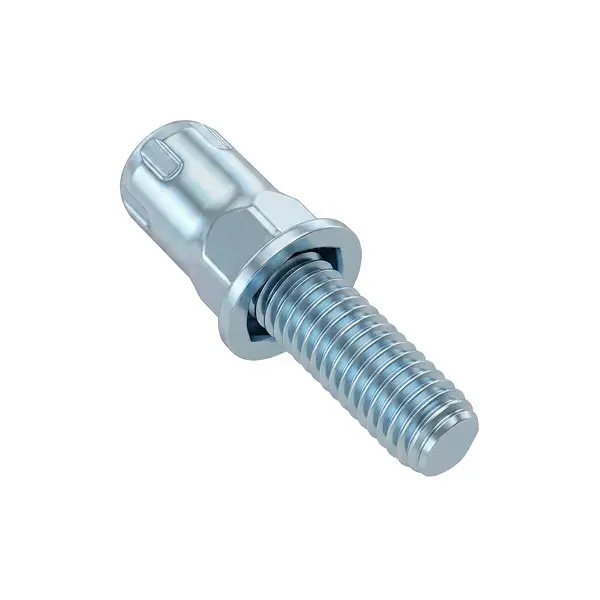
Blind Rivet Studs
Blind rivet studs combine a rivet nut body with an external threaded stud, installed from one side to create a permanent fastening point on thin panels.
Standard
Manufacturer standard
Material
Carbon Steel, Stainless Steel
Size Range
M4 to M8
Product Information
Product Code
CB-BRS-DES
Standard
Manufacturer standard
Material
Carbon Steel, Stainless Steel
Grade
Steel Zinc Plated (Class 8.8), A2 Stainless Steel, A4 Stainless Steel
Size Range
M4 to M8
Surface Finish
Zinc Plated, Plain
Packaging
Bulk packaging, carton packaging, pallet packaging, and custom packaging available.
Customization
Customization available. Custom sizes, special materials, and special surface finishes.
Lead Time
Negotiable
Product Overview
Blind rivet studs are threaded fasteners that combine a blind rivet nut body with an integral external threaded stud. The sleeve deforms on the blind side of the workpiece during installation, creating a permanent external thread on the accessible side without requiring access to the rear of the panel. This distinguishes them from blind rivet nuts, which provide an internal thread for a screw to be inserted, whereas rivet studs provide an external thread onto which a nut, bracket, or panel is mounted.
The product is constructed as two joined components: a sleeve and a threaded stud. These are permanently connected by laser welding or cold welding, which serves a dual purpose — it forms a twist-resistant joint between the sleeve and stud, and it holds the upset on the blind end so the stud head remains fixed during installation. The welding process is what gives the blind rivet stud its load-bearing capacity: under overload, the stud itself yields rather than the rivet connection, meaning installed blind rivet studs can be subjected to comparable loads as same-grade DIN studs.
Installation uses the same setting principle and tooling platform as blind rivet nuts. The stud is screwed into a threaded mandrel on the setting tool, inserted into a prepared hole, and the tool stroke deforms the sleeve on the blind side to clamp the fastener into the workpiece. Because the tooling pulls on the stud rather than a mandrel, the setting tools require internal threaded sleeves instead of standard threaded mandrels. Knurled or hexagonal shank designs are available to increase resistance to rotation in the hole after installation.
Blind rivet studs serve as a mechanical alternative to weld studs and press-in studs. They provide two functions in a single fastener: they join thin materials, including dissimilar material combinations such as sheet metal to plastic, and they create an additional threaded fastening point or positioning aid on the accessible side. Common installations include electrical enclosures, control cabinets, packaging machinery, HVAC housings, automotive body panels, and sheet metal assemblies where only one side of the workpiece is reachable. The thread sizes most commonly supplied are M4, M5, M6, and M8, with stainless steel A2 and A4 options for applications requiring corrosion resistance. When selecting a blind rivet stud, the key considerations are the panel thickness (grip range), the bore hole diameter required by the sleeve, the thread size needed for the mating component, and the head style — flat head for general use or countersunk head where a flush surface is required.
Related Products
Ready to Source This Fastener?
Need a quotation, technical support, or custom fastener solutions? Complete the form below, and we'll provide the information you need for your project.