
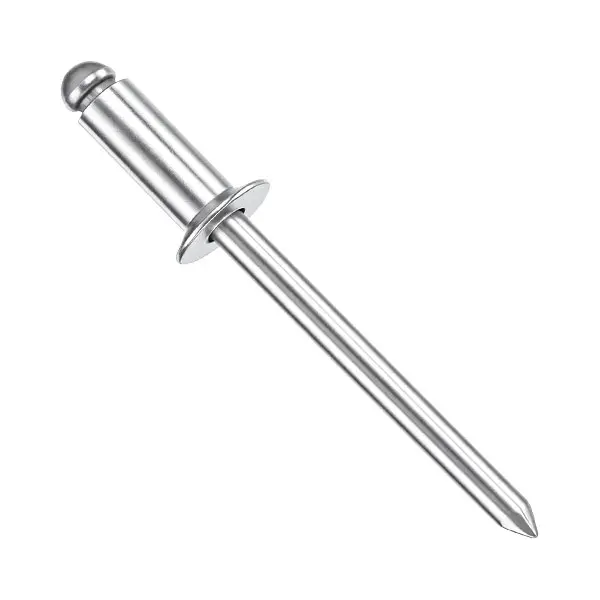
Open End Blind Rivets
Open end blind rivets are break stem fasteners with a hollow barrel open at both ends. The mandrel passes fully through during setting and breaks off at a predetermined load.
Standard
IFI 114, ISO 15977, GB/T 12617.4
Material
Aluminum, Steel, Stainless Steel
Size Range
3.2 mm to 6.4 mm, 1/8" to 1/4"
Product Information
Product Code
CB-OEBR-BS
Standard
IFI 114, ISO 15977, GB/T 12617.4
Material
Aluminum, Steel, Stainless Steel
Grade
Aluminum 5052, Aluminum 5056, Steel, A2 Stainless Steel, A4 Stainless Steel
Size Range
3.2 mm to 6.4 mm, 1/8" to 1/4"
Surface Finish
Plain, Zinc Plated, Painted
Packaging
Bulk packaging, carton packaging, pallet packaging, and custom packaging available.
Customization
Customization available. Custom sizes, special materials, and special surface finishes.
Lead Time
Negotiable
Product Overview
Open end blind rivets are two-piece fasteners consisting of a hollow rivet body pre-assembled onto a headed mandrel. The body is a hollow cylinder, open at the blind end, with a factory-formed head at the accessible end. The mandrel passes completely through the hollow barrel and terminates in an enlarged head that sits inside the body at the blind end. During installation, a rivet tool grips the exposed mandrel stem and pulls it toward the tool. The mandrel head deforms the blind end of the body outward, forming a secondary head — the bucktail — against the rear surface of the workpiece. When the joint is fully clamped and the mandrel reaches its designed break load, the stem snaps at a breakneck groove. The broken stem falls away as waste, leaving the mandrel head permanently captured inside the hollow body.
The defining structural characteristic of the open end type is that the barrel is completely hollow from end to end. The mandrel is not retained after installation; only its head remains inside the body, and the rivet body itself remains open at the blind end. This is the key distinction from closed end blind rivets, where the blind end is sealed to retain the full mandrel and prevent liquid or gas passage. The open barrel construction makes open end blind rivets the simplest and most economical break stem configuration, which is why they are the default choice for general sheet metal fastening where a sealed joint is not required.
Because the mandrel stem breaks off and falls away, the installed rivet presents a finished appearance with a hole visible in the center of the head. The remaining mandrel head inside the body contributes to the joint’s shear and tensile strength but does not protrude beyond the bucktail. Installation requires access to only one side of the workpiece, which allows fastening in enclosures, tubing, and assemblies where the rear face is inaccessible or obstructed.
Open end blind rivets are supplied in aluminum, steel, and stainless steel bodies with mandrel combinations matched to the application. Common material pairings include aluminum body with aluminum mandrel for light-duty and corrosion-sensitive assemblies, aluminum body with steel mandrel for higher shear strength in sheet metal, and all-steel or all-stainless construction for structural and outdoor environments. The product is used across automotive body panels, electrical enclosures, HVAC ducting, appliances, furniture, and general fabrication. In catalogues and on purchase orders, these fasteners also appear as pop rivets, break stem rivets, or standard blind rivets. The primary selection factors are the grip range for the combined material thickness, the body diameter matched to the drilled hole, and the material combination appropriate for the service environment.
Related Products
Ready to Source This Fastener?
Need a quotation, technical support, or custom fastener solutions? Complete the form below, and we'll provide the information you need for your project.