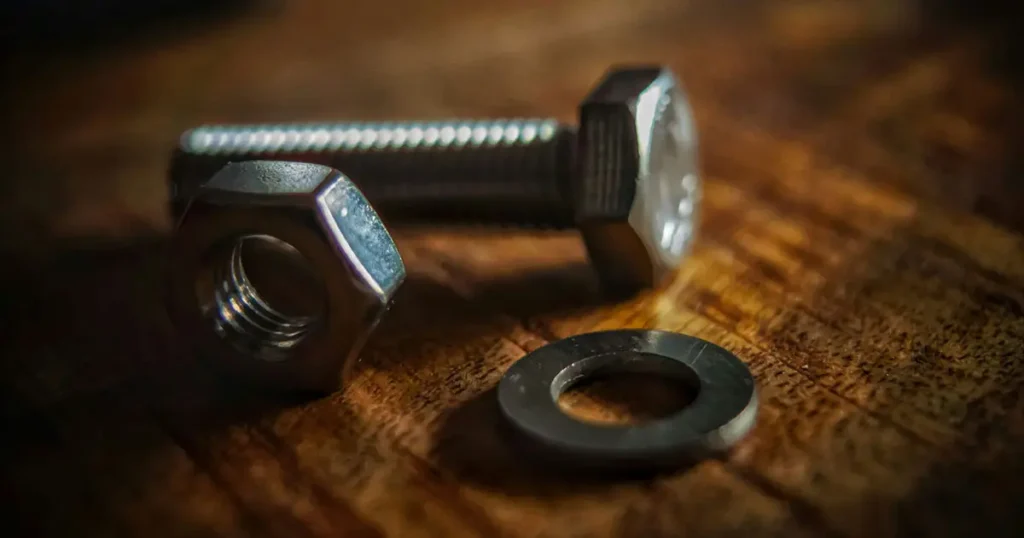
DIN 961 and DIN 933 describe the same fastener with one parameter changed: the thread pitch. Both are hexagon head fasteners with the thread running up to the underside of the head, both cover the same nominal diameters over the M8 to M52 range they have in common, and at every diameter the two DIN tables give the same width across flats and the same head height. DIN 961 carries a metric fine pitch thread; DIN 933 carries the metric coarse pitch for the same nominal diameter — M12 × 1.5 against M12 × 1.75, M20 × 1.5 against M20 × 2.5 — and the same relationship holds at every diameter the two tables share. That single difference is what decides the part, and it also means the two are not interchangeable at the same nominal diameter and length, because a fine pitch external thread does not enter a coarse pitch internal thread of the same size.
Nothing on the outside of the part gives the pitch away. A DIN 961 M10 × 1.25 bolt and a DIN 933 M10 × 1.5 bolt take the same 17 mm socket, stand 6.4 mm high at the head, and can be made in the same material, property class and finish. The designation is the only visible difference, which is why the question comes up on drawings, quotations and stock transfers rather than on the assembly bench.
| Point of comparison | DIN 961 | DIN 933 |
|---|---|---|
| Product form | Hexagon head, thread up to the underside of the head | Same product form |
| Thread | Metric fine pitch | Metric coarse pitch |
| Thread at M10 | 1 mm or 1.25 mm | 1.5 mm |
| Thread at M20 | 1.5 mm or 2 mm | 2.5 mm |
| Nominal diameter range in the table | M8 to M52 | M1.6 to M52 |
| Width across flats and head height | Identical to DIN 933 at every shared diameter | Identical to DIN 961 at every shared diameter |
| Product grades | A and B | A and B |
| Property class / stainless grade | Not fixed by the standard | Not fixed by the standard |
| Status | Withdrawn, edition 1990-01 | Withdrawn, edition 1987-09 |
| Current counterpart | ISO 8676:2022, adopted in Germany as DIN EN ISO 8676:2022-10 | ISO 4017:2022, adopted in Germany as DIN EN ISO 4017:2022-10 |
Neither DIN number is a current standard. Both are still written on drawings and used as commercial descriptions of the shape, and both have a current counterpart in the ISO framework. That matters for the designation on an order, but it is not the difference between the two parts — which is the pitch.
What the pitch difference looks like size by size
Both pitch series sit inside the ISO 261 general plan for general purpose metric screw threads, whose basic dimensions are given in ISO 724 and whose tolerances are in ISO 965-1. Within that plan the two standards simply select different pitches at each nominal diameter.
The DIN 961 table lists a fine pitch or a pair of fine pitches at each size; the DIN 933 table lists the coarse pitch. From the two withdrawn tables:
| Nominal diameter | DIN 961 fine pitch (mm) | DIN 933 coarse pitch (mm) |
|---|---|---|
| M8 | 1 | 1.25 |
| M10 | 1; 1.25 | 1.5 |
| M12 | 1.25; 1.5 | 1.75 |
| M14 | 1.5 | 2 |
| M16 | 1.5 | 2 |
| M18 | 1.5; 2 | 2.5 |
| M20 | 1.5; 2 | 2.5 |
| M22 | 1.5; 2 | 2.5 |
| M24 | 1.5; 2 | 3 |
| M27 | 2 | 3 |
| M30 | 2 | 3.5 |
| M36 | 3 | 4 |
| M42 | 3 | 4.5 |
| M48 | 3 | 5 |
| M52 | 3 | 5 |
Two consequences follow from how these ranges are written, and both are quoted against real orders.
- A DIN 961 call-out that names only the diameter is incomplete. At M10, M12, M18, M20, M22 and M24 the DIN 961 table offers two fine pitches. “DIN 961 M12 × 50” leaves the thread open between 1.25 mm and 1.5 mm. On a purchase order, write M12 × 1.5 or M12 × 1.25.
- The coarse pitch is the only pitch DIN 933 gives at a diameter. “DIN 933 M12” is unambiguous: 1.75 mm. A supplier reading a DIN 933 call-out has nothing to choose on the thread.
Why the two do not interchange at the same nominal diameter
The pitch is the distance from one thread crest to the next, so it fixes the helix of the thread. An external thread of a given pitch only enters an internal thread of the same pitch and nominal diameter. A DIN 961 M10 × 1.25 screw needs an M10 × 1.25 nut or tapped hole, and a DIN 933 M10 × 1.5 screw needs an M10 × 1.5 one. Offering a 1.25 mm screw to a 1.5 mm nut does not produce a loose joint that can be tightened through — the two threads cross and the parts stop.
This is the practical reason a substitution cannot be made on the basis of nominal diameter and length. On a drawing the two parts are the same line with a different pitch figure after the diameter, and the difference is easy to read past. On the assembly, there is no joint until the pitch matches.
There is a second, softer version of the same problem. Fine pitch is also made as an internal thread, so a joint can have a matching fine pitch metric nut on one side and a coarse thread on the other. Where a fine pitch bolt is being replaced, the mating nut or tapped hole has to follow the pitch as well, and that is a change to the other half of the joint.
What the finer pitch actually changes
Four things are worth separating, because some of them are often claimed more strongly than they hold.
The threaded cross-section is slightly larger
A finer pitch cuts less deeply into the shank, so the threaded cross-section is larger at the same nominal diameter. Using the ISO 724 thread form — pitch diameter d2 = d − 0.6495P, minor diameter d3 = d − 1.2269P, stress area As = (π/4)·[(d2 + d3)/2]² — the difference is modest and grows with diameter:
| Fine thread | Stress area (mm²) | Coarse thread | Stress area (mm²) | Difference |
|---|---|---|---|---|
| M8 × 1 | 39.2 | M8 × 1.25 | 36.6 | +7.0% |
| M10 × 1.25 | 61.2 | M10 × 1.5 | 58.0 | +5.5% |
| M12 × 1.5 | 88.1 | M12 × 1.75 | 84.3 | +4.6% |
| M14 × 1.5 | 124.5 | M14 × 2 | 115.4 | +7.9% |
| M16 × 1.5 | 167.2 | M16 × 2 | 156.7 | +6.8% |
| M18 × 1.5 | 216.2 | M18 × 2.5 | 192.5 | +12.3% |
| M20 × 2 | 258.0 | M20 × 2.5 | 244.8 | +5.4% |
| M24 × 2 | 384.4 | M24 × 3 | 352.5 | +9.1% |
The stress area is the cross-section used with the property-class tensile strength to work out what a bolt can carry, so at the same property class a fine pitch bolt of a given diameter has a little more capacity than the coarse one. What it is not is a general statement that fine thread is stronger. That cross-section only governs while the failure would be in the bolt. If the joint is limited by the internal thread, by the clamped material, by the bearing area under the head or by fatigue at the thread run-out, a 5% to 12% larger threaded section does not decide the outcome. Whether fine pitch is the right choice is a joint-design question, and the answer changes with the joint.
Torque and preload behave differently
A finer pitch converts torque into axial load more efficiently, so less tightening torque is needed to reach an equivalent preload. Manufacturer technical literature puts this down to the thread geometry: the shallower helix angle of a fine thread gives a greater mechanical advantage than the coarse thread of the same nominal diameter. In practice this shows up as a different torque figure for the same clamp load, which is why a torque value carried across from a DIN 933 line to a DIN 961 line without checking is not a safe assumption.
Adjustment is finer, and so is the risk of damage
The finer pitch also moves the fastener a shorter distance along the axis for each turn, which matters where a part has to be set to a position rather than simply tightened. The same geometry works against the part in other ways. There is less material between thread flanks and the thread itself is shallower, so a fine thread is more easily damaged by a nick or a burr, and more sensitive to coating build-up — the same zinc or zinc flake thickness consumes proportionally more of the available clearance than it would on a coarse thread. Fine threads also gall more readily, particularly in stainless steel, and assembly takes more turns. The counterweight is that a fine thread’s smaller helix angle makes it less inclined to loosen under vibration than the coarse thread of the same diameter.
Choosing between them
Neither standard is the better one. The pitch selects itself once the joint is described:
| Condition in the joint | The pitch that serves it |
|---|---|
| Maximum threaded cross-section at a given diameter | Fine pitch — DIN 961 |
| Limited thread engagement length | Fine pitch — DIN 961 |
| Clamped or tapped material is weaker than the bolt | Coarse pitch — DIN 933 |
| A position that has to be set or trimmed after assembly | Fine pitch — DIN 961 |
| Fast assembly across a large number of joints | Coarse pitch — DIN 933 |
| A coating with appreciable thickness, or repeated assembly and disassembly | Coarse pitch — DIN 933 |
| Vibration or cyclic loading in service | Fine pitch is the more common starting point, subject to the joint design |
| Stainless steel in an application prone to galling | Coarse pitch — DIN 933 |
The two tables do not start and finish in the same place. The DIN 961 table begins at M8, while the DIN 933 table begins at M1.6, so below M8 there is no fine pitch designation to choose between. Neither table reaches above M52, and those larger sizes are found only in the current ISO documents.
Do not confuse DIN 961 with DIN 960
The other axis in this family is thread coverage, and it is a different question with a different answer. DIN 960 and DIN 961 differ in how far the thread runs: DIN 960 is partially threaded with a plain shank under the head, and DIN 961 is threaded up to the head. Both are fine pitch, and they share the same fine pitch range at each diameter. Comparing DIN 961 with DIN 933 asks about the pitch; comparing DIN 961 with DIN 960 asks about the thread length. Mixing the two questions is how a fine pitch, partially threaded bolt ends up quoted against a call-out that asked for neither.
Both designations are withdrawn, and the current documents are not the same family
DIN 961 and DIN 933 are historical documents. The DIN 961:1990-01 record carries the status UNGÜLTIG — withdrawn — with the English title “M 8 × 1 to M 52 × 3 hexagon head bolts with fine pitch thread; product grades A and B”, and the DIN 961 dimension table states that the standard was cancelled and replaced by DIN EN ISO 8676. The DIN 933 side carries the same kind of notice: its record lists DIN EN 24017 as the replacing document, and the table records replacement by DIN EN ISO 4017.
What replaced them is a pair of ISO documents published on the same day. ISO 8676:2022 covers hexagon head screws with fine pitch thread from M8 × 1 to M64 × 4, product grades A and B, in steel and stainless steel; it is edition 4, and the German edition is DIN EN ISO 8676:2022-10. ISO 4017:2022 covers the same product form with metric coarse pitch thread and the same product grades, adopted in Germany as DIN EN ISO 4017:2022-10.
The fine and coarse pitch ranges carried across, so the distinction described above survives the change of designation. The head does not, at four diameters. The two withdrawn DIN standards agree with each other at every size, including M10, M12, M14 and M22. Between the current ISO documents they no longer do: ISO 4017 and ISO 8676 take 16, 18, 21 and 34 mm across flats at those four sizes, where the DIN tables give 17, 19, 22 and 32 mm. A DIN 961 bolt and a DIN 933 bolt of the same diameter had the same head; an ISO 8676 screw and an ISO 4017 screw of the same diameter do not, at exactly those four sizes. That change is dealt with in the DIN 933 and ISO 4017 comparison, and it applies here as soon as either product is ordered against the current standard rather than the DIN one.
Checking a part, an enquiry or a substitution
The checks that settle it are short, and the first one settles most cases on its own:
- Read the pitch, not just the diameter. A call-out of “M12” is not a thread specification in this family. It is M12 × 1.5 or M12 × 1.25 for DIN 961, and M12 × 1.75 for DIN 933. Where only the DIN number is given, the DIN number itself fixes which of those applies.
- Match the internal thread. The nut, the tapped hole or the threaded insert has to be the same nominal diameter and the same pitch as the bolt. A coarse pitch nut on a fine pitch screw, or the reverse, will not assemble.
- Measure an unidentified part before using it. On a loose part the pitch can be read with a thread pitch gauge or by counting crests over a known length — nine crests of an M12 × 1.25 thread span 11.25 mm, and nine of an M12 × 1.75 thread span 15.75 mm. A caliper on the outside diameter will not separate the two, because both are nominally 12 mm.
- State the property class or stainless grade separately. 8.8, 10.9 or 12.9 for steel, or a complete stainless designation such as A2-70 or A4-80. Neither DIN 961 nor DIN 933 carries this information, and the marking on the head shows the class, not the standard number.
- Confirm the finish, and whether its thickness affects the thread fit. Coating build-up matters more on a fine thread than on a coarse one.
- Write the pitch into a DIN 961 call-out. Where DIN 961 offers more than one fine pitch at a size, name the pitch:
DIN 961 - M12 × 1.5 × 50 - 8.8. Where it offers only one, the pitch is fixed by the standard. A DIN 933 call-out does not need the pitch, because the standard fixes one coarse pitch per nominal diameter, soDIN 933 - M12 × 50 - 8.8already identifies an M12 × 1.75. Where the part is being bought to a current standard, write that standard’s own designation and keep the DIN number alongside it as a cross-reference.
DIN 961 and DIN 933 are the fine pitch and coarse pitch versions of one part — a metric hexagon head fastener threaded up to the head. They share the head, the M8 to M52 diameter range they have in common, the grade framework and the strength framework, and they differ in the thread, with a threaded cross-section at the same nominal diameter that runs from about 5% larger at M12 × 1.5 to about 12% larger at M18 × 1.5 in favour of the fine pitch. That difference is a joint-design input, not a ranking. The decisive fact is simpler: the two do not fit the same nut or the same tapped hole, so the choice has to be made from the joint and written into the call-out, not inferred from the diameter and the length. Both DIN numbers are withdrawn, and both now have an ISO counterpart — with one further change, at M10, M12, M14 and M22, that applies once either product is ordered to the current standard.
DIN 961 hexagon head bolts with fine pitch thread and DIN 933 hex head bolts fully threaded are both part of the ChinaBolts metric bolt range, supplied in carbon, alloy and stainless steel across the standard property classes and finishes, to either the DIN dimension sheet or the current ISO head dimensions. Send the standard, the nominal diameter and the pitch, the length, the property class or stainless grade, the finish and the width across flats the drawing requires, and we will confirm the thread and the head dimensions against the standard you are working to before the order is placed.