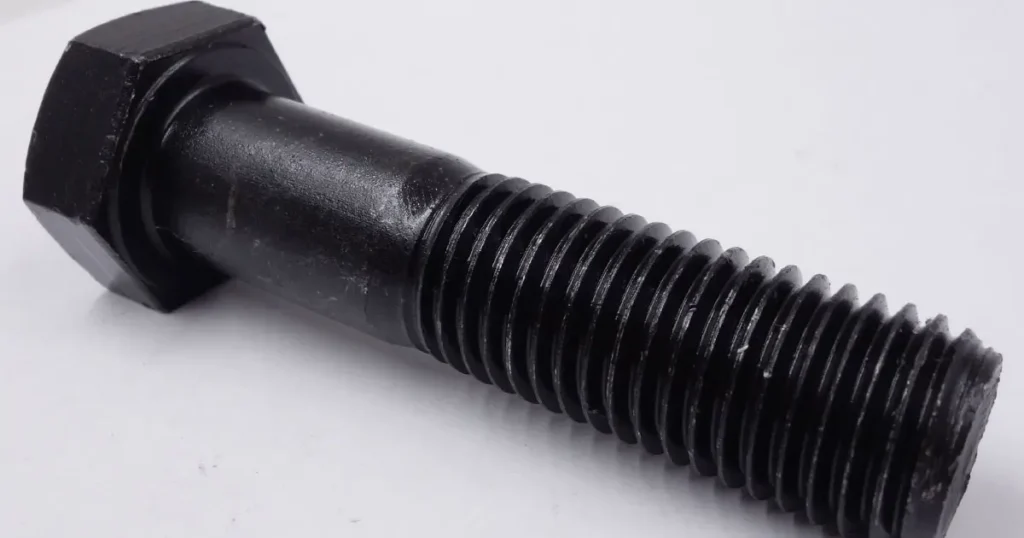
DIN 931 and ISO 4014 describe the same part — a metric hexagon head bolt with a partially threaded shank and a coarse metric thread. They are not the same document, and they are not interchangeable without a check. But the dimensional check is narrow: the two tables agree on the thread, the thread length, the shank and the head height, and differ in head width at exactly four sizes — M10, M12, M14 and M22.
That is why “DIN 931 = ISO 4014” is a useful shorthand on a stock list and a poor rule on a drawing. DIN 931 hex bolts are produced and traded under both names, and for most of the diameter range the two names really do describe the same bolt. At those four sizes they do not: the ISO head is 1 mm smaller across flats at M10, M12 and M14, and 2 mm larger at M22.
The rest of this article sets out the standards relationship, what stays identical, where the four sizes bite, and how to record a substitution so it does not have to be re-argued at the next rebuild.
DIN 931 vs ISO 4014 at a glance
| Point of comparison | DIN 931 | ISO 4014 |
|---|---|---|
| Product | Hexagon head bolt, partially threaded shank | Hexagon head bolt, partially threaded shank |
| Status | Legacy DIN 931-1 (M1.6 to M39) is withdrawn; DIN 931-2:2009-06 remains current for M68 to M160 × 6, product grade B | Current international standard; current German edition DIN EN ISO 4014:2022-10 |
| Diameter range | Legacy part 1: M1.6 to M39. Current DIN 931-2:2009-06: M68 to M160 × 6 | M1.6 to M64 in one document |
| Thread | Metric coarse pitch, 6g external thread | Metric coarse pitch, 6g external thread |
| Standard thread length b | 2d + 6 (up to 125 mm), 2d + 12 (125–200 mm), 2d + 25 (over 200 mm) | Same three bands |
| Width across flats at M10 / M12 / M14 / M22 | 17 / 19 / 22 / 32 mm | 16 / 18 / 21 / 34 mm |
| Head height at those sizes | 6.4 / 7.5 / 8.8 / 14 mm | 6.4 / 7.5 / 8.8 / 14 mm |
| Property class | Not specified by the standard | Not specified by the standard |
Only one row of that table is a difference, and it is confined to four sizes. That does not make the two standards interchangeable by default: when a part written around DIN 931 is produced to ISO 4014, the drawing itself, tool access, clearances and the application requirements still have to be checked.
Is ISO 4014 the same as DIN 931?
No. ISO 4014 is the successor and the corresponding international designation of DIN 931, not a copy of it. The German standard said so itself: DIN 931-1:1982-07 carried the German title Sechskantschrauben mit Schaft; Gewinde M 1,6 bis M 39, Produktklassen A und B, ISO 4014 modifiziert — “hexagon head bolts with shank; threads M 1.6 to M 39; product grades A and B, ISO 4014 modified“. DIN 931 was built on ISO 4014 with national deviations from the start.
That is also the right way to read the name today. DIN 931 is a shape reference in trade rather than a governing standard for the normal range: legacy DIN 931-1 is withdrawn and replaced there by the ISO 4014 series, while DIN 931-2:2009-06 remains current for M68 to M160 × 6. The deviations that mattered then are the ones that still matter now, and they are in the head. The four width-across-flats differences are the principal practical difference, but the head geometry also carries tolerance differences between the two documents, particularly for product grade B.
What is the equivalent standard for DIN 931?
ISO 4014, Fasteners — Hexagon head bolts — Product grades A and B. Its current edition is ISO 4014:2022, edition 5, published on 28 June 2022, which revised the withdrawn 2011 edition. It covers metric coarse pitch threads from M1.6 up to and including M64 in product grades A and B, and points to ISO 898-1 or ISO 3506-1 for property classes and stainless steel grades. The current German edition is DIN EN ISO 4014:2022-10; in Europe the same document is adopted as EN ISO 4014.
The route from one to the other was not direct, which is why a legacy drawing and a current purchase order can name the same bolt and still not name the same document:
- DIN 931-1:1982-07 — earlier German edition, titled “ISO 4014 modified”.
- DIN 931-1:1987-09 — the edition behind most legacy drawings; replaced the 1982 edition and is itself withdrawn.
- DIN EN 24014:1992-02 — German edition of EN 24014:1992, which carried the product into the European framework.
- EN ISO 4014:2001 — the EN ISO edition; the BSI record shows BS EN ISO 4014:2001 superseding BS EN 24014:1992.
- EN ISO 4014:2011 — next edition, now withdrawn.
- DIN EN ISO 4014:2022-10 — current.
One range note belongs with that chain. DIN 931 was published in parts, and part 1 ends at M39. The historical DIN 931-2:1987-09 covered M42 to M160 × 6; the current DIN 931-2:2009-06 dropped M42 to M64 because those sizes are covered by DIN EN ISO 4014, leaving DIN 931-2:2009-06 in force for M68 to M160 × 6, product grade B. ISO 4014 itself covers M1.6 to M64 in a single document. So the series does not simply stop at M39: below M64 the current reference for the product is the DIN EN ISO 4014 series, and from M68 upwards DIN 931-2:2009-06 is the current document to quote.
What stays identical between DIN 931 and ISO 4014
Four things are aligned in both tables, and they are the reason the two standards correspond so closely at most sizes:
- The thread. Both use metric coarse pitch with a 6g external thread tolerance. A DIN 931 M10 × 1.5 and an ISO 4014 M10 × 1.5 have the same thread and will fit the same nut.
- The standard thread length. The same three bands apply: 2d + 6 mm up to 125 mm, 2d + 12 mm above 125 mm up to 200 mm, and 2d + 25 mm above 200 mm. An M12 × 80 bolt has a 30 mm standard thread length under either name.
- The shank and the head height. At the four affected sizes the head height is unchanged — M10 6.4 mm, M12 7.5 mm, M14 8.8 mm, M22 14 mm — and the shank diameter is the same.
- The product grade split. Grade A applies to threads M1.6 to M24 with nominal lengths up to 10d or 150 mm, whichever is shorter; grade B applies to larger or longer parts.
The partial-thread form is shared as well. The fully threaded counterpart is DIN 933 in the German framework and ISO 4017 in the current one, so the same substitution logic applies to DIN 933 hex head bolts with a fully threaded shank.
The four sizes where DIN 931 and ISO 4014 differ
The published comparison is consistent and narrow: ISO 4014 specifies revised head dimensions for M10, M12, M14 and M22, and for the rest of the hex range the two tables give the same head.
| Size | DIN 931 across flats (mm) | ISO 4014 across flats (mm) | DIN 931 across corners, min (mm) | ISO 4014 across corners, min (mm) |
|---|---|---|---|---|
| M10 | 17 | 16 | 18.90 | 17.77 |
| M12 | 19 | 18 | 21.10 | 20.03 |
| M14 | 22 | 21 | 24.49 | 23.36 |
| M22 | 32 | 34 | 35.72 | 37.72 |
Two consequences follow. First, “the ISO head is smaller” is true at M10, M12 and M14, by 1 mm across flats, and false at M22, where the ISO head is 2 mm larger. Second, the difference is not only the spanner size: the across-corners figure moves with the across-flats, so the space the head needs grows or shrinks with it — about 1.1 mm in diameter at M10, and 2.0 mm at M22.
On site this shows up as a socket that will not go on, or one that fits loosely. A 17 mm socket on an ISO 4014 M10 head is a poor fit and can round the corners if it is loaded hard; a 16 mm socket will not go onto a DIN 931 M10 head at all. The same applies at M12 (19 mm against 18 mm), M14 (22 mm against 21 mm) and M22 (32 mm against 34 mm), so a socket set has to carry both sizes at each of those four diameters.
For interchangeability the risk is asymmetric. Fitting an ISO bolt into a joint designed around the DIN head gains clearance at M10, M12 and M14, and loses it at M22, where the larger head can foul a recess, a counterbore or an adjacent component. Fitting a DIN bolt into a joint designed around the ISO head does the reverse, and can break wrench access where a socket has to reach into a pocket. Where the head seats directly on the clamped part, confirm the bearing face as well as the spanner size.
Nuts and washers move with the head
The thread is not the obstacle — either bolt screws into the same nut. The width across flats is. ISO 4032 hex nuts follow the same width schedule as ISO 4014 heads: 16 mm at M10, 18 mm at M12, 21 mm at M14 and 34 mm at M22. So if a DIN-series bolt and nut pair is replaced by ISO-series parts at one of these sizes, both the bolt head and the nut move to a different spanner, even though the thread is unchanged. Washers are specified separately and matched by hole diameter; they do not resolve the head-width question.
What neither standard tells you
Both documents are dimensional. Neither fixes the properties that decide whether a substitution is acceptable in a particular joint, so those have to be stated on the enquiry and on the order:
- Property class or stainless steel grade — 8.8, 10.9 or 12.9 for carbon and alloy steel under ISO 898-1, or a complete stainless designation such as A2-70, A4-70 or A4-80 under ISO 3506-1. The group alone (A2, A4) does not express the property class.
- Material — carbon steel, alloy steel or stainless, including any low-temperature or impact-testing requirement.
- Coating — plain, zinc plated, hot dip galvanised or zinc flake. Coating thickness affects thread fit; hot dip galvanised nuts are tapped oversize to allow for it.
- Thread tolerance — 6g is the normal default for the external thread; state it if the joint needs something else.
- Thread length, where the position of the plain shank matters. Short lengths can be threaded closer to the head, so the standard thread length is not automatically what the joint needs.
The head marking does not settle it either. What is marked on the head is the property class and the producer’s identification, not the dimensional standard, so a bolt in a bin cannot be identified as DIN 931 or ISO 4014 from its marking. At the four affected sizes, the width across flats is the quickest dimensional check.
Reading a legacy drawing that says “DIN 931”
A drawing that cites DIN 931 for a diameter in the normal range cites a withdrawn standard without naming an edition. Substituting from it takes six steps.
- Identify the standard behind the callout. DIN 931 resolves to ISO 4014, or to DIN EN ISO 4014 in Germany. If the bolt on the drawing is fully threaded, the equivalent is ISO 4017, and the comparison you want is DIN 931 vs DIN 933 rather than this one.
- Check the size against the four. If it is M10, M12, M14 or M22, treat the head width as open until someone states it.
- Check the head against the assembly — socket access, recess or counterbore clearance, adjacent components, and the bearing face where the head seats on the part.
- Confirm what the dimensional standard does not cover — property class or stainless grade, material, coating and thread tolerance.
- Confirm the thread length if the plain shank position is functional rather than incidental.
- Write the requirement in full and keep the record — for example
ISO 4014 — M12 × 80 — 8.8 — hot dip galvanised, or, where the original head width has to be kept,ISO 4014, 19 mm across flats.
Step 2 decides most cases; step 6 is the one that gets skipped. A substitution recorded on the drawing and the order does not have to be re-argued at the next shutdown, and a substitution that lives in an email thread does.
The short answer
ISO 4014 is the current standard for this bolt from M1.6 to M64; DIN 931 is the German designation it grew out of, and while the legacy M1.6 to M39 part of that series is withdrawn, DIN 931-2:2009-06 is still current for M68 to M160 × 6. At most sizes the two tables agree on thread, thread length, shank and nominal head height, so the two are closely corresponding standards; they are not interchangeable by default, and the drawing, the tolerances it calls up, tool access, clearances and the application requirements still have to be checked. At M10, M12, M14 and M22 the head width changes — 1 mm smaller in ISO at the first three sizes, 2 mm larger at M22 — and that is where sockets, clearances and pockets have to be checked. Grade, material and coating come from other standards entirely, so a substitution is only complete when those are stated too.
ChinaBolts supplies partially threaded hex bolts to both the DIN 931 and ISO 4014 drawings, in carbon, alloy and stainless steel, across the standard classes and finishes, as part of our wider metric hex bolt range. Send the size, the standard and edition, the head width where it matters, the property class and the finish — request a quote — and we will confirm the thread length and the width across flats against the standard before the order is placed.