
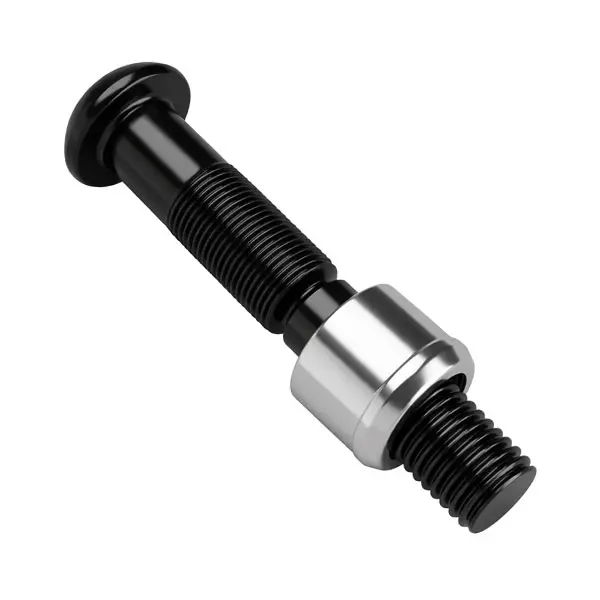
Huck Bolts
Huck bolts are two-piece structural fasteners combining a grooved pin with a swaged collar, forming a permanent vibration-resistant joint without threads.
Standard
BS 7805 Part 1, BS 7805 Part 2
Material
Carbon Steel, Alloy Steel, Stainless Steel, Aluminum
Size Range
1/4" to 1", M6 to M24
Product Information
Product Code
CB-HUCK-HB
Standard
BS 7805 Part 1, BS 7805 Part 2
Material
Carbon Steel, Alloy Steel, Stainless Steel, Aluminum
Grade
Grade 5.8, Grade 8.8, A2 Stainless Steel, A4 Stainless Steel
Size Range
1/4" to 1", M6 to M24
Surface Finish
Plain, Zinc Plated, Double Zinc Plated, Geomet
Packaging
Bulk packaging, carton packaging, pallet packaging, and custom packaging available.
Customization
Customization available. Custom sizes, special materials, and special surface finishes.
Lead Time
Negotiable
Product Overview
Huck bolts are permanent structural fasteners consisting of a grooved pin and a separate collar. Unlike conventional bolts, the pin has annular locking grooves instead of helical threads, and the collar is swaged into those grooves during installation using a hydraulic or pneumatic tool. The result is a joint that cannot loosen under vibration because there is no thread to rotate. This makes the Huck bolt a hybrid between a high-strength bolt and a rivet: it provides the clamping force of a bolt and the permanence of a rivet, without the need for lock washers, cotter pins, or torque verification.
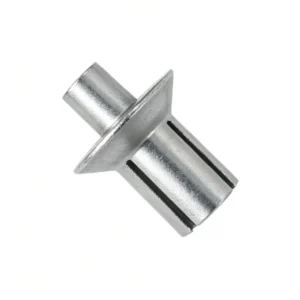
The pin is available in several head styles: round head, flat countersunk head, brazier head, and truss head. The collar also comes in three configurations: standard, flanged, and cylindrical. The combination of pin head and collar type is selected based on the joint geometry and the surface conditions of the workpiece. During installation, the tool pulls on the pintail while the collar is compressed radially into the locking grooves. When the joint is fully clamped and the collar is fully swaged, the pintail breaks off at a breakneck groove, leaving a finished joint that can be inspected visually for proper installation.
Huck bolts are installed from one side of the workpiece, which allows assembly where access to the rear is limited. Installation is faster than conventional bolting because there is no torqueing sequence and no secondary locking device to fit. The absence of a helical thread also means the joint has higher fatigue resistance than a standard nut-and-bolt connection under cyclic loading.
These fasteners are used in structural steel connections for bridges, overhead cranes and crane rails, factory truss structures, wind turbine towers, vibrating screen and crusher frames, and mining machinery where joints are subjected to dynamic and vibratory loads. In truck and trailer body assembly, railcar and rolling stock construction, and container and shelter fixing, Huck bolts provide permanent structural connections that do not require re-tightening during service. When selecting a Huck bolt, the key factors are the grip range required by the joint thickness, the pin diameter matched to the hole size, and the material combination of pin and collar appropriate for the service environment. Common trade names include HuckBolt, Huck lock bolt, and Huck-type lockbolt.
Related Products
Ready to Source This Fastener?
Need a quotation, technical support, or custom fastener solutions? Complete the form below, and we'll provide the information you need for your project.