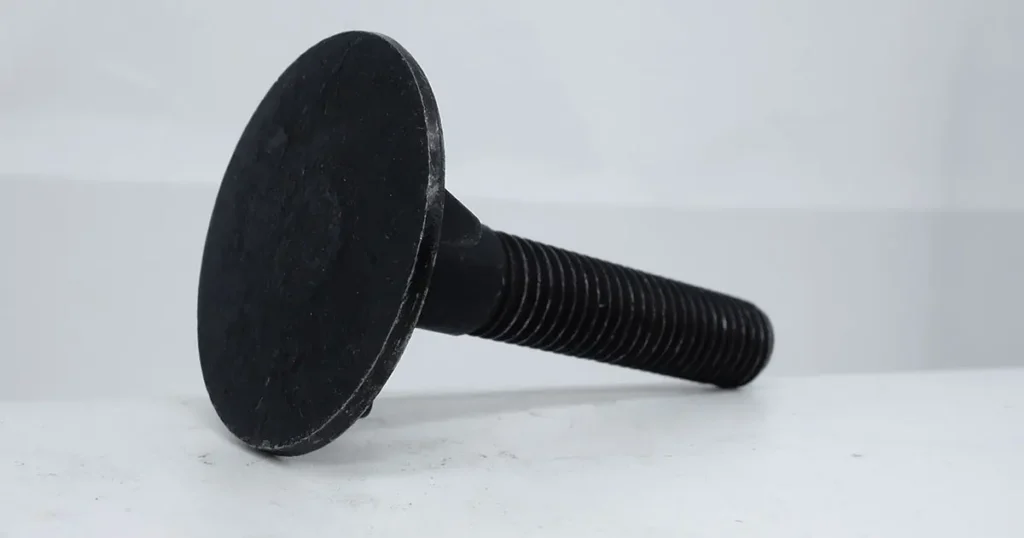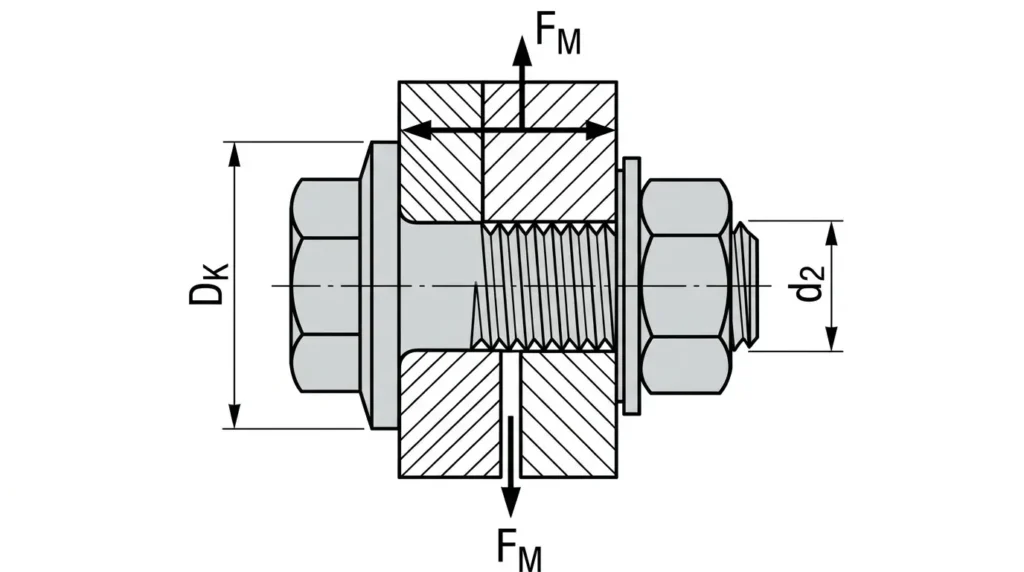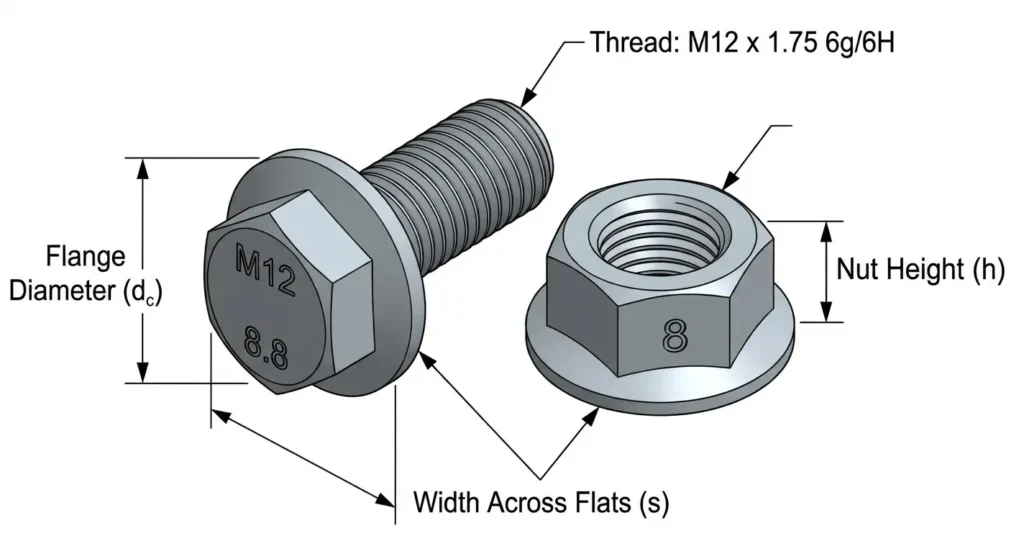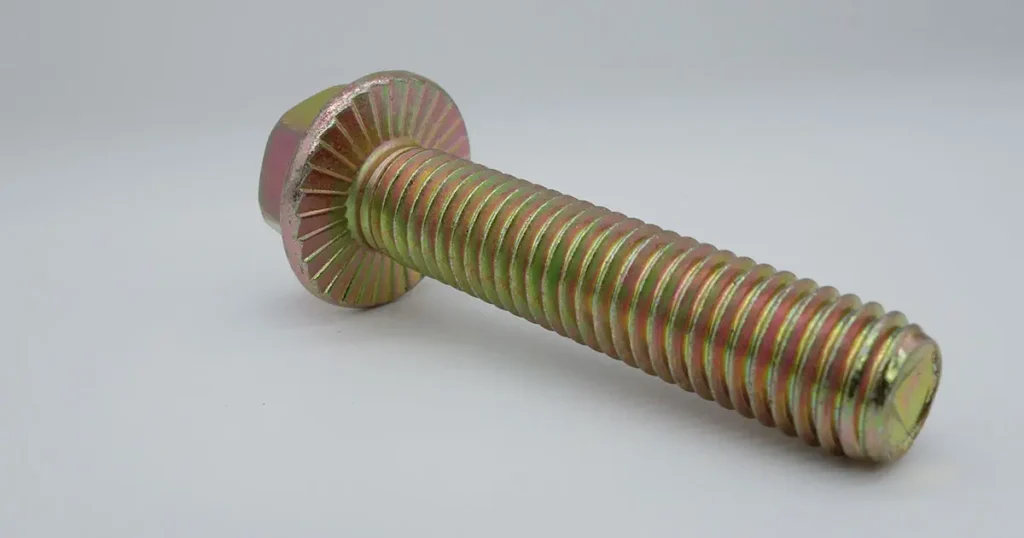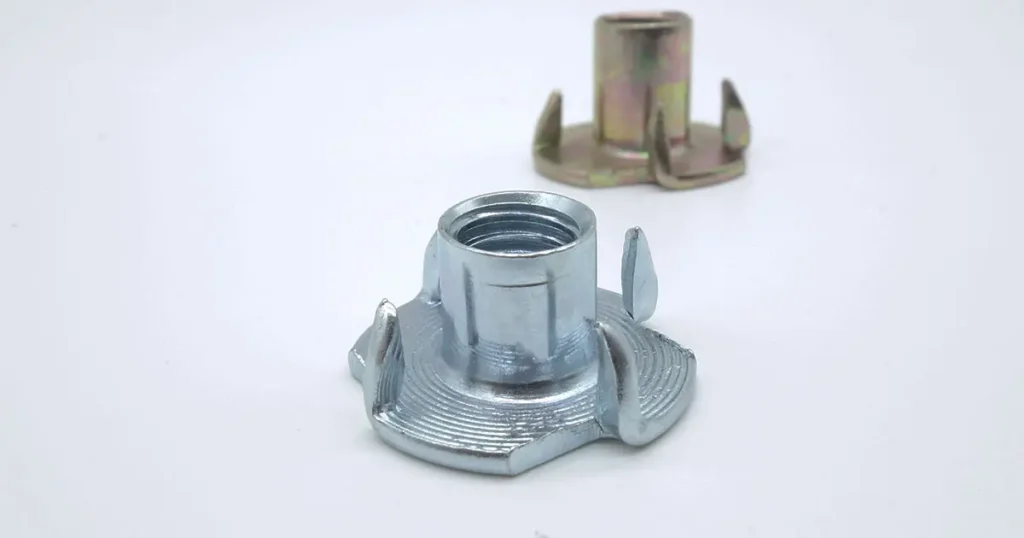
A four-prong tee nut puts a reusable machine thread into a wood or panel component that cannot hold an ordinary nut. It is driven into a drilled hole from the face that will be hidden: the four prongs bite into the material so the nut cannot turn, the flange seats against the surface, and the threaded barrel stays in line with a bolt that arrives from the other side. Pronged tee nuts are used for that single job, and nearly every application below is a variation on it.
Two conditions call for one: access and repetition. A hex nut needs a wrench on the far side of the panel. A coach screw needs no access at all, but it cuts its own thread into the material and loses grip every time it is removed. A tee nut gives you a steel thread where you cannot reach, and it survives being assembled, stripped and assembled again.
What each part of the nut does
A pronged tee nut is a single piece: a threaded barrel, a flange at one end, and prongs formed out of the flange and bent to run alongside the barrel. Like any other nut, its job is to supply an internal thread; what makes it different is where that thread ends up sitting.
| Part | What it does | What goes wrong if it is wrong |
|---|---|---|
| Threaded barrel | Carries the internal thread the bolt engages, and its length decides how many threads are available | Too short for the panel and the bolt crosses an empty hole before it engages, so less thread is available; too long and the barrel protrudes past the opposite face, where it interferes with the mating part |
| Flange | Bears on the panel face and spreads the clamp load so the nut does not sink | A small flange on a soft face crushes the surface before the joint is tight |
| Prongs | Bite into the material and resist rotation while the bolt is tightened or loosened | Blunt prongs, an oversized hole or a brittle panel let the nut spin in place |
This article covers the four-prong version; three-prong versions are also made. The extra prong buys more points of grip around the barrel, but it does not turn the nut into a load-rated anchor, and no tee nut should be chosen on prong count alone.
The prongs and the barrel do different jobs
Most of the confusion around this fastener comes from treating the prongs as the holding feature. They are an anti-rotation device. Their job is to engage the material firmly enough to stop the nut turning when torque comes through the bolt. The thread is in the barrel, and the load path runs from the bolt, through the barrel, out through the flange and into the panel face. The panel, not the nut, sets the limit on the joint.
That division explains the two failure modes that matter. If the prongs lose their grip, the nut spins and the bolt either never tightens or never comes out. If the material around the flange gives way, the nut takes a shallow cone of panel with it and the joint goes slack. Tightening harder fixes neither; on a soft panel it brings the second one on faster. And once a nut has spun inside a closed assembly, recovery is awkward, because the flange is on the side nobody can reach.
It also sets the tightening rule. The bolt should be tight enough to hold the joint and no tighter. Past that point the flange starts to crush the face, the prongs widen their own slots, and the nut loses the grip it will need at the next assembly.
Where four-prong tee nuts are used
Pronged tee nuts are used wherever a bolt has to come in from the finished side of a panel and there is nothing behind the panel to hold a nut. A standard four-prong tee nut is the usual answer.
| Application | Typical arrangement | Why the tee nut fits |
|---|---|---|
| Tables and desks with bolt-on legs | Nut set into the underside of the top; leg bolt comes up from below | The top face stays clean and the legs ship flat |
| Knock-down cabinets and casework | Nuts in gables and panels for brackets, legs and fittings | The cabinet is assembled and adjusted on site, sometimes more than once |
| Seating and bed frames | Nuts in rails and upholstered frames for legs and brackets | The frame is covered before assembly, so the inner face is closed |
| Speaker cabinets and enclosures | Nuts on the inside of the baffle; driver screws from outside | Nothing can be held inside a sealed box |
| Workbenches, jigs and fixtures | Nuts in the underside of a top or in a fixture plate | Fittings can be moved, re-tightened and removed |
| Climbing walls and panel-mounted fixtures | Nuts set from the back of the panel, barrel flush with the climbing face | Holds and fittings are rearranged constantly, and the bolt head has to stay flush |
The pattern repeats because the geometry repeats. Upholstered frames, bed rails and cabinet gables are finished or covered before the bolts go in, so the hidden face is already closed when the joint is assembled. A speaker cabinet is sealed. A climbing wall is painted, and its holds get moved. In each case the tee nut goes in during manufacture, while the hidden face is still open, and the bolt arrives later, often by someone else.
Materials that suit a pronged tee nut
The nut is only as good as the material it is driven into. Four prongs need a material that accepts them without splitting and then holds them under torque.
| Material | How it behaves | What to watch |
|---|---|---|
| Plywood | Cross-laminated construction resists splitting and gives the prongs a firm bite | Voids: a barrel sitting over a void has nothing to grip |
| MDF | Dense and uniform, drills cleanly, grips evenly on the face | Low tolerance for over-torque and for fastening close to an edge |
| Particleboard | The face holds acceptably; the coarse core is the weak point | Crumbles if the hole is undersized or the nut is driven in hard |
| Solid wood | Good in face grain, poor in end grain | Splitting along the grain; hardwoods need a clean hole of the correct size |
| OSB and similar strand boards | Prongs grip, but the surface is uneven | The flange may not seat flat, so the nut sits slightly proud |
| Sheet metal and aluminium | Nothing for the prongs to enter | Use a weld nut or a rivet nut instead |
| Thin hardboard, glass, stone, solid surface, foam-cored panels | No material for the prongs to bite, or no thickness to bury the barrel | A different fastener family entirely |
Plywood and other engineered wood panels underpin much cabinet, casework and furniture production, from residential kitchens to commercial displays. That is the environment where the pronged tee nut belongs, and it is also where the panel, not the fastener, decides how much the joint will take.
Six questions that settle the choice
- Can you reach the far side? If a wrench fits behind the panel, an ordinary nut and washer is cheaper and usually the stronger joint. The tee nut is for the joint where nothing can be held on the back.
- Does the barrel match the panel? A barrel much shorter than the panel leaves the bolt crossing part of the hole before it engages, which reduces thread engagement on the bolt-entry side. A barrel much longer than the panel protrudes past the opposite face and interferes with the mating component. Match the barrel length to the panel thickness and to the actual assembly geometry.
- Will the joint be opened again? If it is assembled once and never touched, a screw or a knock-in insert is enough. Repeated service is where the steel thread earns its cost.
- What is the load doing? A tee nut takes load along the bolt axis well enough for furniture and light equipment. Sideways load, vibration and anything overhead need an engineering check, not a catalog description.
- What is the environment? Zinc plating is adequate indoors. Damp, exterior or treated timber calls for stainless steel or a heavier coating, and the bolt has to match the nut.
- Which bolt? The thread size and pitch of nut and bolt must be the same, and the bolt length has to cover the part, the panel and the barrel without bottoming out.
Fasteners that are also called T-nuts
The name is imprecise, and a drawing settles in one minute what a description can argue about for a week. These are the parts most often confused with a pronged tee nut.
| Name in the catalog | What it actually is | Where it belongs |
|---|---|---|
| Pronged tee nut | Flanged nut with prongs, driven into wood or panel | Furniture, cabinets, seating, speaker cabinets, panel fixtures |
| T-slot nut, hammer nut, sold as T-nut | Nut that slides into an aluminium extrusion slot | Machine frames, guards and jigs built from profile |
| Threaded insert for wood | Screw-in or knock-in insert with a machine thread | End grain, thicker sections, joints that must be adjusted |
| Cross dowel, barrel nut | Cylindrical nut set across the panel | Flat-pack joints where a cross hole can be drilled |
| Rivet nut, blind nut | Tubular rivet with an internal thread | Sheet metal and tube |
| Weld nut | Nut welded to steel | Fabricated steel parts |
The most confusing overlap is “blind nut”, which some catalogs use for the pronged tee nut and others for a rivet nut. A quote taken from a description alone can deliver the right family and the wrong fastener.
What to put on the order
For a part that has to repeat, the description needs more than a name and a thread size.
- Thread size and pitch, and the thread standard it follows
- Barrel length and outside diameter
- Flange diameter and thickness
- Prong count
- Material and grade
- Finish, with the corrosion environment stated
- Packaging, and whether the nuts have to run through an automatic driving machine
- A sample or first-article check against the drawing before the run
A tee nut is a small, cheap part doing a load-bearing job in a material that was never designed to hold a thread. When the panel, the barrel length and the prong grip all line up, it is the least expensive way to put a serviceable thread into wood. When one of the three is wrong, the failure turns up at the stage of assembly where nobody can correct it.