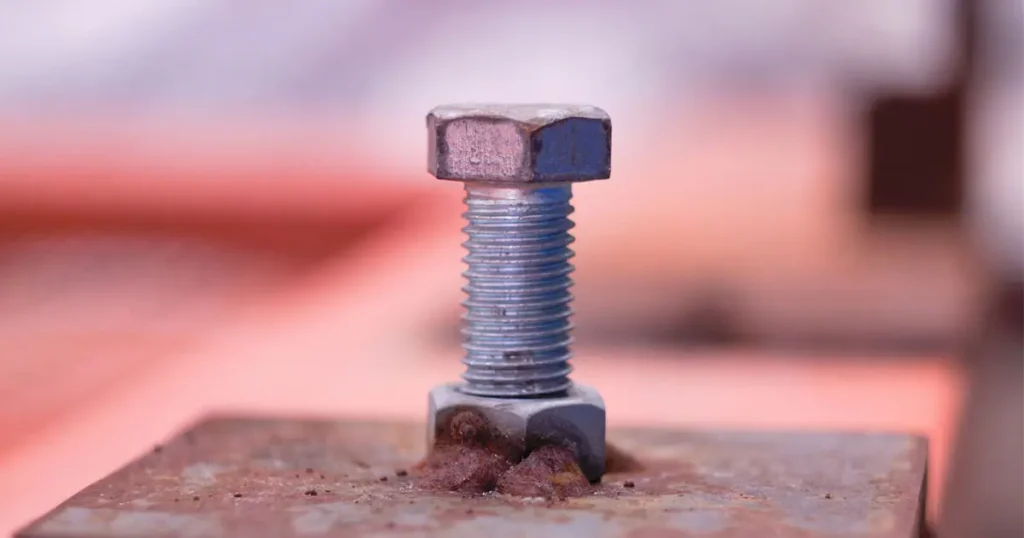
DIN 961 has been replaced by ISO 8676, and for most sizes the two describe the same screw. DIN 961 is the withdrawn German standard for hexagon head screws with a metric fine pitch thread, threaded up to the head. Its current counterpart is ISO 8676:2022, adopted in Germany as DIN EN ISO 8676:2022-10, which covers the same product form over a wider size range. Where the two tables overlap, the thread and the head height are the same, and the head dimensions that do change are confined to four sizes: M10, M12, M14 and M22. At those sizes the width across flats, the across-corners dimension and the bearing face diameter all differ; at every other size in the two tables they agree.
The practical answer is therefore narrower than “equivalent” suggests, and it comes with a condition. A DIN 961 screw is the same fastener as an ISO 8676 screw made to the current table only if the drawing does not depend on the legacy spanner size. Get that one dimension wrong at M22 and a correct part looks like a wrong one.
It is also worth placing the two designations in the family before comparing them. DIN 961 and ISO 8676 both describe a hexagon head screw with a fine pitch thread running up to the head — the fully threaded member of the metric hexagon head group. The partially threaded member is DIN 960, replaced through ISO 8765, and the coarse pitch pair is DIN 933 and ISO 4017.
| Point of comparison | DIN 961 | ISO 8676 |
|---|---|---|
| Product | Hexagon head screw, metric fine pitch thread, threaded up to the head | Same product form |
| Status | Withdrawn (edition 1990-01) | Current |
| Governing document today | — | ISO 8676:2022; German edition DIN EN ISO 8676:2022-10 |
| Thread range | M8 × 1 to M52 × 3 | M8 × 1 to M64 × 4 |
| Size range in the table | M8 to M52 | M8 to M64 |
| Width across flats | 17 / 19 / 22 mm at M10 / M12 / M14; 32 mm at M22 | 16 / 18 / 21 mm at M10 / M12 / M14; 34 mm at M22 |
| Product grades | A and B | A and B — grade A for d = 8–24 mm with l ≤ 10d or 150 mm, grade B above that |
| Property class / stainless grade | Not fixed by the standard | Not fixed by the standard — selected from ISO 898-1 or ISO 3506-1 |
All of that follows from one decision: are the two designations interchangeable for the part you are buying? They are, if the drawing and the supplier are both working to the current table — and the four sizes above are where that has to be checked rather than assumed.
The route from DIN 961 to ISO 8676
DIN 961 is not current and has not been for a long time. The DIN 961 dimension table carries the cancellation notice and states that the standard was replaced by DIN EN ISO 8676. The German catalogue record for the intermediate document records the same handover from the other direction: DIN EN 28676:1992, the German version of EN 28676:1991 and of ISO 8676:1988, lists DIN 961:1990-01 among the standards it replaced, and names DIN EN ISO 8676:2001 as its own replacement.
The full chain is four steps:
- DIN 961:1990-01 — hexagon head screws, metric fine thread, threaded to the head. Withdrawn.
- DIN EN 28676:1992-02 — the European adoption of ISO 8676:1988, published 1 February 1992. Superseded.
- DIN EN ISO 8676:2001, then DIN EN ISO 8676:2011 — the ISO editions as adopted in Germany. Both superseded.
- DIN EN ISO 8676:2022-10, the German edition of ISO 8676:2022 — current. ISO 8676:2022 is edition 4, published 28 June 2022, and it replaced ISO 8676:2011.
Two habits cause most of the confusion around this chain. The first is treating the DIN EN step as a formality. DIN EN 28676:1992 was a real document with its own number, and a drawing that cites it is neither citing DIN 961 nor citing ISO 8676 directly. The second is treating the ISO document as a reprint of the German one under a new cover. It is a European and international adoption of an ISO standard whose own editions have changed since 1988, and the dimension that changed is the subject of the next section.
What actually differs between the two documents
The width across flats at M10, M12, M14 and M22
More than one head dimension changed at these four sizes, and it is worth being precise about which. The width across flats is the most visible and the one that stops a job first, because the socket either fits or it does not. The across-corners dimension moves with it, as it must — it is a function of the width across flats — and the bearing face diameter under the head differs as well. Head height does not change.
| Size | DIN 961 across flats (mm) | ISO 8676 across flats (mm) | Change |
|---|---|---|---|
| M10 | 17 | 16 | −1 mm |
| M12 | 19 | 18 | −1 mm |
| M14 | 22 | 21 | −1 mm |
| M22 | 32 | 34 | +2 mm |
M22 is the clearest illustration, because there the change runs through all three dimensions and the across-corners value moves by 2 mm: the withdrawn DIN 961 table gives the M22 head 35.72 mm across corners at grade A and 35.03 mm at grade B, while the current DIN EN ISO 8676 table gives 37.72 mm and 37.29 mm. Its width across flats goes from 32 mm to 34 mm at the same time. M22 also makes the direction clear: the change cannot be remembered as “the ISO head is always smaller”. Every other size in the two tables takes the same spanner — M8 at 13 mm, M16 at 24 mm, M20 at 30 mm, M24 at 36 mm — and the same across-corners and bearing face dimensions.
The size range widened upwards
The withdrawn DIN 961 table runs from M8 to M52. The current standard is scoped from M8 × 1 to M64 × 4, and its table carries M56, M60 and M64 in addition. At the bottom of the range the two documents start at the same place — M8 × 1 is tabulated in both — so there is no small-diameter gap to bridge. Diameters from M27 upwards are also where product grade B begins to apply rather than a different product.
The fine pitches changed at some sizes
The withdrawn DIN 961 table tabulated pitches for M8 × 1, M10 × 1 and M10 × 1.25, M12 × 1.25 and M12 × 1.5, M14 × 1.5, M16 × 1.5, M18 × 1.5 and M18 × 2, M20 × 1.5 and M20 × 2, M22 × 1.5 and M22 × 2, M24 × 1.5 and M24 × 2, then M27 × 2 up to M45 × 3, M48 × 3 and M52 × 3. The current DIN EN ISO 8676 table covers a wider range and an overlapping set of pitches, and the differences are size-specific rather than a general reduction. M10, M12, M18, M20 and M22 keep two fine pitches, although in the current table every one of those entries except M10 × 1.25 and M12 × 1.5 is marked as a non-preferred size, and M24 × 1.5 is not among them — M24 is listed at 2 mm pitch only. M48 × 3 is still M48 × 3, while M52 × 3 has become M52 × 4 and is non-preferred at that pitch. M56, M60 and M64 are added at 4 mm pitch.
What that means on an order is specific rather than general. A legacy call-out such as M24 × 1.5 no longer appears in the current table, and M52 × 3 has become M52 × 4. Neither size is automatically unavailable — a manufacturer can still produce a thread that the current standard does not list — but it is no longer the size the standard carries, and an enquiry should say which pitch is actually required rather than leaving it to be inferred from the designation.
What the standards do not fix at all
Neither document fixes strength. DIN 961 and ISO 8676 are dimensional standards; mechanical requirements come from elsewhere. The current scope points to ISO 898-1 for steel property classes and ISO 3506-1 for stainless steel grades, with dimensional options from ISO 888 or ISO 4753. A DIN 961 screw and an ISO 8676 screw of the same diameter, pitch and property class therefore have the same strength, and a change of designation on its own tells you nothing about the grade of the parts behind it.
Are the parts interchangeable in practice?
A part made to the current table is a valid replacement for the legacy designation, provided the drawing is treated as a dimensional document rather than a part number. Three practical consequences follow.
- The spanner size is the visible one. At M10, M12 and M14 the current head is one millimetre smaller across flats, so the socket that has always been used on the legacy part is loose on a current one. At M22 the current head is two millimetres larger, and a 32 mm socket will not go on at all. Both directions are easy to mistake for a wrong part.
- An assembly that depends on the old head can fail a substitution. If the screw head sits in a recess, a counterbore or a clearance pocket, or if the joint has a captive washer or a defined bearing area, a head that changes by 1 mm or 2 mm across flats is a design change rather than a like-for-like swap. Check the drawing before assuming the substitution is transparent.
- The pitch is part of the fit, not of the standard. A fine pitch screw only runs into a matching fine pitch internal thread. Where a legacy pitch was dropped from the current table, the mating nut or tapped hole has to follow the new pitch, or the parts will not assemble at all.
One pairing error to avoid
Published comparison tables sometimes pair DIN 961 with ISO 8676, which is correct, and DIN 960 with ISO 8675, which is not. ISO 8675 is Hexagon thin nuts (style 0), with fine pitch thread — a nut standard, not a screw standard. The fine pitch companion to the partially threaded DIN 960 is ISO 8765, and the fully threaded form is the one that pairs with ISO 8676. Pairing a screw standard with a nut standard is a different category of error from a dimensional mismatch, and it is the one that sends a buyer to the wrong product page entirely.
Checking a DIN 961 / ISO 8676 substitution
Most supplier data sheets that carry both designations are not claiming the documents are identical. They are cross-referencing, which is why some of them hedge with “similar to”. The following checks settle the question for a specific order:
- Record which document and edition the drawing cites — DIN 961, DIN EN 28676, DIN EN ISO 8676 or ISO 8676, and the year. A drawing that cites DIN 961 is describing a withdrawn document; the current table is the reference point for anything new. It also confirms which product is meant, since DIN 960 and DIN 961 differ in thread coverage before any standard transition is considered.
- Confirm the thread pitch — M10 × 1.25 or M10 × 1, M22 × 1.5 or M22 × 2. Where a legacy pitch is no longer listed in the current table, decide deliberately whether to keep it or move to the pitch the standard now carries.
- Confirm the width across flats at M10, M12, M14 and M22. This is the check that prevents a line stoppage. It is also the check most easily skipped, because the difference is invisible until a socket is offered up.
- State the property class or stainless grade separately — 8.8, 10.9 or 12.9 for steel, or a full stainless designation such as A2-70 or A4-80. The designation DIN 961 or ISO 8676 does not carry this information.
- Confirm the finish and whether it affects thread fit — plain, zinc plated, hot dip galvanized or another coating.
- Write the call-out in one line — for example
ISO 8676 - M12 × 1.5 × 50 - 8.8, orDIN EN ISO 8676 - M12 × 1.5 × 50 - 8.8where the German edition is the reference. Keeping the DIN 961 number alongside it as a cross-reference is good practice; treating the two as the same document is not.
DIN 961 is withdrawn and ISO 8676 is its current counterpart, reached through DIN EN 28676 and two earlier ISO editions. The product form, the thread system and the strength framework are unchanged, and the head geometry agrees everywhere except M10, M12, M14 and M22, where the width across flats, the across-corners dimension and the bearing face diameter all move — the width across flats from 17, 19, 22 and 32 mm to 16, 18, 21 and 34 mm. ISO 8676 also reaches up to M64 and its pitch table is not simply a shorter version of the DIN one: M10, M12, M18, M20 and M22 still carry two fine pitches, M24 × 1.5 and M52 × 3 do not carry over as they stand, and only some of the current entries are preferred sizes. So the two designations are equivalent as descriptions of a product and not identical as documents — and whether one can replace the other is settled by checking the head geometry of the size in question, above all at M10, M12, M14 and M22, and the pitch the drawing actually calls for.
DIN 961 hexagon head screws with fine pitch thread are part of the ChinaBolts metric bolt range, supplied in carbon, alloy and stainless steel across the standard property classes and finishes. Send the diameter, the pitch, the length, the property class or stainless grade, the finish and the width across flats the drawing requires, and we will confirm the dimensions against the standard you are working to before the order is placed.