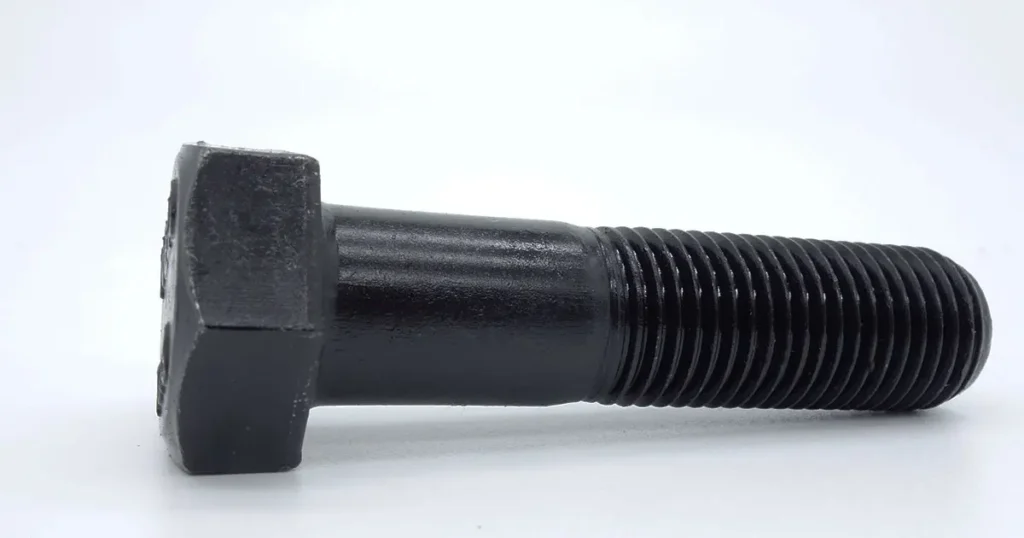
A carriage bolt and a hex bolt solve the same problem — clamping two parts together — in two different ways. The carriage bolt has a smooth domed head and a square neck under it, and no wrenching feature at all; it stays still because the square neck bites into the material or seats in a square hole. A hex bolt has a hexagonal head that a wrench or socket can grip, so it can be driven from the head side and used with a nut or in a tapped hole.
That difference in head design decides more than appearance. It decides which side of the joint has to stay accessible, how the bolt resists turning, how much the head protrudes, and whether the joint can be prepared to accept a square neck at all. It does not, on its own, tell you which fastener is stronger. Strength comes from the governing specification and the mechanical property class, not from head shape.
| Point of comparison | Carriage bolt (round head square neck) | Hex bolt |
|---|---|---|
| Head | Smooth domed head, no drive recess or wrenching flats | Hexagonal head with six wrenching flats |
| Wrenching feature | None on the bolt; the nut is turned | Head can be gripped by a wrench or socket, and the nut too |
| Anti-rotation | Square neck under the head engages the material or a matching square hole | Held by the wrenching feature during tightening |
| Access needed | One side only for tightening, the other side for holding | Ideally both sides; a tapped hole allows one side |
| Head profile | Low domed profile; no sharp corners or snag points | Taller, flat-topped head with six corners |
| Typical thread form | Coarse thread; commonly partially threaded | Coarse or fine thread; partially or fully threaded |
| Inch-series dimension standard | ASME B18.5 (round head bolts, inch series) | ASME B18.2.1 |
The two carriage-bolt standards that matter most in purchasing are ASME B18.5 for inch sizes and DIN 603 for metric sizes. The rest of this comparison uses those two as the reference points.
They Are Specified by Different Standards
Carriage bolts and hex bolts do not sit in the same standard family, and the split matters when you write a purchase order.
In inch sizes, round head square neck bolts are dimensioned by ASME B18.5, Round Head Bolts (Inch Series). The 2012 edition was reviewed and reaffirmed in 2023 and is the edition currently in effect. B18.5 covers the general and dimensional data for the inch-series bolts classified as round head bolts — a group that includes round head, step and elevator types — and it deliberately points to other standards for threads, materials, mechanical properties and finishes rather than fixing them itself. That is an important detail: B18.5 tells you the shape and the dimensions, and something else has to tell you the grade.
Metric carriage bolts are a separate, parallel framework. DIN 603, Cup head square neck bolts, is the German document; its current edition is DIN 603:2026-08, which replaced DIN 603:2017-05. Two international documents cover the same product family with different geometry: ISO 8677 for cup head square neck bolts with a large head, and ISO 8678 for cup head square neck bolts with a small head and short neck, the latter at product grade B and covering M6 to M20 in nominal lengths from 12 mm to 160 mm. Check the status of these two before quoting them: ISO 8677:1986 carries a withdrawn status, while ISO 8678:1988 is published and was confirmed as current in August 2025.
The practical consequence: “M10 carriage bolt” and “3/8 in carriage bolt” are not two ways of saying the same thing, and a DIN 603 bolt is not automatically interchangeable with an ISO 8678 bolt of the same thread diameter — the two documents define different head and neck proportions. If a drawing calls for one of them, the drawing is calling for that head and neck geometry. Read the standard reference on the drawing before quoting.
Hex bolts are dimensioned separately again. Inch-series hex bolts fall under ASME B18.2.1, Square, Hex, Heavy Hex, and Askew Head Bolts and Hex, Heavy Hex, Hex Flange, Lobed Head, and Lag Screws (Inch Series), a standard that covers nine product types of square and hex bolts and screws. The 2012 edition was reaffirmed in 2021 and remains in effect. It is a dimensional standard, and it is widely referenced: ASME B18.2.1-2012 is incorporated by reference in United States marine engineering regulation, which is one reason its dimensional data is treated as the common basis for inch-series hex bolts. Note that heavy hex structural bolts are no longer covered by B18.2.1; they have their own standard, ASME B18.2.6.
So the first question to settle is not which head is better. It is which standard the joint was designed to. If you need the full range of metric hexagon head bolts, that is a separate family again — see the bolts category for how the main product groups are organised.
Head Design Determines Installation Access
The head is where the two fasteners diverge in daily use.
A hex bolt gives you two places to apply torque: the hex head and the nut. That makes it usable as a bolt through a clearance hole with a nut, and also as a headed screw threaded into a tapped hole, where the head does the work by itself. It also means the joint can be tightened to a controlled torque and re-tensioned later, provided a wrench or socket fits the head.
A carriage bolt gives you one place to apply torque: the nut. The domed head has no flats and no recess, so there is nothing to grip. The head is held only by the square neck engaging the surrounding material or a square opening. In practice, a carriage bolt is inserted from the “good” side of the assembly — the side that will be seen or touched — and the nut is run up from the other side. The domed head leaves that visible face smooth, with no exposed corners and nothing to catch on.
That shape is why carriage bolts appear on trailer beds, dock boards, benches, fencing, playground equipment, agricultural implements and similar assemblies. The exposed head does not snag cargo, clothing or hands, and it cannot easily be turned from the outside, which is also useful where casual tampering is a concern. It is not a security fastener — the nut is still accessible from the other side — but the head itself offers nothing to work against.
The trade-off is accessibility. A carriage bolt cannot be tightened from the head side, and it cannot be used in a blind tapped hole. If the assembly leaves no room to reach the nut with a wrench, a carriage bolt is the wrong choice regardless of its strength.
How the Square Neck Resists Rotation
The square neck is the entire anti-rotation system, and it only works when it is engaged.
There are two ways to engage it:
- In timber or a soft material. The square neck is drawn into the wood as the nut is tightened. Provided the hole through the timber is sized so that the round shank passes but the square section does not, the neck beds into the wood and the bolt stops turning.
- In a matching square hole in metal. A steel strap, plate or bracket can be punched or drilled with a square opening that the neck seats into. The square does the work; friction is not relied upon.
If neither condition is met, the bolt spins. One field failure is a hole drilled oversize — large enough that the square neck never grips — in a material the neck cannot bite into. The assembler turns the nut, the whole bolt rotates, and the joint never develops tension. There is also no way to hold the head to stop it. The fix is not a bigger wrench; it is a correctly sized hole, a square opening, or a different fastener.
On the face that the neck bears against, the engagement also means the square corners are pressed into the material. In thin sheet metal that can distort the sheet, and in brittle materials it can crack them. Hex bolts avoid this because they clamp flat against a washer and the clamped surface.
Metric cup head square neck bolts are made both with a large head, as in ISO 8677, and with a small head and short neck, as in ISO 8678. The short-neck version can only work in a joint whose clamped thickness leaves the square sitting where it can still engage. If you are working with the small-head, short-neck form, check the head and neck dimensions against the clamped thickness rather than assuming the assembly will seat.
Strength Depends on the Specification, Not the Head
This is where head shape stops being informative. Neither head has an inherent strength. What the bolt can carry comes from the material and mechanical property class the governing specification assigns to it, together with its dimensions, the way the joint is built, and the size of the bolt. The last point is easy to miss: a single grade can carry different strength values at different diameters.
- Inch-series carriage bolts are supplied to ASTM A307, whose official title states the anchor value directly: Standard Specification for Carbon Steel Bolts, Studs, and Threaded Rod 60 000 PSI Tensile Strength. A307-21 is the current edition. This is a general-engineering specification rather than a high-strength structural one.
- Hex bolts can be made to the same kind of general-engineering specification — A307 hex bolts are widely available — but they can equally be made to high-strength structural bolting specifications, or to the SAE J429 grade system, reaching considerably higher strength levels in the same head shape.
- In metric sizes the same logic runs through ISO 898-1, Mechanical properties of fasteners made of carbon steel and alloy steel — Part 1: Bolts, screws and studs with specified property classes, which is where the familiar property class designations come from. A metric hex bolt and a metric carriage bolt are not distinguished by their heads; they are distinguished by the property class marked on them and the material behind it.
Two ordering lessons follow. First, a carriage bolt and a hex bolt of the same diameter and material can have the same nominal strength — or very different strengths — depending entirely on their property class. “Carriage bolts are weaker” and “hex bolts are stronger” are both statements about the specification, not about the head. Second, a product grade is not a strength class. DIN 603 grade C and ISO 8678 product grade B describe the dimensional and tolerance grade of the product; the mechanical property class has to be specified separately. If a purchase order carries only “grade C” and no property class, it has not specified strength at all.
When a higher class is specified, the matching nut has to be specified too. A high-class bolt with a low-class nut simply moves the failure point into the nut and can strip the threads before the bolt reaches its rated load.
Why a Carriage Bolt Is Not a Drop-In Replacement for a Hex Bolt
Substituting one for the other in a load-critical joint changes more than the part number, and the property-class system itself gives one reason for that.
- Head geometry affects how the class requirement is met. ISO 898-1 states that certain bolts and screws might not fulfil its tensile or torsional requirements because the geometry of their heads reduces the shear area in the head relative to the stress area in the thread, and it names bolts and screws having a low or countersunk head among them. A carriage bolt has exactly that kind of head. This does not mean a carriage bolt has no strength or that it cannot be ordered to a property class; it means the head geometry is a known variable in how the class requirement is demonstrated, so a class number carried over from a hex bolt without checking the product form is not a safe assumption.
- The joint may not be able to hold it. A hex bolt works in a round hole. A carriage bolt needs a square hole, or a material soft enough for the neck to bite. Putting a carriage bolt into an existing round clearance hole in steel removes its anti-rotation function entirely.
- Head bearing changes. A hex bolt head with a washer spreads clamp load over a defined bearing area and tightens directly against the clamped part. A domed carriage bolt head bears on a curved surface and, in softer materials, can crush the material around the neck under high clamp load. The two heads do not distribute load identically.
- The neck creates a discontinuity. The square neck sits at the transition from head to shank. Its presence is a geometric feature that a plain hex bolt shank does not have, and it is introduced at the point of highest bending and stress concentration.
- Tension control is different. A hex bolt can be brought to a controlled torque from either end. A carriage bolt is tightened by the nut alone, and once the neck is fully seated the bolt cannot be turned at all. If a specified preload is part of the joint design, that requirement has to be checked against how the fastener can actually be tightened.
- Standards are not interchangeable. A head that looks similar across ASME B18.5, DIN 603, ISO 8677 and ISO 8678 does not mean the dimensions match. Mixing a metric bolt with an inch nut, or a small-head ISO 8678 bolt into a joint designed for a large-head DIN 603 bolt, is an assembly error, not a substitution.
There is also a design documentation issue. A carriage bolt is often recorded on a drawing simply as “carriage bolt” with a diameter and length, and no standard and no property class. That is not a specification. It leaves the supplier free to deliver any head geometry and any strength class the factory happens to run, and it leaves the buyer with no basis for a claim if the part does not fit or does not hold.
Choosing Between Them
Work through the joint, not the product list.
| Joint situation | Fits better | Reason |
|---|---|---|
| Timber or wood-based panels, one face visible, nut side accessible | Carriage bolt | Square neck beds into the timber and takes the rotation; the domed head leaves the visible face clean |
| Wood to steel bracket, steel plate can take a square or slotted opening | Carriage bolt | Neck seats in the opening; nothing needs to grip the head |
| Steel to steel through a round clearance hole | Hex bolt | The carriage bolt neck would have nothing to engage |
| Tapped hole, no nut, blind or limited access | Hex bolt | Torque is applied to the head itself |
| Assembly to be re-tensioned or torque-checked later | Hex bolt | A controlled torque can be applied to head or nut |
| Smooth, snag-free exposed surface is required | Carriage bolt | Low domed head with no corners |
| Specification calls for a structural bolting grade | Hex bolt | Structural bolting specifications are written around hex-head products |
| Thin or brittle material at the head face | Hex bolt with washer | Avoids pressing square corners into the material |
A short version: if the joint is designed around a smooth head and can provide something for the square neck to bite or seat into, use a carriage bolt. If the joint needs a wrenching head, a tapped hole, a controlled torque, or a structural grade, use a hex bolt — and specify the grade.
What to Put on the Specification
Whether the answer is carriage or hex, an order that can be manufactured and inspected without follow-up questions contains the same five items:
- Standard and edition. ASME B18.5, DIN 603:2026-08, ISO 8678:1988, ASME B18.2.1 — the standard fixes head and neck geometry and is the basis of any dimensional dispute.
- Diameter, pitch and length. Metric or inch, coarse or fine, and the length convention used.
- Mechanical property class. For example ASTM A307 for a general-engineering inch-series carriage bolt, or an ISO 898-1 property class for a metric bolt. This is the line that actually determines strength — product grade alone does not.
- Material and finish. Carbon steel or stainless steel, and plain, zinc plated or hot-dip galvanized. If hot-dip galvanizing is required, say so at the quotation stage so coating thickness and thread fit are handled deliberately.
- The nut. Class-matched to the bolt, for example a nut to ASTM A563/A563M for carbon and alloy steel nuts in inch or metric sizes. Nut dimensions and nut strength are covered by different documents, so both the nut standard and its grade have to be stated.
Two worked examples make the difference clear. A guardrail repair specified as “3/8-16 UNC x 2-1/2 in ASME B18.5-2012 (R2023) round head square neck bolt, ASTM A307-21 Grade A, hot-dip galvanized, with an ASTM A563/A563M Grade A hex nut tapped oversize to suit the hot-dip galvanized thread” states everything an order needs: the thread size and the length, the product standard that fixes the head and square neck dimensions, the material specification and its grade, the finish, the nut, and the thread fit that the coating requires. Here the two standards divide the work rather than substitute for each other, because ASME B18.5 controls the dimensions of the bolt and ASTM A307 controls its material and mechanical properties, so one cannot stand in for the other. “DIN 603 M10 x 80, grade C” is not: it fixes the head and neck geometry, but leaves the strength class open, so the delivered bolt could be a low or a high property class depending on the supplier. On a joint working in tension, that is the difference between passing and failing.
Products in This Comparison
Carriage bolts are often ordered against one of two families: the inch-series round head square neck bolt to ASME B18.5, or the metric cup head square neck bolt to DIN 603. The additional metric option is the small-head, short-neck ISO 8678 cup head square neck bolt, which is a different head geometry again and should not be ordered as a substitute for a DIN 603 bolt without checking the drawing.
For the inch-series carriage bolt itself, ChinaBolts lists ASME B18.5 round head square neck bolts from #10 to 1 in, in carbon steel, alloy steel and stainless steel, and DIN 603 cup head square neck bolts from M5 to M20 in carbon and stainless steel. Both pages state the material and grade options that are actually quoted.
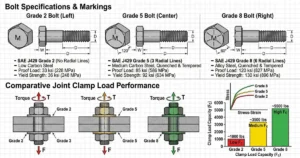
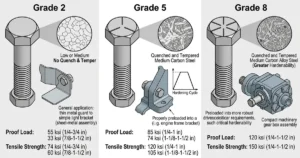
On the hex side, grade is usually the deciding factor rather than head geometry, and a single grade does not mean a single strength figure. SAE J429 Grade 5, for example, is specified at 120 ksi minimum tensile strength from 1/4 in through 1 in, and 105 ksi from over 1 in through 1-1/2 in — the larger diameters carry the lower value under the same grade designation. ChinaBolts lists this product as SAE J429 Grade 5 hex bolts to ASME B18.2.1, which also illustrates how the two standards divide the work: SAE J429 sets the mechanical and material requirements, ASME B18.2.1 sets the dimensions.
If you are comparing carriage bolts with a related round head design rather than with hex bolts — an elevator bolt or a step bolt, for instance — that is a different comparison. ASME B18.5 groups those as separate product types with their own head proportions, and treating them as variants of a carriage bolt is a common source of wrong-part orders.