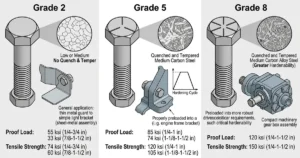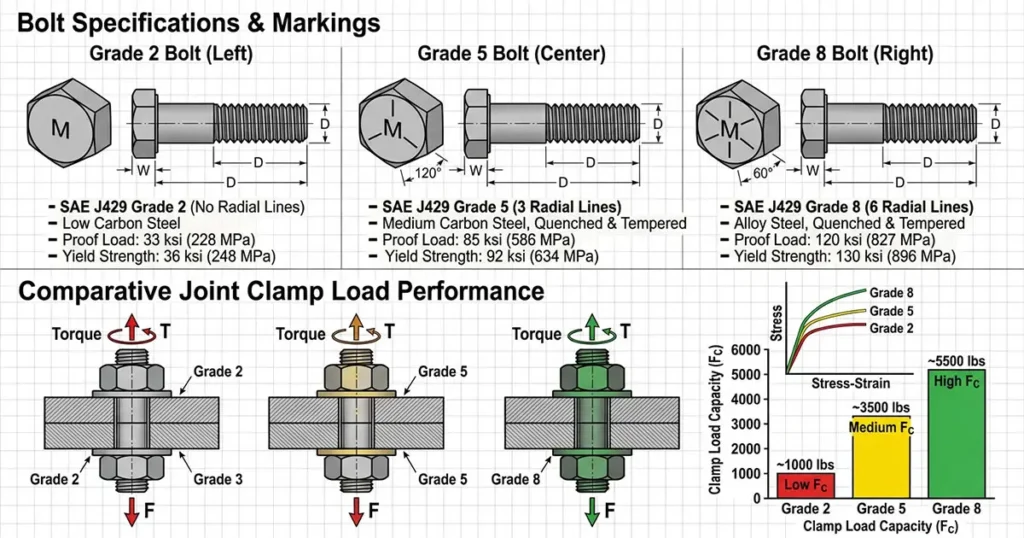
The three grades answer three levels of demand rather than three industries. Grade 2 covers light, general-purpose fastening where the bolt is not the part that limits the joint. Grade 5 covers machinery and equipment assemblies designed around a medium-strength bolt. Grade 8 covers joints that have to carry more load at the diameter they already have. What separates them is capacity and the conditions under which that capacity is asked for, not a list of approved machines.
The joint, not the equipment category, decides which of the three is right. The same 1/2 in bolt can be Grade 2 in one assembly and Grade 8 in another and be correct both times, because the clamp load the design needs, the capacity of the mating thread, the fatigue duty and the governing specification are different. An application list can tell a buyer where to start looking; it cannot tell them what to fit.
Read as a ladder, the grades are also easy to misuse. Each step up adds capacity at the same diameter and costs more to make, which makes the ladder look like a scale of quality. It is a scale of capacity, and a joint designed around Grade 5 does not automatically benefit from a Grade 8 bolt. The higher grade increases the bolt’s available strength but does not itself increase the installed preload, which must be determined by the joint design and remain within the limits of the nut, threads and clamped material.
What a Grade Decides, and What It Leaves to the Joint
SAE J429 sets the mechanical and material requirements for inch-series steel bolts, screws, studs, sems screws and U-bolts up to 1-1/2 in. The current edition is J429_201405, published in May 2014, and the editions before it are withdrawn — which matters when a grade requirement is copied from an older drawing or catalogue.
Within the standard, a grade is a package: a steel class, a heat-treatment condition and minimum properties at stated diameters. That package classifies the part. It does not approve it for an industry, a component or an assembly, and the standard contains no table of applications to consult.
Two statements in the scope do most of the work in selection. Fatigue behaviour, corrosion resistance and impact properties are outside the document, and responsibility for establishing that the product is acceptable where those properties matter rests with the end user. A grade therefore fixes the steel and the room-temperature strength; it says nothing about how a joint behaves under repeated loading, in a wet or chemical environment, or at temperature.
Dimensions come from a separate document. ASME B18.2.1 supplies the dimensional data for inch-series hex bolts and screws, from width across flats to thread length; J429 has no dimension table. A complete part is two references, and a grade on its own still leaves head form, thread series, length basis and class of fit open.
From General-Purpose Assembly to Loaded Machinery
The three grades are easiest to follow as a response to one variable: how much the joint depends on the bolt. In the lightest joints the bolt holds parts together while the sheet, the casting or the thread sets the capacity. In equipment joints the design assumes a preload that the bolt has to sustain against vibration and load. In the heaviest joints both the bolt and the material around it are working near their limits, and the geometry of the joint begins to decide the result.
Grade 2: where something else in the joint is weaker
The applications are ordinary and mostly static: guards, covers, access panels, cabinets, signage, fencing, light brackets, furniture, and the repair hardware kept for exactly that kind of work. What they have in common is not an industry but a load path. The parts are often thin sheet, timber or a soft casting; the joint is often tightened by feel rather than to a calculated preload; and the capacity is set by the sheet gauge, the casting section or the length of thread engagement rather than by the bolt.
That is where Grade 2 fits. A Grade 2 hex bolt can be tightened, but it has the lowest allowable preload capacity of the three, so a joint that depends on clamp load to keep its parts from separating or slipping reaches its limit sooner. Where the design relies on the bolt mainly to locate and retain, the difference between grades buys little, because the fastener is not the part that decides whether the assembly holds.
J429 also makes “Grade 2” less uniform than the label suggests, in two ways a buyer has to control. The required properties step down at the larger diameters inside the 1/4 to 1-1/2 in range. And the Grade 2 requirements carry a length provision: bolts and screws of 1/4 to 3/4 in diameter that are longer than 6 in are held to the Grade 1 property values instead of the Grade 2 values. A 1/2-13 × 8 in bolt ordered as Grade 2 is therefore a different article from a 1/2-13 × 3 in bolt ordered to the same grade, and the order should say which values the lot will be certified to.
The grade stops being adequate at a recognisable point: when the joint depends on a controlled clamp load, sees vibration or reversing load, or carries a safety function. At that point the answer is a higher grade or a different specification, and often a change to the joint itself. Adding bolts or moving up a size does not fix a limit that sits in the parent thread or the clamped material.
Grade 5: the working grade for equipment
Grade 5 is where a great deal of equipment assembly lands: vehicle brackets, mounts, accessory drives and chassis attachments; implement frames, linkage, guards and hitch hardware on agricultural equipment; machine frames, motor and gearbox mounts, drive guards and conveyor structures in plant; and the replacement work on equipment whose manual or parts list names the grade. In each of those settings the grade is there because a drawing, an OEM specification or a maintenance instruction put it there, and that document, not the equipment category, is what makes it correct.
The move up from Grade 2 is usually a preload requirement rather than a load figure. A bracket that sees vibration has to stay clamped; once the joint depends on the bolt holding that clamp load over time, the lowest grade stops being the economical choice, because a joint that loosens or separates puts the whole external load through the bolt instead of only its share. Grade 5 hex bolts are the ordinary answer when the joint needs a preload that Grade 2 cannot hold.
What it does not do is certify anything. A bolt sold as “automotive Grade 5” has not been approved for vehicles by any authority; the approval, where one exists, is the manufacturer’s specification and the validation behind it. The same holds for agricultural and industrial equipment. The grade describes the steel and the strength, while the specification describes the duty.
Fatigue is the factor most often left out at this level, because the grade does not contain it. J429 sets no fatigue requirement, so a Grade 5 callout says nothing about how the joint behaves under repeated loading; that has to come from the joint design, the preload and the service duty. It is also why the same grade can be right for a chassis bracket and wrong for a component carrying a similar nominal load through far more cycles.
Grade 5 stops being sufficient when the joint needs more clamp load than the bolt can develop at the diameter available, or when another standard governs the joint. The options then are Grade 8, a larger bolt, a different fastener type, or a change to the joint. Tightening a Grade 5 bolt further is not one of them: past its limit the bolt yields and the clamp load stops rising with torque.
Grade 8: load without room to grow
Grade 8 appears in the joints that are loaded hardest and have the least space: suspension, steering and driveline attachments where the manufacturer calls for it, implement and structural joints on heavy equipment that see high static or shock loads, and high-load bearing housings, couplings and press frames in industrial machinery. The common feature is a constraint rather than an industry. The joint needs more capacity than Grade 5 gives at the diameter it has, and increasing the bolt size is not an option.
At this level the joint around the bolt matters more than at any other. The higher preload reaches the nut or tapped thread, the washer, the bearing surface and the clamped material, and any of them can become the limiting part. Joint stiffness decides how much of the external load the bolt is asked to carry, so a soft joint or a short thread engagement spends the bolt’s capacity on load the design did not intend it to take. The assembly method also has to produce the intended preload and show that it did, which is a requirement on the process rather than on the bolt.
A Grade 8 requirement and a Grade 8 preference are different things, and the difference belongs on the drawing. Where an OEM specification, a regulated design or a customer drawing names Grade 8, that is the requirement, and fitting a lower grade is an engineering change. Where “heavy-duty” or “high-strength” is only a description, Grade 8 is a choice the joint has to justify: the mating thread, the clamped material, the fatigue duty and the assembly method all have to accept the higher preload.
Greater tensile strength also carries costs that do not show on a data sheet. Grade 8 gives up some ductility relative to Grade 5, so it deforms less before it fractures and redistributes load less well across a group of bolts. It does not strengthen the parent thread, the bearing area under a soft plate, the fatigue life of the assembly or the corrosion resistance of the finish. Where any of those is the limit, the extra strength is paid for and not used.
There is also a size ceiling. J429 stops at 1-1/2 in, so a Grade 8 callout on a larger bolt is not a J429 Grade 8 part, however the catalogue labels it; above that size the drawing has to name a different specification, and the properties come from that document. Grade 8 hex bolts to ASME B18.2.1 sit inside that range.
The Half of the Joint the Grade Does Not Cover
The grade fixes one component of a system, and the rest of that system can turn a correct grade into a failed joint.
The nut is a separate specification. SAE J995 covers three grades of steel nuts from 1/4 to 1-1/2 in, and a Grade 5 bolt with a lower-grade nut has moved the weak point into the thread rather than removed it. Where the bolt goes into a tapped hole instead, the internal thread is only as strong as the parent material and the engagement length allow, and stripping has to be checked as its own failure mode. The bearing surface is the third part: a washer that dishes or a plate that crushes relaxes the joint even when the bolt stays elastic.
Finish belongs in the same list for two different reasons. Corrosion resistance comes from the coating and not from the grade — the standard puts corrosion outside its scope — so a Grade 8 bolt is not a more weather-resistant bolt than a Grade 5. And the coating, with any lubricant, changes the friction in the thread and under the bearing face, which changes the clamp load produced by a given tightening effort. A finish that satisfies the corrosion requirement but is not the one the assembly was set up for alters the joint as surely as a change of grade.
The sequence that avoids most grade errors starts with the specification rather than the shelf. Where a drawing, an OEM requirement or a project standard names a grade, that grade is the requirement; the application categories above explain why it was chosen, and they do not override it. Where nothing is named, the grade follows from what the joint has to carry and what the mating parts can develop, and the working answer is the lowest grade that satisfies both: Grade 2 for light general-purpose work, Grade 5 where machinery loads and vibration are designed around a medium-strength bolt, and Grade 8 only where the extra clamp load is genuinely needed and the rest of the joint can accept it. The strength values and diameter bands behind those choices sit side by side in the Grade 2 vs Grade 5 vs Grade 8 comparison.
What remains is the order, which has to carry everything the grade does not: the dimensional standard, the nominal size and thread series, the length, the finish, the inspection document the lot will be checked against, and the nut specification where the nut is part of the supply. The bolts category covers the inch-series forms those order lines are written against. A grade on its own describes a capability; a line with those elements describes a part that can be quoted, made and verified on delivery.