SAE J429 is the SAE standard that sets the mechanical and material requirements for inch-series steel bolts, screws, studs and U-bolts. The grade numbers used on inch-series fasteners come from it: Grade 2, Grade 5 and Grade 8 are J429 designations, not product names and not dimensional classes. The edition in force is SAE J 429, published in May 2014 and catalogued by SAE as J429_201405.
What the standard does not do matters just as much. J429 fixes the steel and the strength level. It does not fix head shape, thread fit, length, tolerances or coating. An order line that says only “Grade 8” has therefore settled the part’s material and its minimum properties, and left everything that decides whether the bolt fits — and whether it survives the environment it goes into — to be agreed somewhere else.
What SAE J429 covers
The scope is narrow and stated plainly. J429 covers inch-series steel bolts, screws, studs, screws for sems and U-bolts in sizes to 1-1/2 in inclusive. A sems screw is the pre-assembled screw-and-washer item, and it is in scope. Metric fasteners are not: J429 is an inch-series document, written for Unified-thread fasteners, and the equivalent job for metric bolts is done by a different standard with a different designation system.
The standard also defines what it means by a stud — a cylindrical rod of moderate length, threaded at one or both ends or throughout — and states that the term does not apply to headed, collared or similar products, which are covered as bolts. That clause matters at the boundary of a purchase order. A headed part is not a stud because a catalogue heading says so.
The document itself is short: 14 pages in the current edition, with the requirements concentrated in two tables. Table 1 carries the mechanical properties. Table 2 carries the chemical composition, including the limits on sulphur and phosphorus. The rest of the text defines the grades those tables apply to, the size bands within which each value applies, and how conformance is demonstrated.
Temperature, fatigue and corrosion: what the standard leaves outside
J429 states that the mechanical properties in Table 1 were compiled at an ambient temperature of approximately 20 °C (68 °F), and that they are valid within a temperature range which depends on the material grade used and on the thermal and mechanical processing the fastener received. A Grade 8 bolt is a 150 ksi bolt at room temperature on a test certificate. It is not automatically a 150 ksi bolt in a hot exhaust assembly or a cold-store structure.
The scope statement is equally direct about what is not covered. Fatigue behaviour, corrosion resistance and impact properties are outside the document, and responsibility for establishing that the product is acceptable in an application where those properties matter is placed on the end user.
That exclusion explains a great deal of confusion in the trade. “Grade 8” is routinely read as a durability claim. It is not one. It says the fastener is made from an alloy steel in a quenched and tempered condition and that the lot meets the specified tensile, proof load and hardness requirements. It says nothing about how the bolt behaves under repeated loading, in chloride-bearing air, or at low temperature — and no amount of grade number will supply that answer.
The edition in force, and the ones still circulating
J429 has been revised repeatedly, and the revisions are not cosmetic. The record for J429_201405 shows the current edition replacing the April 2013 edition, with editions from 2011, 1999, 1998, 1997 and 1983 all withdrawn. The 1999 edition was superseded in September 2011.
That history matters because older editions stay in circulation as PDFs long after they are withdrawn. A specification built from a copy of the 1999 edition is quoting values from an edition that was superseded in September 2011.
The practical test is the same one used for any standards-based product: read the edition on the drawing or the purchase order, and confirm which edition the supplier will actually work to. “SAE J429” on its own does not name an edition, and the difference between a 1999 lot and a 2014 lot is not visible on the head of the bolt.
What a J429 grade actually requires
A grade in J429 is a package of requirements, not a single number. Four things travel with it.
- Mechanical properties (Table 1). Minimum tensile strength, proof load, yield strength, elongation, reduction of area and hardness — each stated for the grade and for a band of nominal diameters.
- Chemical composition (Table 2). The permitted steel analysis, including sulphur and phosphorus limits. J429 allows higher sulphur and phosphorus in alloy steel for Grade 8 fasteners that are hot forged or machined from bar — the published abstract gives SAE 4140 as the example this enables — while the Table 2 limits must be met by all cold formed fasteners.
- Size limits by grade. The grade only exists within its stated diameter range, and the values change at the band boundaries. A value quoted without its diameter is only half a specification.
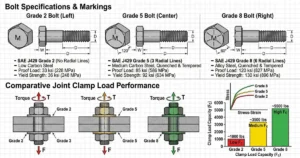
- Grade identification. The grade is marked on the head in the trade: three radial lines for Grade 5, six radial lines for Grade 8, and no grade mark for the low-carbon grades, which is why an unmarked hex head cannot be identified as a Grade 2 with any confidence.
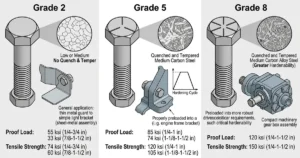
The heat-treatment requirement is what separates the grades in practice. Grade 2 is a low or medium carbon steel without the quench-and-temper step that the higher grades require; Grade 5 is a medium carbon steel, quenched and tempered; Grade 8 is a medium carbon alloy steel, quenched and tempered. That is also why processing after the bolt is made matters more at the higher grades: the higher the strength, the less tolerance the part has for a step that goes wrong.
Grade 2, Grade 5 and Grade 8
These three are the grades an inch-series order is most likely to call for. They are successive strength levels, each tied to a material class, a heat-treatment condition and a head marking.
| Grade | Material and condition | Head mark | Minimum tensile strength by diameter |
|---|---|---|---|
| Grade 2 | Low or medium carbon steel, not quenched and tempered | None | 74 ksi up to 3/4 in; 60 ksi from 7/8 to 1-1/2 in. Bolts and screws of 1/4-3/4 in diameter and over 6 in long take Grade 1 properties |
| Grade 5 | Medium carbon steel, quenched and tempered | Three radial lines | 120 ksi up to 1 in; 105 ksi from 1-1/8 to 1-1/2 in |
| Grade 8 | Medium carbon alloy steel, quenched and tempered | Six radial lines | 150 ksi up to 1-1/2 in |
Read the right-hand column for its size bands, not only for its numbers. The values step down at the larger diameters, and the step is part of the grade, not a footnote to it. A catalogue or quotation that gives one figure for a grade with no diameter attached is usually quoting the small-size value as though it held everywhere — which is exactly the mistake that matters on a 1-1/4 in bolt.
Grade 2 carries a length limit as well as a diameter limit. Bolts and screws of 1/4 to 3/4 in nominal diameter and more than 6 in long are not held to the Grade 2 values: Table 1 requires Grade 1 mechanical properties for those parts. A 1/2-13 × 8 in bolt ordered as Grade 2 therefore falls under the Grade 1 requirements at that length, and a quotation that carries 74 ksi across to it is quoting a figure the standard does not assign to that part. Studs follow a different length rule in the same table, so the 6 in provision should not be applied to a stud.
The table above is a summary of the three grades, not a substitute for the standard. Table 1 of J429 also sets proof load, yield strength and hardness for every grade and size band, and those columns are what an inspection document is read against.
The three grades also differ in what they are worth buying for. Grade 2 hex bolts are general-purpose fasteners, chosen where their strength meets the joint’s design requirements. Grade 5 is the working grade for machinery, vehicles and equipment. Grade 8 is specified where the joint is highly loaded and the design assumes the higher strength. On a fully tightened joint the benefit of Grade 8 arrives only if the nut, washer and clamped material are matched to it — a Grade 8 bolt with a Grade 2 nut has moved the weak point rather than removed it.
J429 carries grades beyond these three for other material and strength combinations. Those grades are read from the standard’s own table; they are not deduced by interpolating between Grade 2, 5 and 8, and a drawing that names one should be quoted against that row.
What a grade does not tell you
J429 leaves a great deal outside its scope, and every item on the list can stop a shipment or fail a joint.
- Dimensions. Head width across flats, head height, shank diameter, thread length and the length basis all come from a dimensional standard. For inch-series hex cap screws and bolts that is ASME B18.2.1. J429 does not contain a dimension table.
- Thread. Series (UNC or UNF) and class of fit are not J429 requirements. They come from the thread standard and from the drawing.
- Finish and coating. Nothing in J429 defines a plating, a coating thickness or a corrosion performance. The standard puts corrosion resistance outside its scope, and says so explicitly.
- The nut. J429 covers externally threaded fasteners only. The nut counterpart is a separate SAE document — SAE J995, which sets requirements for three grades of steel nuts and takes its dimensions from ASME B18.2.2 or SAE J482. A “Grade 5” joint is therefore at least two specifications.
- Fatigue, impact and service temperature. Out of scope, as the standard says itself, with responsibility passed to the end user.
The practical consequence is that “Grade 8” and “ASME B18.2.1” are not competing specifications and one does not replace the other. One describes a shape; the other describes a strength and a steel. A part that satisfies only one of them is not the part on the drawing. The SAE J429 Grade 8 hex bolts supplied to ASME B18.2.1 are an example of both being applied to the same item.
A grade is not a part number
This is where most sourcing problems begin. “Grade 8 bolt” is trade shorthand for a strength and material class. It does not describe a part. Two suppliers can quote “1/2 in Grade 8” and deliver different head styles, different thread lengths, different tolerances and different coatings, all of them legitimately J429 Grade 8.
A line that can be manufactured without a follow-up question carries five things: the product type, the dimensional standard, the size and thread, the material or grade specification, and the finish. Written out, it looks like this:
Hex cap screw, ASME B18.2.1, 1/2-13 UNC × 3.0 in, SAE J429 Grade 5, zinc electroplated.
Each element answers a different question and none of them is optional. Remove the dimensional standard and the head and thread are open. Remove the thread series and UNC or UNF is open. Remove the finish and the corrosion performance is open. Remove the grade and the strength is open. The grade alone is the single most quoted element and the least sufficient.
Two size traps sit inside the same shorthand. The first is the upper limit: J429 stops at 1-1/2 in, so a “1-3/4 in Grade 8” is not a J429 part whatever the catalogue calls it, and the strength and material have to be specified some other way. The second is the boundary inside the grade: at 1-1/8 in a Grade 5 bolt is no longer a 120 ksi bolt, so an order that carries a strength figure forward from the small sizes has specified something the standard does not offer.
J429 beside the metric property classes
Metric bolts are not described by grades of this kind. Carbon and alloy steel metric bolts, screws and studs are described by property classes under ISO 898-1:2013 — 8.8, 10.9 and 12.9 being the classes that matter for hex bolts — and the two systems are built differently.
The property class encodes its own numbers. In 8.8 the first digit is one tenth of the nominal tensile strength in MPa and the second is the yield ratio, so the class itself states the strength level. A J429 grade number encodes nothing: Grade 5 does not mean 5 of anything, and the strength has to be looked up.
The strengths are close enough to invite substitution and not close enough to permit it. Grade 5 at 120 ksi is about 827 MPa, a little above the 800 MPa minimum of class 8.8. Grade 8 at 150 ksi is about 1,034 MPa, close to the 1,040 MPa minimum of class 10.9. Those coincidences do not make the parts interchangeable: the yield, elongation and hardness requirements are set separately, the thread forms differ, and the test conditions differ — ISO 898-1 tests at 10 °C to 35 °C, where J429’s table was compiled at about 20 °C. The metric side of the same question is worked through in DIN 933 bolt grades.
Checking a delivered lot
Because the grade is a marking and a set of properties rather than a shape, verification splits into two parts, and both are needed.
On the head: the grade mark, and the manufacturer’s identification mark beside it. Six radial lines are Grade 8, three are Grade 5, and no mark at all belongs to the unmarked low-carbon grades, which cannot be confirmed from the head alone. An unmarked bolt sold as Grade 8 has not been identified, only described.
On the paperwork and the sample: the inspection document that accompanies the lot, the diameter and thread against the dimensional standard, the length measured on the correct basis, and the coating thickness or finish against what was ordered. The mechanical properties are not something a buyer can check at goods-in without a tensile test, which is precisely why the grade mark and the document carry the weight.
ChinaBolts supplies inch-series hex bolts to J429 in all three common grades, dimensioned to ASME B18.2.1, with the finish stated on the order rather than assumed from the grade.
J429 answers one question well: what steel, and how strong, for an inch-series externally threaded fastener up to 1-1/2 in. It never answers what shape, what thread, what length or what finish. A specification that is complete on both counts is the only one that can be quoted, made and checked without a conversation in between — and the bolts category is the place to match the shape to the grade once the strength question is settled.