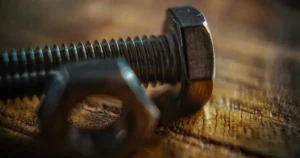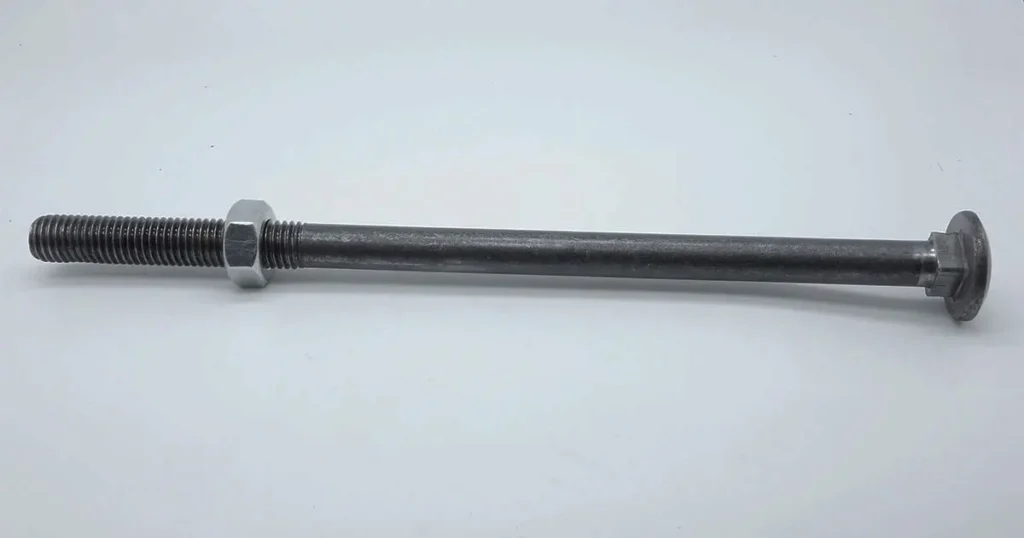
A carriage bolt is a bolt with a smooth domed head, a square neck directly under the head, and a machine-threaded shank that takes a nut. The square neck is the feature that defines the product. It is shaped to bite into the material it passes through and to stop the bolt turning while the nut is tightened from the other side, which is why the head carries no slot, recess or hex.
That single design decision explains almost everything else about the product: where it works, how it is installed, and why it is ordered by name in some trades and by standard number in others. This article covers what the bolt is, how the square neck actually works, what it is called in different markets, where it is used, and what a buyer has to state to receive the right part.
What defines the product
Four features, taken together, separate a carriage bolt from other threaded fasteners. Any one of them on its own describes something else.
- A domed head with a square shoulder and no drive feature. There is nothing to fit a wrench or a driver into. The head is not meant to be held.
- A square neck under the head. This is the locking feature. It is a short square section, formed between the head and the shank, and it is the part that engages the material.
- A round shank with a machine thread, plain immediately below the neck, with the thread cut or rolled further down the shank.
- A machine thread and a nut. A carriage bolt is a through-bolt: it passes through the parts being joined and is closed with a nut on the far side. It is not a screw that cuts its own way in.
Because the head cannot be gripped, the bolt has to be prevented from rotating in some other way, and the square neck is that mechanism. Screwdrivers and wrenches are replaced by geometry. That is also why the carriage bolt is a poor substitute for a hex bolt wherever the joint has to be tightened and re-tightened from both ends over the life of the assembly.
How the square neck works, and where the design stops working
The neck only does its job if it is engaged. The usual way that happens is in timber: the hole through the timber is drilled to the shank diameter, the bolt is pushed in, and the square shoulders of the neck cut their own seat in the wood as the nut is tightened. Once seated, the neck resists rotation and the nut can be run up to the required tightness.
This is a mechanical interference fit, not a formal locking device, and it is worth being precise about what that means. It depends on the material around the neck being soft enough to take the impression of the square and firm enough to hold it. Applications that rely on it choose timber and similar materials for that reason, and ASME’s own summary of the round head bolt family describes the design goal in the same terms, as an underhead feature that holds the bolt in place while a nut is being tightened.
Three consequences follow, and they are the source of most problems in service.
- A washer under the head defeats the design. A round washer spreads the load, so a hardened washer is sometimes fitted under a bolt head. Under a domed carriage bolt head it prevents the head from seating and stops the square neck reaching the material. The neck then never engages, and the bolt spins as soon as the nut is turned. If the joint needs a washer and the head has to sit tight, a different head form is the correct answer, not a washer under a dome.
- The hole has to suit the material. In timber, the neck needs an interference seat. In metal, it needs a matching square hole, punched or drilled and squared. A plain round hole in steel leaves the bolt free to turn, however well the joint is otherwise made.
- An oversized, worn or slotted hole gives the neck nothing to bite. The bolt may still hold the joint together in shear, but it can no longer be tightened reliably, and it can loosen in service.
One further point is worth building into the specification. In a timber connection the usable clamping force is normally limited by the bearing capacity of the timber behind the head and by how well the square neck keeps its engagement, because the neck loses its seat once that material crushes. The bolt’s own mechanical properties, the bearing arrangement at the head and the material being clamped all take part in carrying the load, so the head shape on its own does not settle how much preload a joint can take. Where a joint needs high preload, choose the fastener from the actual load requirement, the bolt’s mechanical properties and the joint design rather than from the head form.
The head has a functional limit of its own. It is intended to sit against or slightly into the surface, and it is often set into a counterbore so that it finishes flush or just proud. What it is not is adjustable: there is no way to hold the head while a seized nut is worked free, and a carriage bolt that has rusted into a joint is usually cut off and replaced rather than unscrewed.
Carriage bolt, coach bolt, cup head square neck bolt: one product, several names
The product has no single international trade name, and the name varies with both the market and the document you are reading. Three names cover most of what a buyer will see.
| Name | Where it is mainly used | What it points to |
|---|---|---|
| Carriage bolt | North America and most export markets | General trade name; no fixed dimensional meaning |
| Coach bolt, cup square bolt | United Kingdom, Ireland, Australia, New Zealand | The same product in trade use |
| Cup head square neck bolt | The metric standards themselves | The formal product description in DIN 603 and the ISO 8677 and ISO 8678 documents |
| Round head square neck bolt | The inch standards themselves | The formal product description in ASME B18.5, which also covers step bolts and elevator bolts that share the round head form |
Two points matter more to a buyer than the label. First, carriage bolt is a trade name and not a specification: it tells you the shape of the part, not what it was made to. Second, “coach” is used for two different products. A coach bolt is a carriage bolt, while a coach screw is a coarse-threaded timber screw that cuts its own thread and needs no nut. The two are sold side by side, both have a domed head, and catalogue cross-references and stock lists frequently treat the names as interchangeable. They are not interchangeable parts. Carriage bolt vs coach screw sets out the difference in mechanism, installation and hole preparation.
Where carriage bolts are used
The bolt suits joints where the head side is a timber or wood-based member, the head will be exposed and preferably flush, and access to the bolt head during tightening is either impossible or not wanted. That covers a wide field:
- Timber structures and timber-to-metal connections, including trusses, pergolas, and brackets bolted through a timber member into a steel plate or casting with a square hole.
- Decking, fencing, gates and agricultural equipment, where a fastener head that neither snags nor offers a grip is an advantage and the joint may be tightened after installation.
- Furniture and joinery, from bed frames and bench slats to knocked-down commercial furniture, where a flush domed head on the visible face is preferred.
- General mechanical assemblies and hardware, such as guard rails, signage frames, and machine guards, where a through-bolt is wanted and the head side can be counterbored.
The deciding question in every case is the same one: will the material behind the head take a square neck seat, or is there a square hole for it? If the answer is no, a hex head bolt with a washer is the practical choice.
Why the “same” carriage bolt arrives in different forms
Two bolts that look alike in a photograph can be different products on a drawing. Carriage bolts are made to several national and international standards, and those standards use different thread systems and different dimension series. The inch series is covered by ASME B18.5, Round Head Bolts (Inch Series), currently the 2012 edition reaffirmed in 2023, which specifies Unified inch threads. The metric equivalent is DIN 603, Cup head square neck bolts, in its 2026-08 edition, which covers metric threads from M5 to M20.
The International Organization for Standardization circulates the same product in two configurations instead of one: ISO 8678:1988, cup head square neck bolts with a small head and short neck, and ISO 8677:1986, cup head square neck bolts with a large head, which was withdrawn in 2002. That is the practical reason a buyer cannot settle a carriage bolt by name alone: the family contains more than one head and neck geometry, and those two features determine whether the bolt seats properly in a prepared joint.
Within one standard there are further variables. A metric carriage bolt may be supplied partially threaded with a plain shank, or threaded closer to the neck, depending on the length and the standard’s thread length rules. Head diameter and neck dimensions are tabulated per size. And the standard usually stops at geometry and product grade. Material, property class and surface finish are normally separate decisions taken at the order level, so two bolts ordered as “M12 carriage bolts” can differ in strength class, base metal and coating while remaining dimensionally identical.
The documented scopes show the split. ASME B18.5 draws on separate ASTM, ASME, IFI and SAE documents for thread dimensions, materials, mechanical properties and finishes. DIN 603 sets dimensional and technical delivery requirements for the bolt form. The EN 14592 dowel-type fastener standard goes further for load-bearing timber structures, treating bolts with nuts as one fastener family with its own geometry, material and performance requirements. Each document answers a different part of the question, and none of them answers all of it.
Specifying a carriage bolt so you get the right one
The product name tells a supplier what shape to make. Everything else has to be stated. A workable carriage bolt specification contains the following.
- Name and standard, for example “cup head square neck bolt, DIN 603” or “round head square neck bolt, ASME B18.5”. Naming the standard rather than the trade name removes the ambiguity.
- Nominal diameter and thread pitch, for example M12 x 1.75 for the metric coarse thread, or the inch size and thread series for the inch product.
- Nominal length, measured from the flat bearing surface on the underside of the head to the end of the bolt, so the domed head is not part of the length. How to measure a carriage bolt covers the measuring sequence and what each dimension is compared against.
- Head and neck variant, where the family offers more than one, such as large head against small head and short neck.
- Thread length: partially threaded with the plain shank length, or threaded further up the shank.
- Property class or material grade, such as 4.8, 8.8, A2-70 or A4-80, together with the material group.
- Surface finish, plain, zinc plated, hot-dip galvanized or another coating, and the coating standard where one applies.
- Documentation, where the part is going into a controlled or structural application: dimensional record, material certificate, or coating record.
Written out, a complete line reads: M12 x 80 cup head square neck bolt, DIN 603, partially threaded, property class 8.8, hot-dip galvanized. The standard pins the geometry, and every later item is an order-level decision that no product name can carry. A bolt ordered as “12 mm carriage bolt, 80 mm” leaves the thread series, the head variant, the strength and the coating to whoever picks the stock, and that is where substitution happens.
Both the DIN 603 cup head square neck bolts and the ASME B18.5 round head square neck bolts are stocked in the metric and inch versions of this product and are part of the wider bolts range. Confirm the standard, size, property class and finish on the order, because the product name alone will not carry them.