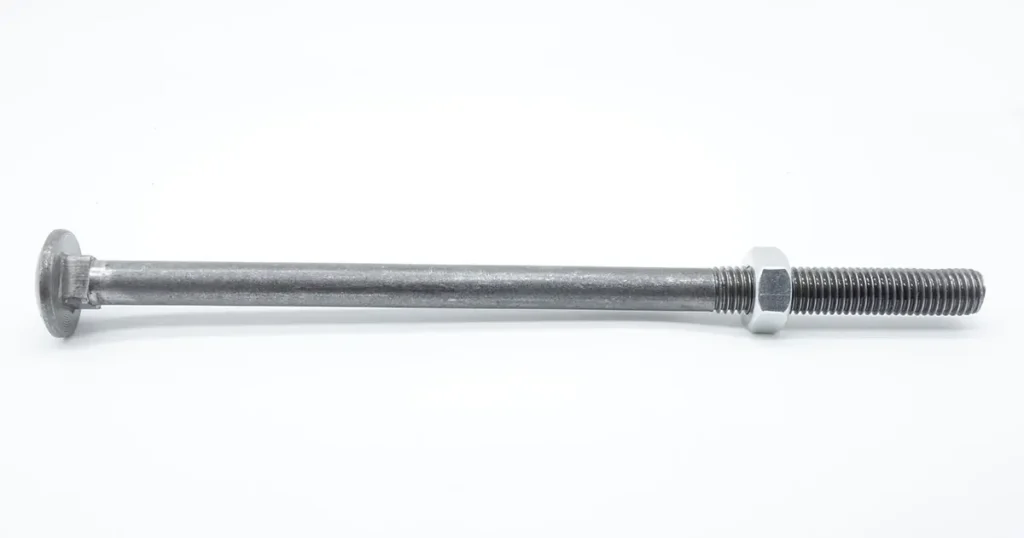
DIN 603 has no equivalent ISO standard. Neither standard record names one, and neither document has a successor. The ISO document that carries the same product name and a near-identical dimension table, ISO 8677:1986, was withdrawn on 21 May 2002 and no replacing document is named on its record. The other ISO standard in this family, ISO 8678:1988, is still current but describes a different bolt: a cup head square neck bolt with a small head and a short neck, in product grade B.
The designation that matters is the current German edition, DIN 603:2026-08, the standard for cup head square neck bolts with metric threads M5 to M20 in product class C. Where a buyer or a supplier writes “DIN 603 / ISO 8677”, that pairing is a market convention for a product family, not a statement that one bolt satisfies both documents. And ISO 8678, published in 1988, is not a successor to DIN 603 or to ISO 8677.
What each of the three documents actually is
| DIN 603 | ISO 8677 | ISO 8678 | |
|---|---|---|---|
| Title | Cup head square neck bolts (Flachrundschrauben mit Vierkantansatz) | Cup head square neck bolts with large head — Product grade C | Cup head square neck bolts with small head and short neck — Product grade B |
| Status | Current. Edition 2026-08 | Withdrawn. Stage 95.99, effective 21 May 2002, no replacing document named | Published. Stage 90.93, standard confirmed at its review effective 18 August 2025 |
| Thread sizes in scope | M5 to M20 | M5 to M20 | M6 to M20 |
| Nominal lengths tabulated | From 16 mm upward, in length steps up to 200 mm | From 20 mm to 200 mm | From 12 mm to 160 mm |
| Head geometry | Domed cup head, full head diameter | Large head — the same head family as DIN 603 | Small head, short neck — a visibly different bolt |
| Product grade or class | Product class C | Product grade C | Product grade B |
| Issuing framework | DIN (German national) | ISO, ISO/TC 2 | ISO, ISO/TC 2/SC 11 |
Both ISO records come from the ISO project catalogue as republished by a national member body, and they are the place to check the status rather than a distributor catalogue. That distinction matters, because aggregator pages in this product family mark ISO 8678:1988 as “cancelled” alongside ISO 8677:1986 without separating a withdrawal date from a review stage. The stage codes do separate them: 95.99 is withdrawal, 90.93 is a standard confirmed as still valid.
Why ISO 8678 is not the replacement for DIN 603
Two things rule it out, and both are visible in the catalogue records rather than in a data sheet.
- No replacement relationship is recorded. ISO 8677:1986 is withdrawn and its record names no replacing document. ISO 8678:1988 is not absent from that record because it supersedes ISO 8677 — it was issued as the other configuration of the product, and no ISO document is listed as the successor of either.
- The substantive difference is one of product configuration. ISO 8677:1986 tabulates the large head version in product grade C, while ISO 8678:1988 tabulates the small head with a short neck in product grade B. A document that specifies a smaller head, a shorter neck and a different product grade is a different product specification, not an update to the one it is set beside.
What ISO 8678 is, instead, is the second configuration of the same product concept. Where ISO 8677:1986 tabulates “large head” cup head square neck bolts, ISO 8678:1988 tabulates the small head with a short neck, and it does so in product grade B rather than grade C. The only version of the product that a buyer can still order against an ISO document is therefore the one whose dimensions sit furthest from DIN 603 — not the one whose dimensions nearly match it.
DIN 603, ISO 8677 and ISO 8678 dimension by dimension
The comparison below covers the sizes the three documents share, M6 to M12. DIN 603 extends down to M5; ISO 8678 starts at M6. The thread-length column is where the length coverage differs. DIN 603 and the withdrawn ISO 8677 both tabulate a minimum thread length for lengths over 200 mm on the larger sizes, although not for the same set of them; the ISO 8678 table has no row for that band, which fits a scope that stops at a 160 mm nominal length. Up to and including 200 mm, the bands tabulated by DIN 603 and ISO 8677 are identical size for size. Values are taken from published reproductions of the DIN 603, ISO 8677 and ISO 8678 dimension tables. The DIN 603 values are those of the 2017-05 and 2010-09 tables, which are the editions whose dimension tables are published. No independent verification has been carried out against the official text of DIN 603:2026-08, so the dimensional requirements of that edition have to be confirmed in the standard itself, which remains the edition that governs an order.
| Thread size | Feature | DIN 603 (mm) | ISO 8677 (mm) | ISO 8678 (mm) |
|---|---|---|---|---|
| M6 | Head diameter, dk | 15.45 – 16.55 | 16 | 14.2 max |
| Head height, k | 3.12 – 3.88 | 3.0 – 3.6 | 3.0 – 3.6 | |
| Square neck across flats, v | 5.52 – 6.48 | 5.52 – 6.48 | 5.88 – 6.48 | |
| Neck height, f | 3.40 – 4.60 | 3.40 – 4.60 | 2.4 – 3.0 | |
| M8 | Head diameter, dk | 19.35 – 20.65 | 20 | 18 max |
| Head height, k | 4.12 – 4.88 | 4.0 – 4.8 | 4.0 – 4.8 | |
| Square neck across flats, v | 7.42 – 8.58 | 7.42 – 8.58 | 7.85 – 8.58 | |
| Neck height, f | 4.40 – 5.60 | 4.40 – 5.60 | 2.4 – 3.0 | |
| M10 | Head diameter, dk | 23.35 – 24.65 | 24 | 22.3 max |
| Head height, k | 4.62 – 5.38 | 5.0 – 5.8 | 5.0 – 5.8 | |
| Square neck across flats, v | 9.42 – 10.58 | 9.42 – 10.58 | 9.85 – 10.58 | |
| Neck height, f | 5.40 – 6.60 | 5.40 – 6.60 | 3.2 – 4.0 | |
| M12 | Head diameter, dk | 29.35 – 30.65 | 30 | 26.6 max |
| Head height, k | 6.05 – 6.95 | 6.0 – 6.8 | 6.0 – 6.8 | |
| Square neck across flats, v | 11.30 – 12.70 | 11.30 – 12.70 | 11.82 – 12.70 | |
| Neck height, f | 7.25 – 8.75 | 7.25 – 8.80 | 3.2 – 4.0 |
Three things in that table decide the question.
- DIN 603 and ISO 8677 differ in the head height. Head diameter and thread lengths agree across the shared range that the table covers, M6 to M12, which all sit in the l ≤ 125 mm and 125 < l ≤ 200 mm bands; the over-200 mm thread-length bands are tabulated for a different set of sizes in each document. The square neck column matches except for the single case at M12, where the ISO table carries 8.80 mm against 8.75 mm. The head-height columns do not agree anywhere: ISO 8677 gives k = 3.0 to 3.6 mm at M6 against 3.12 to 3.88 mm in DIN 603, 5.0 to 5.8 mm at M10 against 4.62 to 5.38 mm, and 6.0 to 6.8 mm at M12 against 6.05 to 6.95 mm. At M10 the ISO range sits almost entirely above the DIN range. Close is not the same as equivalent.
- ISO 8678 changes the head, not the thread. At M6 the maximum head diameter is 14.2 mm against 16.55 mm in DIN 603; at M12 it is 26.6 mm against 30.65 mm. The neck is shorter across the range as well: 2.4 to 3.0 mm at M6 against 3.40 to 4.60 mm, 3.2 to 4.0 mm at M10 against 5.40 to 6.60 mm, and 3.2 to 4.0 mm at M12 against 7.25 to 8.75 mm. For the same thread size, the bolt that arrives is a different part.
- Some tolerances are tighter than they look. The square neck across flats is a range, not a nominal figure. The two tables share the upper limit — 6.48 mm at M6, 12.70 mm at M12 — but the lower limit is higher in ISO 8678 at those sizes, 5.88 mm against 5.52 mm and 11.82 mm against 11.30 mm, while at M8 and M10 it sits within about a tenth of a millimetre of the DIN 603 figure. The mating square hole is sized against the range, so a change of standard can move the fit in the material even where the nominal thread diameter is unchanged.
One caution on reading any reproduced table in this family: two traps are common. The first is column order — at least one widely copied online reproduction of the DIN 603 and ISO 8677 tables shows the head-height and neck-height columns in the opposite order to the standards, which makes the neck depth look like the head height. The second is symbol reuse — the Chinese-language fastener databases that publish the ISO 8678 table use k for the head height and k1 for the neck depth, whereas in DIN 603 and ISO 8677 the neck depth is f, so a value copied across without its label can land in the wrong row. The table above uses the parameter order of the standards. Every value that matters for a substitution should be re-checked against the edition that governs the order, because a mixed-up column is enough to produce a bolt that will not seat.
Substituting ISO 8678 for DIN 603: what actually changes
Because ISO 8678 is the current document and DIN 603 is the specified one, a substitution enquiry usually runs in one direction: can this order be filled with the small head and short neck bolt? Four things change, and only one of them is a workshop problem.
- Bearing area under the head. The head diameter sets the annular contact area against the clamped part. A smaller head means a smaller bearing area and higher bearing stress at the same preload, which matters most in soft materials — timber, composites, thin sheet — where the head can crush into the surface. A cup head has no drive recess and cannot be gripped, so once it sinks it cannot be recovered from the head side.
- Head height and clearance. The head height does not move in one direction across the range. Both ranges overlap at every size, and only M10 has both limits higher in ISO 8678 (5.0 to 5.8 mm against 4.62 to 5.38 mm). The ISO head is lower at M6 (3.0 to 3.6 mm against 3.12 to 3.88 mm), at M8 (4.0 to 4.8 mm against 4.12 to 4.88 mm), at M12 (6.0 to 6.8 mm against 6.05 to 6.95 mm) and at M16 (8.0 to 8.9 mm against 8.05 to 8.95 mm). At M20 the ISO range straddles the DIN range: its minimum is slightly higher (10.0 mm against 9.95 mm) and its maximum lower (10.9 mm against 11.05 mm), so it is not uniformly higher or lower. Where the ISO head is taller it projects further above the surface; where it is lower it helps if clearance or a flush finish is the constraint, and hurts where the connection relied on the head standing proud. The size decides which case applies, so it has to be checked per size rather than assumed from the designation.
- Neck height against the material thickness. The neck is what resists rotation after the head bears on the surface. A shorter neck reaches less depth into the material, so it may not develop the same grip in a thick timber member or through a deep square hole — the gap is widest at the larger sizes, where ISO 8678 gives 4.2 to 5.0 mm against 11.1 to 12.9 mm in DIN 603 at M16 and 14.1 to 15.9 mm at M20; in thin sheet it is less likely to bottom out before the head seats.
- Square neck across flats. The tolerances differ slightly. A punched or broached square sized for the DIN 603 neck is not automatically the right size for the ISO 8678 neck.
What does not change is the thread, the pitch series, the property class system or the finish options. Both are product standards, and neither establishes a strength level by itself — mechanical properties come from the standards they reference, principally ISO 898-1 for steel and ISO 3506-1 for stainless steel, exactly as they do for DIN 603 read as a designation. The same is true of the withdrawn ISO 8677: it is a four-page document, and it does not make a bolt any stronger or weaker than a DIN 603 bolt made from the same material to the same property class.
That ISO 898-1 reference carries a limitation worth knowing, because head geometry is the whole subject here. The standard’s own scope states that certain bolts and screws may not fulfil its tensile or torsional requirements, because the geometry of their heads reduces the shear area in the head compared with the stress area in the thread, and it names bolts and screws with a low or countersunk head among them. A cup head square neck bolt is a low-head fastener. Where a property class such as 8.8 is written on the order, the strength requirement and the head that has to deliver it belong in the same conversation — and a smaller head works against that, not for it.
What to compare before accepting a substitute
A cross-reference on a quotation is not a specification. When a supplier offers ISO 8678 in place of DIN 603, or DIN 603 in place of a legacy ISO 8677 call-out, these are the items that settle the decision. The first two decide most cases.
- The standard and the edition. DIN 603:2026-08, ISO 8678:1988. An undated “DIN 603” on a drawing does not say which revision of the tables the part was made to, and a withdrawn standard cannot govern a new order.
- Head diameter and head height in millimetres. These are the two dimensions that separate the three documents. A dimension taken from a catalogue illustration is not enough; the head diameter has to come from a table with tolerances.
- Square neck across flats and neck height. Both have to suit the hole in the material and the thickness of the material. Nominal diameter alone says nothing about either.
- Material and property class or stainless grade. 4.6, 4.8 or 8.8 under ISO 898-1, or a stainless grade such as A2-70 or A4-80 under ISO 3506-1. If it is not on the order, it is not specified.
- Surface finish and coating. A coating adds thickness to a toleranced thread, so the coating standard belongs on the order with the finish.
- Thread tolerance class and thread length. State the class where the joint requires something other than the default. Where the position of the plain shank is functional rather than incidental, state the shank or thread length.
- Documentation. A dimensional record, a material certificate or a coating thickness record, depending on what has to be held on file.
Where the substitution is accepted, record it in writing on the drawing and the purchase order with the dimension that changed. A substitution that lives in an email thread has to be re-argued at the next delivery; one written onto the drawing does not. Where the head diameter is the reason the bolt was chosen, the answer is usually to keep DIN 603 rather than to accept a smaller head, and in an imperial project the comparable product is covered by a different standard altogether — our ASME B18.5 round head square neck bolts page shows the equivalent form on that side.
The practical position
DIN 603 has no equivalent ISO standard. ISO 8677:1986 is withdrawn and has no successor; ISO 8678:1988 is current but specifies a small head and short neck bolt in product grade B and was never a replacement for either document. Where a drawing cites DIN 603, specify DIN 603:2026-08 and check the head diameter, head height, square neck across flats and neck height on the offer against the tables. Where an ISO document has to be named, ISO 8678:1988 is the only one of the two that can still be ordered against, and accepting it means accepting a smaller head and a shorter neck, with a head height that is lower at M6, M8, M12 and M16, higher at M10, and overlapping the DIN range at M20, on a fastener whose head geometry is already the limiting factor. ChinaBolts supplies the DIN 603 form — the cup head square neck bolt in carbon and stainless steel from M5 to M20 — within the wider bolts range, and quotes against the edition and dimensions named on the enquiry rather than against a cross-reference.