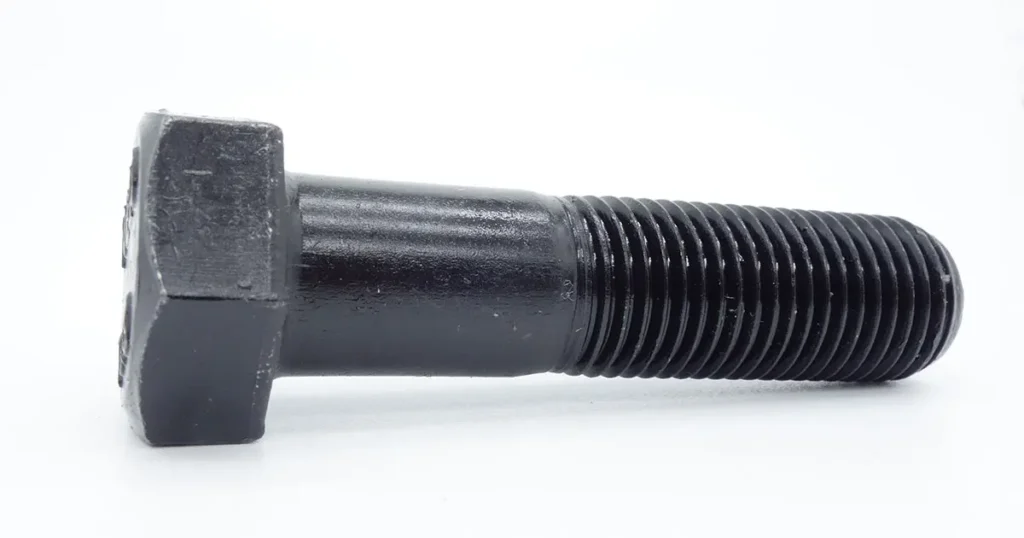
DIN 931 is the German standard designation for a metric hexagon head bolt with a partially threaded shank — a hexagon head, a plain unthreaded shank below it, and a coarse metric thread over the rest of the length. That is the whole of the DIN 931 meaning: it describes the shape of the part, not its strength grade, material or coating.
Its status is the part most short explanations leave out. DIN 931 is no longer a current German standard. DIN 931-1:1982-07 has been withdrawn, and the product it described is now covered by DIN EN ISO 4014, Fasteners — Hexagon head bolts — Product grades A and B. The current German edition of that standard is DIN EN ISO 4014:2022-10.
The trade term itself has not gone anywhere. Suppliers in Europe and Asia still list, quote and ship “DIN 931” bolts, often with a note that the item is “similar to ISO 4014”. So when a drawing, purchase order or catalogue says DIN 931, it is telling you what the part looks like — and leaving you to confirm which standard actually governs it.
What DIN 931 designates
DIN 931-1:1982-07 carried the German title Sechskantschrauben mit Schaft; Gewinde M1,6 bis M39, Produktklassen A und B, ISO 4014 modifiziert — literally “hexagon head screws with shank; threads M1.6 to M39, product grades A and B, ISO 4014 modified”, as recorded in the standard’s own record.
| What the designation fixes | DIN 931 |
|---|---|
| Product | Hexagon head bolt (a hexagon head screw with a shank) |
| Thread | Metric coarse pitch |
| Threading | Partial — the thread does not run to the head |
| Product grades | A and B |
| Diameter range in DIN 931-1 | M1.6 to M39 |
| Status | Withdrawn |
| Current standard for the product | DIN EN ISO 4014 (ISO 4014) |
Read as a designation rather than a part number, the DIN 931 meaning has three commercially important parts.
- “With shank” is the defining feature. It separates DIN 931 from a fully threaded hex bolt, and it is the reason the designation exists at all.
- “Product grades A and B” is a tolerance split, not a strength class. Grade A covers the smaller sizes and shorter lengths, grade B the larger and longer ones.
- “ISO 4014 modified” is the phrase to remember. The 1982 German standard was built on ISO 4014 with national deviations, so DIN 931 and ISO 4014 are close relatives rather than the same document.
One terminology note, because it causes confusion in translation. German Schraube covers both what English calls a screw and what it calls a bolt, and Schaft means shank. DIN 931 is rendered as “hexagon head screw with shank” in some catalogues and “hexagon head bolt with shank” in others, and ISO 4014 uses “bolt”. The part is the same; the wording is not a specification difference.
What “partially threaded” means in numbers
Partial thread is not vague. The standard thread length b is a function of the nominal diameter d and the bolt length l.
| Bolt length l | Standard thread length b |
|---|---|
| 125 mm and under | 2d + 6 mm |
| Over 125 mm, up to 200 mm | 2d + 12 mm |
| Over 200 mm | 2d + 25 mm |
An M12 × 80 bolt falls in the first band, so its standard thread length is 2 × 12 + 6 = 30 mm. An M12 × 220 bolt falls in the last band, giving 2 × 12 + 25 = 49 mm. The DIN 931 tables and the ISO 4014 tables use the same three bands.
Two consequences matter on the shop floor.
- On a long bolt, “partially threaded” still leaves a substantial threaded section — a 220 mm M12 bolt carries 49 mm of thread, not a token few threads.
- On a short bolt, the bands can consume most of the length, and short lengths may be threaded closer to the head. If the joint depends on unthreaded shank sitting at a particular place, the thread length is a drawing dimension and should be stated rather than assumed.
Product grades work the same way for tolerances. Grade A applies to threads up to M24 and to nominal lengths up to 10d or 150 mm, whichever is shorter; grade B applies beyond that. It is a tighter-tolerance against looser-tolerance distinction, so an enquiry that says only “DIN 931” leaves the grade open.
DIN 931 vs DIN 933: partial thread, full thread
This is the pair buyers mix up most often, and the difference is exactly one thing: how far the thread runs.
- DIN 931 — hexagon head bolt with a partially threaded shank. The thread stops partway down; the section under the head is plain.
- DIN 933 — hexagon head bolt with thread up to the head. The same head and the same thread, threaded over the full nominal length.
Both were superseded in the same way: DIN 931 maps to ISO 4014 and DIN 933 maps to ISO 4017. Both are made in the same property classes and the same materials.
The choice between them is a joint decision, not a preference. A partially threaded bolt puts unthreaded shank in the shear plane and through the bearing length, which is generally better for joints loaded in shear and for fatigue, and it lets a nut run down onto plain shank instead of thread. A fully threaded bolt gives adjustable engagement and suits tapped holes and varying grip lengths. If a drawing calls for DIN 931 hex bolts with a partially threaded shank, substituting a fully threaded DIN 933 changes the joint, not just the part number.
The dimensional trap: M10, M12, M14 and M22
For most sizes the DIN 931 and ISO 4014 tables agree. Four sizes do not.
| Size | Width across flats, DIN 931 | Width across flats, ISO 4014 |
|---|---|---|
| M10 | 17 mm | 16 mm |
| M12 | 19 mm | 18 mm |
| M14 | 22 mm | 21 mm |
| M22 | 32 mm | 34 mm |
These are the four sizes where “DIN 931” and “ISO 4014” describe bolts that are visibly and functionally different. An ISO 4014 M10 bolt takes a 16 mm socket; the DIN 931 M10 takes 17 mm. M22 runs the other way: DIN 931 used 32 mm, ISO 4014 uses 34 mm. Every other common size — including M8, M16, M20, M24 and above — uses the same width across flats in both tables.
The published dimensional comparison is consistent on this point, and it has two practical effects.
- Tooling and clearance. The head is not merely a different wrench size. The 1 mm difference at M10 and M12, and the 2 mm difference at M14 and M22, changes the circumscribed diameter and therefore the clearance the head needs.
- Nut and washer matching. The widths were changed so that ISO 4014 heads line up with ISO 4032 nuts, while the DIN 931 head lined up with the older DIN 934 nut. Pairing a DIN-series head with an ISO-series nut in those four sizes produces a mismatch in the assembly even though the thread is identical.
That is why a quotation line reading “DIN 931/ISO 4014” is usually harmless at M8 or M16 and genuinely ambiguous at M10, M12, M14 or M22.
DIN 931 today: withdrawn, replaced by DIN EN ISO 4014
The German national standard for this product has no current form, and it did not pass straight to ISO 4014.
- DIN 931-1:1982-07 — the German standard, “ISO 4014 modified”. Now withdrawn.
- DIN EN 24014:1992-02 — the European adoption of ISO 4014, published in Germany as Hexagon head bolts — Product grades A and B.
- DIN EN ISO 4014:2001-03 — the EN ISO edition, after the Vienna Agreement aligned European and international fastener standards.
- DIN EN ISO 4014:2011-06 — the next edition, now withdrawn.
- DIN EN ISO 4014:2022-10 — the current German edition of ISO 4014:2022, Fasteners — Hexagon head bolts — Product grades A and B.
The ISO document needs its own edition check. ISO 4014:2011 was withdrawn on 28 June 2022 and revised by ISO 4014:2022, edition 5, published the same day. ISO 4014:2022 specifies hexagon head bolts in steel and stainless steel with metric coarse pitch threads from M1.6 up to and including M64, in product grades A and B, and points to ISO 898-1 or ISO 3506-1 for property classes and stainless steel grades and to ISO 888 or ISO 4753 for dimensional options.
So “made to ISO 4014” is not a complete statement either. ISO 4014 has been published in several editions — 1979, 1988, 1999, 2011 and 2022 — and a drawing that cites only the number leaves the edition to be agreed.
What DIN 931 does not tell you
Because DIN 931 is a dimensional designation, it is silent on everything that determines performance. An enquiry or a product page that says only “DIN 931 M16 × 80” leaves all of the following open.
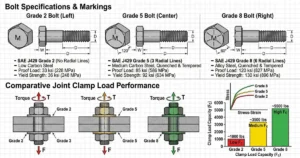
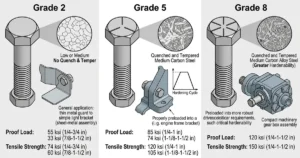
- Property class. 4.8, 5.6, 8.8, 10.9 and 12.9 bolts share the same DIN 931 geometry and behave very differently. Steel property classes come from ISO 898-1.
- Material and stainless grade. A2 (304-type) and A4 (316-type) stainless bolts are covered by ISO 3506-1, with classes such as A2-70, A4-70 and A4-80.
- Coating. Plain, zinc plated, hot dip galvanised and zinc flake finishes are selected separately, and they affect friction and torque as well as corrosion life. Hot dip galvanising also has to be allowed for in the thread tolerance, which is why galvanised nuts are tapped oversize.
- Thread tolerance. The external thread on these bolts is normally tolerance class 6g.
- Marking and documentation. Whether you need a mill certificate with heat traceability, third-party inspection, or particular marking on the head.
A complete callout therefore carries more than the standard number:
Hexagon head bolt DIN 931 — M16 × 80 — property class 8.8 — hot dip galvanised
or, in the current equivalent, ISO 4014 — M16 × 80 — 8.8 — hot dip galvanised.
Two things the “931” number does not cover
The DIN 931 family has a second part, and it is widely misread. DIN 931-2 is not the fine pitch part. DIN 931-2:2009-06 is titled Hexagon head bolts — Part 2: Metric thread M68 to M160 × 6 — Product grade B. It extends the shank-bolt range to large diameters on a 6 mm pitch, and it remains a current German standard.
If you need a fine pitch thread on a partially threaded hex bolt, that is a different standard altogether: DIN 960, whose current German designation is DIN EN ISO 8765. ChinaBolts supplies DIN 960 hexagon head bolts with fine pitch thread separately from the coarse pitch range.
The size range also moved. DIN 931-1 ran from M1.6 to M39; ISO 4014 runs from M1.6 to M64. Enquiries above M39 that quote “DIN 931” or “ISO 4014” should be checked against the table actually being used rather than assumed to be covered.
How to use “DIN 931” correctly when buying
- Treat DIN 931 as a shape reference, not a governing standard. When a drawing or catalogue uses it, confirm which standard and edition controls the order — normally ISO 4014, adopted in Germany as DIN EN ISO 4014.
- Pin down the head width at M10, M12, M14 and M22. This is the one place where “DIN 931” and “ISO 4014” describe different parts. State the width across flats in the enquiry.
- State the property class, the material or stainless grade, and the coating. None of them come from DIN 931. Where strength matters, the property class is the specification.
- Say whether the thread length is the standard one or a special. If the shank position is functional, give the thread length as a dimension.
- Ask for the marking and documentation you need. Property class and manufacturer identification on the head, and a mill certificate with heat traceability where the application requires it.
For every common size other than those four, the two tables give the same head width, the same head height and the same thread length, which is why the two names are used almost interchangeably in day-to-day trade. A quotation that says “DIN 931/ISO 4014” is therefore usually workable, provided the size is not one of the four and the property class, material and coating are stated.
Conclusion
So the DIN 931 meaning in one line: a metric hexagon head bolt with a partially threaded shank and a coarse metric thread, made in product grades A and B over a nominal range of M1.6 to M39. It is the German national standard that sat on top of ISO 4014 with national modifications, and it has been withdrawn; the product is covered today by DIN EN ISO 4014, in its 2022 edition.
What the name still gives you is a clear picture of the part, and that is genuinely useful: partial thread rather than full thread, a plain shank in the bearing length, a hexagon head, a coarse metric thread. What it does not give you is a complete specification. The four sizes where the DIN and ISO head widths differ — M10, M12, M14 and M22 — together with the property class, material and coating, are the details that decide whether the bolt that arrives is the bolt the drawing asked for.
ChinaBolts supplies metric hex bolts in both partially threaded and fully threaded configurations, in carbon, alloy and stainless steel. Send the size, thread length, property class, material and finish, and request a quote.