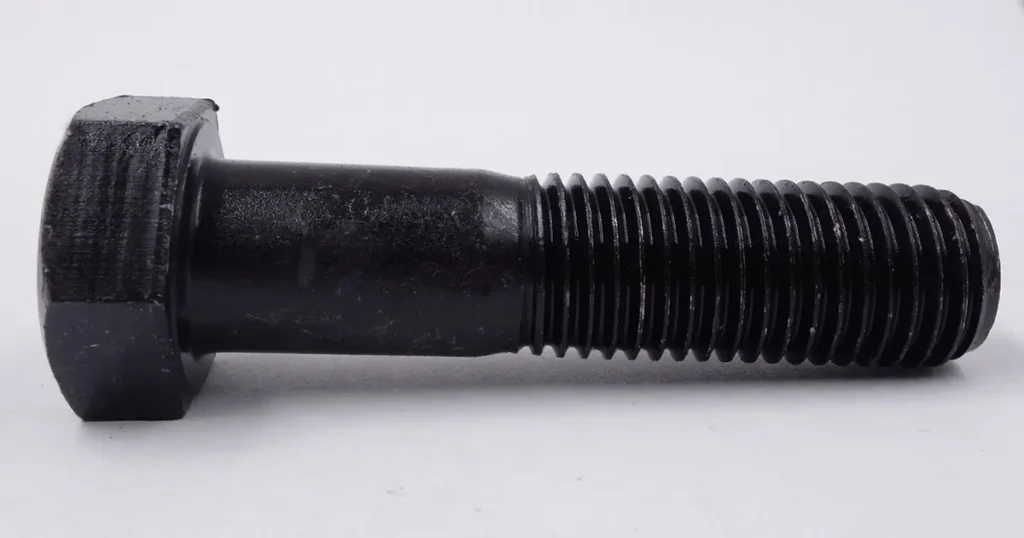
DIN 960 and DIN 931 describe the same bolt with a different thread. Both are metric hexagon head bolts with a partially threaded shank, both use the same head geometry and the same thread length rules, and both are quoted at the same nominal diameters. The difference is the pitch: DIN 960 is the fine pitch version and DIN 931 is the coarse pitch version. A DIN 960 bolt is supplied as M12 × 1.5; the equivalent DIN 931 bolt is M12 × 1.75. The head of a DIN 960 bolt is stamped with the property class, not with a pitch, so the only way to tell them apart on the bench is to measure the pitch or try the mating nut.
That one difference decides the joint. A fine pitch bolt will not run into a coarse pitch nut, the two pitches put a different number of threads into the same depth of engagement, and they carry slightly different loads at the same property class. The rest of this article covers what actually changes, when a fine thread is the better choice, and how to specify either one without an expensive mistake.
| Point of comparison | DIN 960 | DIN 931 |
|---|---|---|
| Product | Hexagon head bolt, partially threaded shank | Hexagon head bolt, partially threaded shank |
| Thread series | Metric fine pitch | Metric coarse pitch |
| Example at 12 mm | M12 × 1.5 | M12 × 1.75 |
| Head dimensions | Same as DIN 931 at the same nominal diameter | Same as DIN 960 at the same nominal diameter |
| Status | Withdrawn; replaced through the ISO 8765 series | Withdrawn; replaced through the ISO 4014 series |
| Current counterpart | ISO 8765:2022 | ISO 4014:2022 |
Fine pitch and coarse pitch in one line
Pitch is the distance from one thread crest to the next. A coarse thread takes the largest pitch that the ISO general plan allows for that diameter; a fine thread takes a smaller one. Both are standardised series, not specials — the diameter stays the same and only the pitch changes. That is why both bolts are called M12 and why neither one is “wrong”.
For the sizes normally traded under these two designations, the pitch pairs are:
| Nominal diameter | DIN 931 coarse pitch | DIN 960 fine pitch |
|---|---|---|
| M8 | 1.25 mm | 1.0 mm |
| M10 | 1.5 mm | 1.25 mm (M10 × 1 also appears) |
| M12 | 1.75 mm | 1.5 mm (1.25 mm also available) |
| M16 | 2.0 mm | 1.5 mm |
| M20 | 2.5 mm | 1.5 mm (2 mm also available as a fine pitch) |
| M24 | 3.0 mm | 2.0 mm |
The table shows the pitches normally quoted for these two designations, not every pitch that exists. Diameters up to M24 frequently have more than one fine pitch in the ISO general plan — M10 × 1 alongside M10 × 1.25, and M20 × 2 alongside M20 × 1.5, for example — so a size that appears as M10 × 1 in one catalogue and M10 × 1.25 in another is not a contradiction. The withdrawn DIN 960 table runs from M8 up through M100, and ISO 8765:2022 tabulates metric fine pitch threads from M8 × 1 to M64 × 4. The basic dimensions of these threads are defined in ISO 724, revised in 2023, and the coarse and fine pitch series themselves are selected from the ISO 261 general plan.
The two standards behind the two names
Both designations are historical German standards and neither is current. DIN 960:1990 covered hexagon head bolts with metric fine pitch thread and a partially threaded shank, and DIN 931 covered the coarse pitch equivalent. The current international documents are ISO 8765:2022 for the fine pitch bolt and ISO 4014:2022 for the coarse pitch bolt, with current German editions DIN EN ISO 8765:2022-10 and DIN EN ISO 4014:2022-10.
The scope statements of the two ISO documents are the cleanest summary of the difference. ISO 8765:2022 specifies hexagon head bolts in steel and stainless steel with metric fine pitch threads M8 × 1 to M64 × 4, in product grades A and B. ISO 4014:2022 specifies the same product with metric coarse pitch threads M1,6 to M64, also in product grades A and B. Both documents then hand off the bolt’s strength to ISO 898-1 for steel property classes or ISO 3506-1 for stainless steel grades, and both point to ISO 888 or ISO 4753 for dimensional options.
Three points follow. Neither designation defines a strength grade — the pitch and the property class are separate decisions. Neither designation is a fully threaded bolt: DIN 960 and DIN 931 both have a plain shank, and the fully threaded versions of the same products are covered by a different standard family — for the fine pitch part that is ISO 8676, and for the coarse pitch part ISO 4017 — so a fully threaded bolt quoted as “DIN 960” is stock-list shorthand rather than a standard reference. And because both documents are withdrawn, a new part should be specified against the current standard, with the DIN number kept at most as the commercial description.
What the pitch changes in the joint
Swapping a coarse thread for a fine one at the same nominal diameter changes four things that matter to a designer or a buyer.
Engagement length
A finer pitch puts more thread turns into the same length of engagement, and each turn advances the bolt less. At M12 × 1.75 the bolt moves 1.75 mm per revolution; at M12 × 1.5 it moves 1.5 mm. For a given number of engaged threads, the fine thread therefore reaches that count in a shorter axial length than the coarse thread of the same diameter — a useful property where the nut is short or a tapped hole is shallow, because limited engagement length can be one reason to choose the finer pitch.
That does not mean a fine thread is the stronger choice in a shallow hole, and the required engagement length is not set by pitch alone. How much engagement a joint actually needs depends on the strength of the mating material, the thread geometry of both members, which mode of thread stripping governs — the external thread, the internal thread, or the bolt in tension — and the design of the joint itself. In a soft mating material the internal thread is usually the limiting element, and that is a question about the nut or tapped-hole material rather than about the pitch. Work the required engagement out from the joint, not from the thread series.
Cross-sectional area in the thread
A finer pitch cuts less material out of the shank, so the thread’s minor diameter is larger and the tensile stress area goes up. The stress areas used by ISO 898-1 for the traded fine pitch sizes, alongside the coarse pitch value at the same diameter, are:
| Thread | Stress area (mm²) | Coarse pitch at the same diameter | Stress area (mm²) | Increase |
|---|---|---|---|---|
| M8 × 1 | 39.2 | M8 × 1.25 | 36.6 | +7.0% |
| M10 × 1.25 | 61.2 | M10 × 1.5 | 58.0 | +5.5% |
| M12 × 1.5 | 88.1 | M12 × 1.75 | 84.3 | +4.6% |
| M16 × 1.5 | 167 | M16 × 2 | 157 | +6.8% |
| M20 × 1.5 | 272 | M20 × 2.5 | 245 | +10.9% |
| M24 × 2 | 384 | M24 × 3 | 353 | +9.1% |
The gain is real but modest, and it is not constant: roughly 5% at M12 and around 11% at M20. It is also a geometric property of the thread, not of the material — the property class is unchanged. A class 8.8 M12 × 1.5 bolt and a class 8.8 M12 × 1.75 bolt are both class 8.8; the fine pitch one simply has more area to put that strength through.
Tightening behaviour and adjustment
A fine thread is a shallower helix. For a 60° metric thread with a friction coefficient of about 0.10, the thread helix angle of a coarse thread sits near 3° while a fine thread of the same diameter sits between roughly 1.4° and 2.5°. Both angles are smaller than the friction angle, which is the condition a screw thread has to satisfy to be self-locking, so an ordinary metric coarse or fine thread is self-locking in the static sense: left alone, it will not spin out under an axial load.
Thread friction self-locking is not the same thing as a joint that stays tight in service, and this is where the distinction matters. Self-locking governs whether the thread unwinds under a steady load; it says nothing about the loss of preload that vibration, transverse slip between the clamped parts, embedding and thermal cycling can cause. A joint exposed to those influences can still lose its clamp load even though the thread itself is self-locking, which is why maintained preload and, where the joint demands it, a positive locking method remain part of the design. The smaller helix angle of a fine thread does improve resistance to vibration-induced loosening relative to a coarse thread, but that is a matter of degree, not a substitute for preload and locking.
Two further consequences follow from that shallower helix. It converts torque into preload with less of the applied torque lost to thread friction, so at the same torque and the same friction conditions a fine thread tends to reach a slightly higher preload — but that is a tendency, not a rule, and it does not mean the bolt reaches its limit sooner, because the fine thread also has a larger stress area to carry that load. The second is resolution: because one revolution advances the bolt less, fine threads give finer adjustment, which is why they appear in setting and adjusting mechanisms and in joints where preload has to be trimmed rather than simply applied.
Neither tendency is a reason to re-use a torque figure from a coarse thread bolt. The torque a given fastener needs depends on the friction that is actually present: thread friction, friction under the head or nut bearing face, lubrication, and surface finish all move the torque–preload relationship, alongside the helix angle. Take the tightening torque from the specific fastener and the specific joint conditions rather than from the thread pitch.
Fatigue and stress concentration
Fatigue is the one property in this comparison that cannot be settled by the pitch, and it should not be presented as a fine thread advantage. The larger minor diameter of a fine thread does reduce the notch severity at the thread root in principle, but measured fatigue life is governed by a longer list: the thread form and root geometry, how the thread was produced — rolled or cut, and with what radius — heat treatment, the preload actually achieved, and the design of the joint around it. Experimental comparisons of coarse and fine pitch bolts do not show a consistent fine thread win, and in some conditions standard ISO coarse thread bolts have returned the higher fatigue life. Treat fatigue as a joint design question to be settled by testing or by the application’s own practice, not by choosing a pitch.
How to tell a DIN 960 bolt from a DIN 931 bolt
The two bolts are visually identical. They share the same head width across flats, the same head height, the same shank tolerance and the same thread length series, because DIN 960 was tabulated against DIN 931 and the fine pitch standard changes the thread and nothing else. Put the two side by side at M12 and you will not see the difference from a metre away; the pitch has to be measured, or a nut tried.
- The head marking will not help. What is marked on the head is the property class and the manufacturer’s identification, not the pitch and not the dimensional standard.
- Count or measure the pitch. A thread pitch gauge or a caliper across several crests identifies the part in seconds and is the only reliable check on an unlabelled bolt.
- Try the nut. A DIN 931 coarse nut will not run onto a DIN 960 fine thread, and vice versa. Never force a mismatch with a wrench; the threads will cross and both parts are scrap.
- Read the designation, not just the diameter. “M12” without a pitch is ambiguous. M12 × 1.75 is the coarse bolt; M12 × 1.5 is the fine bolt. On a drawing or a stock list, the pitch is the part number.
When a fine thread is the better choice
Fine pitch is a deliberate choice with costs attached, so it is worth being clear about what it buys.
- A thin-walled or thin-section part. Where a tapped hole sits in a tube wall or a narrow flange, a fine thread removes less material from the wall and keeps more of the section intact. This is the classic reason a fine thread is specified on a cylinder, a tube fitting or a thin casting.
- A tight space. Because less material is removed around the hole, a tapped hole can sit closer to an edge or to an adjacent hole before the surrounding section is weakened as much as it would be by a coarse thread of the same nominal diameter.
- Adjustment and setting. Where the bolt doubles as an adjusting element, the finer advance per turn gives the resolution the job needs.
- Better resistance to vibration-induced loosening. The smaller helix angle makes a fine thread less inclined to unwind under vibration than a coarse thread of the same diameter. This is a relative advantage in the thread itself, not a substitute for maintained preload or a locking method, and it is not a claim about fatigue life — fatigue performance is not decided by pitch alone.
- A slightly higher load at the same diameter. Where the joint is close to the limit of what the coarse thread can carry and the next diameter up will not fit, the 5% to 11% stress area gain is worth having. It is a fine margin, not a substitute for going up a size.
When to stay with the coarse thread
Coarse pitch is the default for good reasons, and most joints are coarse for reasons that have nothing to do with strength.
- Softer mating material. Where the internal thread is in a lower-strength material such as aluminium, brass, a casting or a plastic, the coarse thread’s greater material depth between crests and its larger shear area in the nut make stripping less likely. Fine threads are the wrong instinct in that pairing.
- Assembly speed and robustness. A coarser thread starts more easily, tolerates a little dirt and thread damage better, and is less likely to cross-thread when a bolt is started by hand or by a power tool on a production line.
- Availability and lead time. Coarse pitch hex bolts are the volume product. Fine pitch is a smaller market, so range, stock and delivery differ, and it is worth confirming availability before a fine pitch is written into a drawing that is already frozen.
- Cost. A finer pitch needs more thread turns cut or rolled into the same length and tighter process control, which generally shows up in the piece price.
Where a joint genuinely calls for both a fine thread and a soft mating material, the answer is usually a longer engagement or a stronger nut material rather than a pitch change.
Specifying and substituting without a mismatch
Nothing here is complicated, but every step is a place where a purchase order can go wrong.
- Name the pitch, always. Write M12 × 1.5 or M12 × 1.75 on the enquiry and on the order. A bare “M12 hex bolt” is not a specification, and the risk is that you are quoted and supplied the coarse bolt without anyone noticing.
- Match the nut to the bolt. The internal thread must have the same pitch as the external thread. There is no adapter and no tolerance that bridges coarse and fine.
- Check the engagement depth against the finer pitch. The fine thread needs less axial depth for the same number of engaged threads, so a hole that was adequate for a coarse thread will not be made marginal by the change — but confirm the depth against the engagement the joint actually needs, which is a question of mating material and joint design rather than pitch.
- State the property class or stainless grade separately — 8.8, 10.9 or 12.9 under ISO 898-1, or a full designation such as A2-70 under ISO 3506-1. The pitch says nothing about strength.
- Cite the current standard if the joint is new — ISO 8765:2022 for the fine pitch bolt, ISO 4014:2022 for the coarse one. Keep the DIN number as the commercial description if the market expects it, but do not treat a withdrawn standard as the governing document.
- Do not substitute one for the other to clear a shortage. A coarse bolt in place of a fine one changes the pitch, the nut, the engagement and the load capacity at the same time, and the joint has not been checked for any of them.
The difference in one paragraph
DIN 960 and DIN 931 are the fine pitch and coarse pitch versions of the same partially threaded metric hexagon head bolt. Same head, same shank, same thread length rules; different pitch, and therefore a different nut, more fine thread turns in the same depth of engagement, a stress area that is between about 5% and 11% higher on the fine thread, and a shallower helix that gives finer adjustment, slightly more preload per unit of applied torque and better resistance to vibration-induced loosening. Fine pitch earns its place on thin walls, tight spaces, adjusting mechanisms and marginal load cases. Coarse pitch remains the default for soft mating materials, rough assembly conditions, availability and cost. The decision is made by the mating thread and the joint, not by which bolt looks stronger — and it is recorded in the pitch, so the pitch has to be written down.
ChinaBolts supplies both thread configurations — fine pitch DIN 960 hexagon head bolts and partially threaded DIN 931 hex bolts — in carbon, alloy and stainless steel, across the standard property classes and finishes, as part of our wider metric bolt range. Send the diameter, the pitch, the length, the property class and the finish, and we will confirm the thread against the standard before the order is placed.