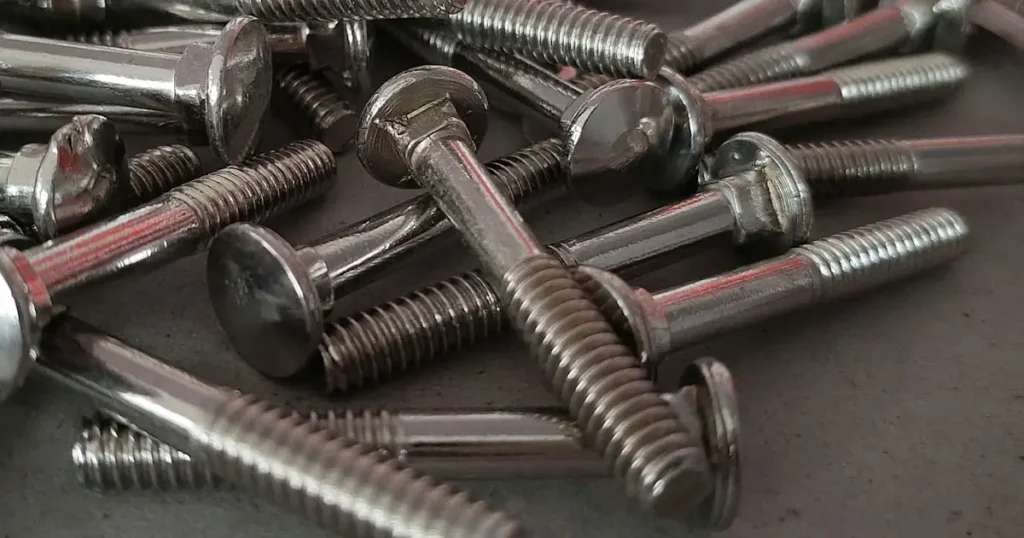
A carriage bolt, also called a coach bolt, is a through-fastener: it passes through the parts and is tightened by a nut, and its thread is a machine thread sized to accept that nut. A coach screw is not a bolt at all. It is a large wood screw with a hexagon head that is turned from the head side and holds entirely by the grip of its own coarse thread in the material — usually timber — with no nut and no access to the far side. The two are confused constantly, and the confusion is expensive, because a nut will not fit a coach screw and a carriage bolt will not drive into a coach screw’s pilot hole.
Naming is the first thing to settle. In the UK, Ireland, Australia and New Zealand, “coach bolt” is the everyday name for the product North American buyers call a carriage bolt, and the metric version of it is standardised as a cup head square neck bolt: a smooth domed head with a square collar underneath, a machine thread and a blunt end. In the current German edition, DIN 603:2026-08 covers metric threads from M5 to M20 in product class C. A “coach screw” is a different fixing altogether — a hexagon-headed, coarse-threaded screw that cuts its own way into timber.
So this is not a choice between two grades or two finishes of the same part. It is a choice between a clamped connection and a driven one, and one question settles most cases: can you reach the back of the joint?
One product, several names — and one name used for the wrong product
Most of the confusion in this family is naming, not engineering. The same domed-head, square-neck bolt travels under different names in different markets, and the word “coach” attaches to two different fasteners.
- Carriage bolt — the usual North American name for a round or cup head bolt with a square neck under the head.
- Coach bolt — the usual UK, Irish, Australian and New Zealand name for the same product family. In the UK trade a “coach bolt” is normally understood as the cup head square neck bolt, and cups, square-neck bolts and cup head bolts are all catalogue names for the same form.
- Cup head square neck bolt — the formal product name used in metric standards, and the name to use when the part has to be quoted to a standard rather than to a catalogue description.
- Coach screw — not a synonym for any of the above. A coach screw is a screw: a large, hexagon-headed, coarse-threaded timber screw. The usual North American names for the same fastener are lag screw and lag bolt.
The trap is that “coach screw” is sometimes listed as an alternative name on carriage bolt catalogue pages. It is not one. A buyer who searches for a coach screw and receives a quotation for a cup head square neck bolt has been quoted the wrong fixing, however convincing the cross-reference looks.
Carriage bolt and coach screw compared
| Carriage bolt / coach bolt | Coach screw | |
|---|---|---|
| Thread form | Machine thread (metric coarse or inch UNC), matched to a nut | Coarse wood-screw thread with a tapered point |
| How it holds | Clamped by a nut and washer on the far side | Held by the thread’s grip in the material — no nut |
| Head | Smooth domed head, no drive recess or spanner flats | Hexagon head, driven with a spanner or socket |
| Anti-rotation feature | Square neck under the head, engaged with the material or a square hole | None needed — the head is the drive |
| Access required | Both faces | One face only |
| Hole preparation | Clearance hole through both parts, sized to the shank | Pilot hole in the receiving material, sized to the core diameter |
| Can be taken up later | Yes — if timber shrinks or the joint settles, the nut can be tightened again | Not in the same way — the thread has already cut its path in the timber |
| Typical material | Timber, steel, and timber-to-steel assemblies | Timber, and masonry with a suitable plug |
| Typical jobs | Timber-to-timber joints, gates, fence rails, brackets, structural connections where a nut is specified | Fixing a bracket, ledger, hanger or fitting to a single timber or to a wall where only one face is open |
| Standards landscape | Product standards define the dimensions of the bolt form; strength comes from separate mechanical-property standards | Covered as a screw within dowel-type fastener standards for structural timber |
Why the difference is access and mechanism, not size
Both fasteners are large, both are often supplied in galvanised or stainless steel, and both are used in timber. That is where the resemblance ends.
A carriage bolt is tensioned by turning a nut. The head is smooth and domed with no recess and no flats, so there is nothing to hold and nothing to turn it with. The square neck exists to stop the bolt spinning once the head is seated: it beds into the material on the head side, and the nut is then tightened from the far side. That is why the through-hole, the nut and the access behind the joint are not optional extras — they are the mechanism. A carriage bolt without its nut, or without a washer under it, is not a fastener.
A coach screw is turned by its own head. Because the hexagon is the drive, no square neck is needed; because the thread holds in the material, no nut and no second face are needed. The joint it makes is a one-sided one: the fastener is pulled into the receiving member and holds there.
That single mechanism difference produces the consequences buyers actually meet:
- The nut will not fit. A coach screw carries a wood-screw thread sized for timber, not the machine thread a standard nut is made for. It is not intended to take a nut, so a coach screw is not a substitute for a carriage bolt in a nutted joint.
- It will not drive. A carriage bolt has a machine thread and a blunt end. It cannot cut its own path in timber the way a coach screw does, and forcing one into a pilot hole damages the material and the thread.
- Depth and clearance change. A carriage bolt’s length is governed by the thickness of the parts plus the nut and washer. A coach screw’s length is governed by how far the thread must penetrate the receiving member to develop its hold.
- Only one of them can be adjusted later. A nut can be taken up again if timber shrinks or a joint settles. A coach screw has already cut its thread into the timber; turning it further does not restore the fit once the wood has yielded.
Hole preparation: two different holes for two different fasteners
This is where the two are most often mixed up in practice, because both need a hole drilled before the fastener goes in — but not the same hole.
For a carriage bolt, drill a clearance hole through both members, sized to the shank so the bolt slides through and the square neck can seat into the head-side material. The hole must be aligned across the joint, because the bolt cannot be steered once the head is down. A washer under the nut spreads the load and stops the nut pulling into the timber; a washer under the head is common for the same reason on the bearing side. Because the bolt cannot be steered once the head is seated, any misalignment between the two holes shows up at assembly rather than being corrected on site.
For a coach screw, drill a pilot hole in the receiving member, sized to the core diameter rather than to the full thread diameter, so the thread bites into undisturbed fibres without splitting the timber or shearing the screw. In masonry, the fixing is set into a suitable plug instead. Because the load path runs through the head, a washer under the head is normal practice on soft material, and overtightening should be avoided: the aim is firm seating, not crushing the fibres around the head.
What the standards cover — and what they do not
The standards landscape reinforces the split, and it also contains a trap for buyers who read a product grade as a strength class.
On the bolt side, the product standards are dimensional. DIN 603:2026-08 specifies cup head square neck bolts with metric threads from M5 to M20 in product class C, and it supersedes DIN 603:2017-05. The ISO documents that carry the same product name are ISO 8677:1986 for the large head version, which is recorded as withdrawn, and ISO 8678:1988 for the small head and short neck version, published in June 1988 and covering M6 to M20 with nominal lengths from 12 mm to 160 mm. All three describe the same family of through-bolts. None of them describes a screw.
What these documents do not do is set the strength of the part. Product class C and product grade B are statements about the dimensional and product-grade system, not about mechanical properties. Where a property class such as 4.8 or 8.8 is required, it has to be specified separately and traced to the mechanical-property standard for the material — which is why a quotation that names only “DIN 603” or “grade C” has not yet specified the bolt.
On the screw side, the relevant framework treats screws and bolts as separate families within the same set of dowel-type fasteners. EN 14592:2022, the European standard for dowel-type fasteners, specifies characteristics for nails, staples, screws, dowels and bolts with nuts, and covers them for structural use in load-bearing timber structures only. The fact that a single standard has to name “screws” and “bolts with nuts” as two separate categories is the clearest statement of the point this article is making: they are different fastening mechanisms, and each has its own requirements.
One caution applies to both sides. Structural timber connections are designed, not improvised. Where a connection carries a calculated load, the fastener type, size, grade and hole preparation come from the design, and the design references the applicable code and fastener standard. A fastener that looks equivalent on a catalogue page is not automatically equivalent in a designed joint.
Choosing between them on site
Work through these in order. The first one usually decides the answer.
- Can you reach the back of the joint? If not, a carriage bolt is out and a coach screw is the practical option. If the reverse face is closed off after assembly, decide this before the joint is built, not after.
- Do you need clamping force across two members? If the joint depends on pulling two components together — a timber-to-timber lap, a bracket to a post, a plate to a beam — a through-bolt with a nut does that work. A coach screw pulls itself in; it does not clamp a second member to the first in the same way.
- Is the connection in a designed structural element? If so, follow the specified fastener. Substituting a screw for a specified bolt, or the reverse, changes the load path and requires the designer’s agreement, not the buyer’s.
- Can the joint move? Where timber will shrink or the joint may need taking up later, a nutted bolt can be re-tightened. A coach screw cannot.
- What does the existing fastener look like? For a replacement, match the mechanism first, then the material: a smooth domed head with a square collar means a through-bolt; a hexagon head with a coarse thread and a tapered point means a screw.
Specifying either one so the order comes back right
These are the items that have to be on the enquiry or the purchase order. Missing any of them leaves the supplier to assume, and assumptions in this family produce wrong parts.
- The product, named unambiguously. Write “cup head square neck bolt” or “carriage bolt” for the through-fastener, and “coach screw” or “lag screw” for the timber screw. Do not use “coach” alone, and do not accept a cross-reference that treats the two as one product.
- The standard and edition where the part is made to one — for example DIN 603:2026-08, ISO 8678:1988, or the relevant imperial-series bolt standard.
- Thread or diameter and pitch series — metric coarse, or the inch series where the project is imperial.
- Length, and the length basis. For a through-bolt, confirm the length is measured under the head and check it against the total thickness of the parts plus the nut and washer. For a coach screw, confirm the thread length and the required penetration into the receiving member.
- Material and property class or stainless grade — for example 4.8 or 8.8 to the applicable mechanical-property standard, or an A2 or A4 stainless grade.
- Finish and coating — plain, zinc plated, hot-dip galvanised or another specified system, with the coating standard named where the thickness matters to the thread fit.
- The mating components. A carriage bolt is ordered with the nut and washer it has to work with. For a coach screw, say whether a washer is required and what the receiving material is, so the supplier can quote the right part.
- Documentation. State what has to be held on file: a dimensional record, a material certificate, or a coating record.
Where a cup head square neck bolt is the specified product, it is supplied as a DIN 603 cup head square neck bolt in carbon and stainless steel from M5 to M20, with the smaller-head ISO 8678 form available separately in the wider bolts range. For either, quote against the standard edition and the dimensions on the enquiry rather than against a trade name, and confirm whether the order is for a through-bolt or a screw before the material is cut.