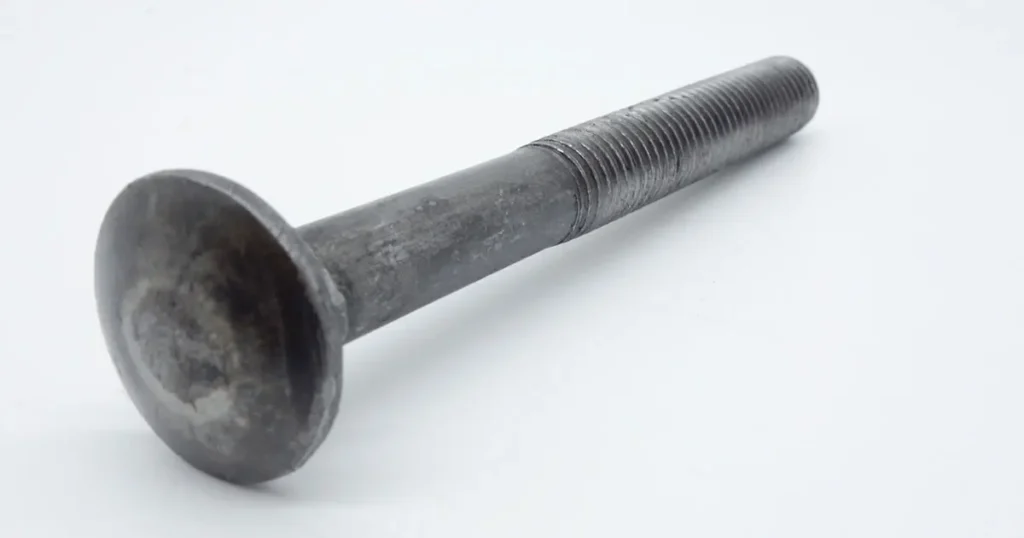
DIN 603 is the German standard for cup head square neck bolts — the fastener most English-speaking buyers call a carriage bolt or coach bolt. It is a product standard: it fixes the shape and the dimensions of one specific bolt type, a domed head with a square neck beneath it and a metric thread on the shank, and it covers metric thread sizes M5 to M20 in product class C. As of August 2026 the current edition is DIN 603:2026-08, which replaced the 2017 edition.
The sentence worth remembering is the next one. DIN 603 tells you the shape of the bolt, not its grade. It does not set the property class, the steel grade or the coating, and it does not describe the finished item by itself. Those decisions sit in separate standards and in whatever the buyer writes on the enquiry. A purchase order that says only “DIN 603 M12 × 80” leaves the bolted connection’s strength and corrosion performance unspecified — and the bolt will not be checked against anything except the drawing in that standard.
This article unpacks the designation in the order a buyer or engineer meets it: what the standard covers, what it leaves open, the dimensions it governs, how it relates to the standards whose numbers are usually printed next to it, how the square neck decides whether the bolt works at all, the applications that follow from that, and how to write a complete order line. ChinaBolts supplies this product as DIN 603 cup head square neck bolts, and the specification points below are the ones that come up most often when an enquiry is being converted into a drawing.
What DIN 603 identifies
DIN 603 is one of the German national product standards for fasteners, issued by the DIN standards committee for mechanical fasteners. Its German title is Flachrundschrauben mit Vierkantansatz and its official English title is Cup head square neck bolts. The standard is maintained, not frozen: the 2026 edition follows 2017-05, which in turn followed 2010-09 and 1981-10, and the edition date matters because a drawing that cites “DIN 603” without a date does not say which revision of the tables the part was made to.
Its scope is narrow and worth reading literally. DIN 603 applies to cup head square neck bolts with metric threads from M5 to M20, in product class C, and it sets out the technical delivery conditions for that product. Three things follow from that scope statement:
- The product is fixed. The standard is not a generic bolt specification with a head-style option. It is the standard for one shape, which is why a “DIN 603 bolt” and a “DIN 605 bolt” are different parts even though both have a cup head and a square neck.
- The size range is fixed. M5 to M20. A carriage bolt offered in M24 is not covered by this standard whatever the catalogue line says.
- Product class C is a tolerance class, not a strength class. It describes the level of dimensional tolerance the product is made to. It says nothing about how strong the bolt is — a point that causes more confusion than any other in this product family.
What the standard does and does not define
The simplest way to keep a DIN 603 order out of trouble is to separate what the standard establishes by itself from what has to be added to it.
| Element of the bolt | Covered by DIN 603 itself | Established elsewhere |
|---|---|---|
| Product type: cup head with square neck | Yes — this is the product the standard defines | — |
| Head diameter and head height | Yes | — |
| Square neck across flats, neck height and radii | Yes | — |
| Shank diameter and length tolerances | Yes | — |
| Thread: metric coarse, pitch, thread length bands | Yes | — |
| Acceptance and general delivery requirements | Yes, by reference | Referenced standards, e.g. DIN ISO 8992 |
| Property class (4.6, 4.8, 8.8 …) | No | ISO 898-1 for steel; ISO 3506-1 for stainless steel |
| Material — carbon steel or stainless steel | Named as the two material groups only | The order and the material standard |
| Surface finish and coating | No | Electroplating, hot dip galvanising and zinc flake standards such as ISO 4042 and ISO 10684 |
| Thread tolerance class | Stated in the technical delivery conditions of the current edition | Confirm on the enquiry where the joint requires it |
The last four rows are the ones that decide whether the part suits the job. The standard’s own cross-references make the arrangement explicit: the current edition refers to DIN EN ISO 898-1 for the mechanical properties of steel bolts and screws, DIN EN ISO 3506-1 for corrosion-resistant stainless steel fasteners, DIN EN ISO 4032 for the hexagon nut that goes with it, DIN EN ISO 4042 for electroplated coatings, DIN EN ISO 10684 for hot dip galvanised coatings, and DIN 962 for the designation system. Well-established supplier guidance makes the same point in plain terms: the product guide published by Westfield Fasteners states that DIN 603 covers the tolerances and permissible variation in form from M5 to M20, and that the mechanical properties of these items are defined in ISO 898 and ISO 3506.
In practice that means four separate decisions travel with every DIN 603 line item: the size and length, the property class, the material group, and the finish. The standard supplies the fifth element — the shape those decisions are applied to.
The four features that identify a DIN 603 bolt
Four features define the product. They are also the four things to check when a delivery has to be confirmed against the standard, because each one can be varied by a supplier without the word “DIN 603” on the box becoming wrong in any obvious way.
- The square neck under the head. This is the feature the standard is built around. It is a square section between the head and the shank, tabulated across flats with its own tolerance, and it is what allows the bolt to be held while the nut is tightened. A round-necked or nibbed bolt with the same head is a different standard.
- The cup head. A shallow domed head, tabulated by diameter and height with a head radius, and with no drive recess of any kind. Nothing on the head can be gripped by a tool, which is a design consequence rather than a defect: it is the reason the bolt is used where the head side is inaccessible or has to present a smooth face.
- The metric coarse thread on the shank. The thread is metric coarse, tabulated by pitch for each size from M5 to M20, and the standard gives thread length bands rather than a single fixed thread length.
- The thread length arrangement. Partially threaded and fully threaded versions are both supplied under this standard. The tabulated thread lengths are minimum values, and supplier guidance notes that manufacturers often depart from the standard when deciding how much thread to apply. Where the position of the plain shank is functional, it has to be stated on the enquiry.
DIN 603 dimensions across the size range
The table below shows the parameters a buyer is most often asked about, across the full M5 to M20 range. It is a summary of the standard’s dimension table rather than a reproduction of it — enough to answer a design or goods-in question, and not a substitute for the drawing and full table in the edition named on the order, which also carries the head and neck radii, the incomplete-thread allowance, and the shank-length tolerances for every nominal length.
| Thread, d | Pitch | Head diameter, dk max / min (mm) | Head height, k max / min (mm) | Square neck across flats, v max / min (mm) | Thread length, b min (mm): l ≤ 125 / 125 < l ≤ 200 / l > 200 |
|---|---|---|---|---|---|
| M5 | 0.8 | 13.55 / 12.45 | 3.30 / 2.70 | 5.48 / 4.52 | 16 / 22 / — |
| M6 | 1 | 16.55 / 15.45 | 3.88 / 3.12 | 6.48 / 5.52 | 18 / 24 / — |
| M8 | 1.25 | 20.65 / 19.35 | 4.88 / 4.12 | 8.58 / 7.42 | 22 / 28 / 41 |
| M10 | 1.5 | 24.65 / 23.35 | 5.38 / 4.62 | 10.58 / 9.42 | 26 / 32 / 45 |
| M12 | 1.75 | 30.65 / 29.35 | 6.95 / 6.05 | 12.70 / 11.30 | 30 / 36 / 49 |
| M16 | 2 | 38.80 / 37.20 | 8.95 / 8.05 | 16.70 / 15.30 | 38 / 44 / 57 |
| M20 | 2.5 | 46.80 / 45.20 | 11.05 / 9.95 | 20.84 / 19.16 | 46 / 52 / 65 |
Two notes on this table. First, the values are from the DIN 603 dimension table as published in the 2017-05 and 2010-09 editions and reproduced by permission of DIN; the 2026-08 edition is the edition to check an order against, and the parameter order matters, because at least one widely copied online reproduction of the table labels the head-height and neck-height columns in the opposite order to the standard, which makes the neck depth look like the head height and vice versa. Second, the square neck across flats is a tolerance range, not nominally the bolt diameter: at M12 it is 11.30 mm to 12.70 mm. That range is the number the mating square hole has to work with. Note also that k and the neck depth are different heights — k is the height of the domed head above the bearing surface, and the square neck sits underneath it, between the head and the shank.
DIN 603, ISO 8677 and the other numbers on the same line
Stock lists rarely print “DIN 603” alone. Because that matters commercially, it is worth being precise about what the neighbouring designations are.
- ISO 8677 and ISO 8678. These are the only ISO standards with the same product name — cup head square neck bolts. ISO 8677 covers the large head version in product grade C, and ISO 8678:1988 covers a small head and short neck version in product grade B — ISO 8678:1988 remains current, having been confirmed at its latest review on 18 August 2025. ISO 8677 is withdrawn: the ISO 8677:1986 record shows its withdrawal on 21 May 2002, with no replacing document named. The one ISO document of the two that a buyer can still specify is therefore the small head and short neck version, not the one whose dimensions sit closest to DIN 603, and the DIN 603 record names no equivalent ISO standard either way. Close dimensions are not the same thing as an equivalence: at the sizes where the two tables overlap, the thread length, head diameter and square neck across flats agree, but the head height columns do not, so “DIN 603 / ISO 8677” on a supplier’s list should be treated as a name the market uses, not as a claim that one bolt satisfies both documents.
- DIN 605 and DIN 607. These are the neighbours within the German framework, and they are different parts. DIN 605 describes a cup head square neck bolt with a long square, in M6, M8 and M10, product grade C. DIN 607 describes a cup head bolt with a nib instead of a square neck, in M8 to M16. A nib fits a slot or bites into timber where a square hole is impractical; a square neck needs a square feature to work against. Substituting one for the other changes how the joint is assembled, not just how it is drawn.
- DIN 962. The standard for the designation system — the document behind the way a complete fastener call-out is written, including the property class and the coating. It is the reason a designation line can carry information that DIN 603 itself does not contain.
- EN 15048-1. The European standard for non-preloaded structural bolting assemblies. Its scope covers complete bolting assemblies — bolts and nuts together, tested as an assembly — rather than separate bolts, and it states that bolts and nuts supplied separately and not tested as an assembly are not covered by it and cannot be CE marked under it. If a project specification calls for structural bolting assemblies, DIN 603 is not the document that answers it. The applicable requirements of EN 15048-1:2016 should be read before that bolt is offered into a structural connection.
The pattern here is familiar from other fastener families: a German product standard that is current, an international counterpart that has been withdrawn and never replaced, and a set of related standards that supply the material, mechanical and coating requirements the product standard deliberately leaves open. Our comparison of DIN 960 and ISO 8765 works through the same problem from the hex bolt side.
Why the names carriage bolt and coach bolt are not a specification
In the UK and much of Europe the same fastener is sold as a coach bolt; in North America it is a carriage bolt; the standardised name is cup head square neck bolt. The names are useful in a catalogue search and useless as a purchase specification, because each of them also covers products that are not DIN 603 at all.
Coach screw is the clearest example. A coach screw is a lag screw — a hexagon-headed fastener with a coarse thread that cuts its own way into timber and needs no nut. A DIN 603 bolt has a machine thread and is used with a nut. Both have a domed head, which is exactly why the two names get mixed up, but they are different products with different installation methods. Nothing in DIN 603 uses the words coach bolt, carriage bolt or coach screw; those are market names layered on top of the standardised one, and the standardised one is the only version that identifies the drawing the bolt was made to.
Where the square neck decides whether the bolt works
The square neck exists for one reason: to stop the bolt turning while the nut is tightened, on a fastener whose head cannot be gripped. Everything practical about using a DIN 603 bolt follows from whether the material being fastened can hold that square.
- In timber, the usual method is to drill a round hole at the bolt diameter, insert the bolt and draw it in as the nut is tightened. The square neck bites into the wood and forms its own socket, and the square then resists rotation. This is the application the product was designed around.
- In metal, the square neck does not bite. The hole has to be square, punched or broached, or the neck has to sit in a slot that stops rotation. Where a round hole is drilled in steel, the bolt simply spins and the joint cannot be tightened.
- The square has a dimension, not a nominal size. Because the across-flats dimension is toleranced — 11.30 mm to 12.70 mm at M12, for example — the mating square has to be sized for the neck that will actually arrive, not for a nominal figure. If the hole is too large the square will not engage before the bolt turns; if it is too tight the neck will not enter.
- Neck height has to match the material thickness. The square neck sits between the head and the shank. In thin sheet, the neck can be deeper than the material, so the square bottoms out before the head bears on the surface and the assembly never pulls up tight. That is a job for a plate washer, a thicker section, or a different fastener.
If a design cannot provide a square or a slot, the honest answer is usually a different product rather than this bolt in a round hole. A hexagon head bolt gives the installer something to hold and is the simpler choice for a round hole in steel.
Where DIN 603 bolts are used
The bolt’s characteristics, not its catalogue section, determine where it fits: a smooth head with no drive, a square neck for anti-rotation, a machine thread that always needs a nut, and a low head height relative to diameter. That combination suits timber-to-timber and timber-to-metal connections, punched or slotted steel assemblies, clamps, brackets and hardware where the head side is inaccessible or has to present a flush, snag-free face, and general construction, agricultural and machinery fixing where a low-profile head and a nut on the far side are acceptable.
It fits less well where neither the bolt nor the joint can supply a square feature, where the fastener has to be tightened from the head side, or where the connection is structural and governed by a bolting assembly specification. Within the wider bolts range this is a timber and light-assembly fastener, and it is specified as one.
What a complete DIN 603 order line contains
A designation that carries only the standard number and the size leaves the property class, the material, the finish and the documentation to the supplier’s default. The practical version of a complete enquiry or purchase order contains:
- The standard and the edition — for example DIN 603:2026-08 — so that both sides are working from the same tables.
- Thread size and pitch where it is not the standard coarse pitch: M12 × 1.75 or simply M12.
- Nominal length under the head, in millimetres, and whether the bolt is fully threaded or partially threaded. Where the unthreaded shank has a functional length, state it; the tabulated thread lengths are minima and thread length varies in practice.
- Property class or stainless steel grade — 4.6, 4.8, 8.8, A2-70 or A4-80 as applicable. If it is not on the order, it is not specified.
- Material group, and any impact or low-temperature requirement that follows from the application.
- Surface finish and coating, with the coating standard where one applies, since a coating adds thickness to a toleranced thread.
- Thread tolerance class, where the joint requires something other than the class in the current edition.
- Quantity, packaging method, and the documentation required — a dimensional inspection record, a material certificate, or a coating thickness record, depending on what the buyer has to hold on file.
Written out, a line looks like this: DIN 603:2026-08 — M12 × 80 — 8.8 — hot dip galvanised. Each element after the standard number comes from a different place, and that is the whole point of reading the designation properly. An enquiry that states the edition, size, property class, finish and documentation requirement can be checked against the standard line by line; one that states only the standard and the size cannot. If you are sourcing this item, send the specification and the size, class and finish can be confirmed against the edition named on the drawing before the order is placed.
The practical summary
DIN 603 is the current German standard for cup head square neck bolts in metric threads M5 to M20, product class C. It defines the shape, the dimensions, the tolerances and the delivery conditions of that bolt, and nothing else. Property class, material and coating come from other standards and have to be specified by the buyer, and the common trade names — carriage bolt, coach bolt — describe a family of similar products rather than this standard. The one item that decides whether the fastener performs as intended is the square neck, which needs a square or slotted feature, or timber that will take the square, and which cannot hold anything in a plain round hole. Read the designation as a shape, add the grade and finish yourself, and the order line is complete.